Competition

‘Your guts will form a stinky pool’: Roald Dahl explains Covid-19 to children

In Competition No. 3153 you were invited to recruit a well-known children’s writer to explain Covid-19 to their young audience. Designer Jim Malloy’s reimagining of Dr Seuss titles for the coronavirus age — Oh, the Places You Won’t Go!; Docs in Smocks — gave me the idea for this challenge and though I had high hopes for Seuss-inspired submissions none quite hit the mark. Of the many entries featuring Richmal Crompton’s William Brown, Adrian Fry’s was my favourite: ‘William wasn’t exactly sure what a moonity was, but gathered it had something to do with freedom, of which he naturally approved…’.

The pleasure and pain of staycations

In Competition No. 3152 you were invited to supply a poem about the joys — or otherwise — of the staycation. A poem that transports me back to childhood bucket-and-spade holidays — ‘Half an annual pleasure, half a rite…’ — is ‘To the Sea’ by Philip Larkin (not a fan of holidays abroad). But while lines such as ‘the small hushed waves’ repeated fresh collapse/ Up the warm yellow sand…’ make me long to head straight for the south coast, you lot, judging by the entry, are not relishing the prospect of holidaying at home this summer. Well, most of you.

Famous writers get to grips with DIY

In Competition No. 3151 you were invited to imagine famous authors reflecting on their struggles with DIY. Highlights in a terrific entry included John Osborne on grouting, A.E. Housman on the torture of cutting your own hair and several accounts of W.B. Yeats’s botched attempts at sorting out the plumbing (‘things fall apart’). I much admired Mike Morrison’s reworking of Robert Frost’s ‘Mending Wall’ and also tip my hat to strong -performers -Patrick Massey, Dominica Roberts, Nick Hodgson, Bill Greenwell, George Simmers and Anne Parsons. It was especially tough to choose the winners this week but those who made the cut appear below and pocket £25 each. While we were shut in there was an outbreak of cleaning the barbecues.

Herculean sonnets

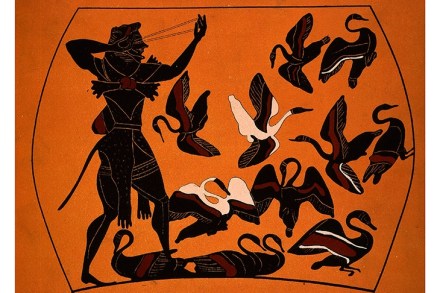
In Competition No. 3150 you were invited to submit a sonnet describing one of the labours of Hercules. This challenge seemed to strike a chord, attracting an entry of modest size but rich in wit and invention. There were some clever topical touches as well as echoes of master sonneteers from times past: Milton, Donne and Shelley. Honourable mentions go to Chris O’Carroll, Katie Mallett, Simon May, Hamish Wilson and Rob Stuart. The prizewinners, printed below, are rewarded with £20 each. Lerna in lockdown faced a sombre fate;the many-headed Hydra grew two headsfor every one lopped off — the beast’s R-ratekept fearful locals cowering in their beds.How do you kill a multi-headed brute?

‘Around the House in 80 Days’ and other titles for lockdown

In Competition No. 3149 you were invited to tweak an existing book or poem title for lockdown and provide an excerpt from the resulting work. This excellent challenge, suggested by a reader, produced a vast entry and some cracking titles, including Masefield’s ‘Cabin Fever’ and Jane Austen’s Compulsion, as well as several variations on ‘Come Not into the Garden Maud’. There was more Tennyson from Sally Fiery, whose impassioned ‘Charge of the Price Hike-Brigade’ begins: Half a quid, half a quid,/ Nobody wondered,/ That was the price of soap,/ Now it’s six hundred…’ Commendations also go to Brian Allgar, Barry Baldwin, Frank Upton, Nick Syrett, G.M.

Authors making sneaky appearances in their own novels

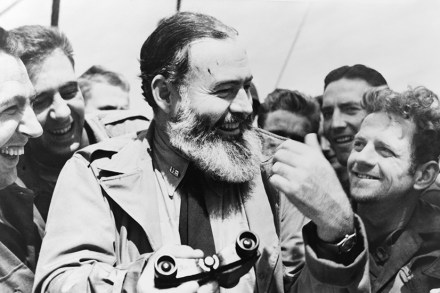
In Competition No. 3148 you were asked to imagine what the result might have been had a well-known writer slipped a self-portrait into a scene from one of their works. The challenge was inspired by artists who insert a sneaky selfie into their paintings, a well-known example of which is Velazquez’s ‘Las Meninas’. But authors have done it too: Douglas Coupland made an appearance in his 2006 novel jPod and Barry Baldwin tells me that Malcolm Bradbury smuggled himself into The History Man. There were creditable Hemingway cameos courtesy of Christopher Linforth, J.E. Tomlin, and The Parson, and I enjoyed J.C.H. Mounsey’s sketch of self-confessed misanthrope Evelyn Waugh, and Martyn Hurst’s of the rather less self-aware Jeffrey Archer.

How famous writers do social isolation

In Competition No. 3147 you were invited to submit tips on social isolation in the style of a well-known writer. It was a terrific entry, in which famously retiring souls such Emily Dickinson loomed uncharacteristically large. I loved Nicholas Stone’s twist on Louis Macneice’s ‘Bagpipe Music’ (‘It’s no go the bog roll, it’s no go the office,/ All we want is a conference call and a bag of Werther’s toffees…’) and J.G. Ballard’s suggestion, via Adrian Fry: ‘Exercise in liminal spaces: abandoned office complexes, rewilding traffic islands, Shepperton’. Commendations, too, to Hamish Wilson’s Philip Larkin (‘Man hands on unwashed misery to man,/ Keep people distant. Stay in while you can.

Spectator competition winners: poems about the goats of Llandudno

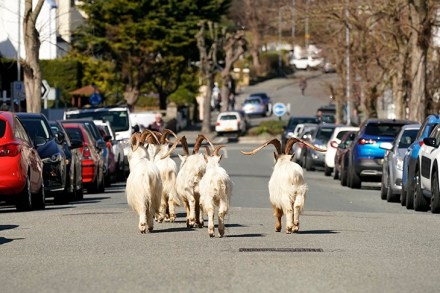
In Competition No. 3146 you were invited to submit a poem about the goats of Llandudno, who recently ran amok through the Welsh seaside town. It’s not just the caprine brigade who have been broadening their horizons with humankind under lockdown. Racoons have invaded Arkansas State Library, wild boars are roaming the streets of Bergamo and lions lie sparko in the middle of the road in Kruger national park. Maybe, as Frank McDonald suggests in the closing couplet of his delightful, insightful sonnet, there is a message in all this: Perhaps these goats have come that man might see A sign of how his world is going to be. Nick Syrett’s Poe-inflected entry also foresaw a time when the beasts inherit the earth.

Competition winners: Clerihews on Spectator contributors

In Competition No. 3145, to mark the 10,000th issue of The Spectator, you were invited to submit clerihews (two couplets, AABB, metrically clunky, laconic and humorous in tone) on the magazine’s contributors. My predecessor Jaspistos was a popular subject. Clerihews should contain biographical truth and D.A. Prince assures me that the incident described in her entry, a pre--internet judge’s worst nightmare, really did happen. If indeed it did, Jaspistos was not alone; entries to a New Statesman comp once flew out of the judge’s bicycle basket down High Holborn, and were lost for ever. Commendations go to G.N.

Spectator competition winners: Pangrams in six lines

In Competition No. 3144 you were invited to submit a poem, six lines at most, containing all the letters of the alphabet. Some of the more technical challenges in the past have prompted howls of protest; under the circumstances, I decided not to make this one too taxing. Max Ross speaks, I am sure, for many: Crazily quizzical, anagrammatical,Fiendishly taxing they drove compers wild,Almost undoable, don’t-have-a-clueableThankfully this one’s just pleasantly mild. Hats off to you all for a terrific entry, in which the topical rubbed shoulders with the absurd. There were lots of entertaining riffs on the famous pangram ‘the quick brown fox jumps over the lazy dog’, but so much more besides.

Spectator competition winners: Love in the Time of Covid-19

In Competition No. 3143, a nod to García Márquez’s 1985 novel, you were invited to submit a short story entitled ‘Love in the Time of Covid-19’ in the magical realist style. Magic realism has been contaminated somewhat by overuse and is in any case not to everyone’s taste. But if done well it can be wondrous and transporting, and it lends itself well to trauma narratives. As the late poet and translator Alastair Reid wrote of Márquez: ‘What … [he] is showing us all the time is the humanising power of the imagination. In all his writing, the imagination is no mere whimsy, nor a Latin-American eccentricity: it is a way of survival, as we say nowadays.

TripAdvisor reviews — with added spice

In Competition No. 3142 you were invited to supply a review on TripAdvisor that has been spiced up with a number of misprints. You saw this challenge for what it was: a brazen invitation to lower the tone. Take this snippet, for example, from Brian Murdoch: ‘The only problem we had was that I had taken my tablet, but the wife never seemed to function in the bedroom, so if I wanted to get on to the pet I had to go into the pubic areas downstairs.’ And Mike Morrison: ‘Constant hot waiter on top in each room.’ But while most went the full oo-er-missus! there was the occasional respite from the relentless innuendo.

Songs to wash your hands by

In Competition No. 3141, you were invited to submit a song we can sing instead of ‘Happy Birthday’ during hand-washing. Congratulations all round: this challenge produced a cheering entry — funny, varied and drawing inspiration from far and wide; from the Knack’s ‘My Sharona’ to the Hokey-Cokey. Commendations to David Silverman, Frank Upton and Nick Syrett. The winners earn £25 each. And now the peak is near, So wash your hands with soap and water. My friends, I’ll say it clear, We wash our hands because we oughta. We’ve lived a life that’s free With many friends who all desire us; But now it’s time to kill Coronavirus.   We loved, we coughed and sniffed, We gave high fives, our share of sneezing.

The secret lives of poets

In Competition No. 3140 you were invited to submit a poem in the style of a famous poet in which they make a surprising confession. It’s elbow-bumps all round this week: an excellent entry. Douglas G. Brown reveals the raciness (gin; trollops) that lurks beneath Henry Wadsworth Longfellow’s high-minded exterior. Nick MacKinnon exposes the jolly, ‘Kumbaya’-singing side of misery guts Larkin. And E.E. Cummings fesses up, via Christopher Davies: it’stime(i came clean)my typewriter(is)broken. Commendations to Peter Mills, Paul A. Freeman, David Silverman, P.M. Davidson and Lachlan Rurlander. The winners earn £25 each.

Spectator competition winners: Grave thoughts

In Competition No. 3139 you were invited to submit a four-line verse epitaph for a well-known person, living or dead. There was lots of waspish wit on show this week, often deployed at the expense of our elected representatives. Many entries ran along similar lines to this one, from Steve Baldock, though not all of them took the Donald as their subject: DonaldTrump.Lying,still. It wasn’t just politicians under the spotlight. Some competitors turned their attention closer to home. Here’s Philip Machin: They laid awaiting her critique,Upon her desk arrayed,The myriad entries, strong and weak,That Lucy’s eyes surveyed.

Spectator competition winners: lines on a young lady’s Instagram

In Competition No. 3138 you were invited to submit a poem entitled ‘Lines on a Young Lady’s Instagram’. Thanks to David Jones, who suggested this challenge, a nod to Philip Larkin’s 1953 ‘Lines on a Young Lady’s Photograph Album’ from the collection The Less Deceived (‘My swivel eye hungers from pose to pose —/ In pigtails, clutching a reluctant cat;/ Or furred yourself, a sweet girl--graduate…’). There were echoes of Larkin-esque perviness in the entry, and stalkerish voyeurism, too, courtesy of Nick Syrett’s twist on Betjeman’s ‘A Subaltern’s Love Song’, which appears below. The witty and accomplished winners earn £25 each.

No. 3137: By George

In Competition No. 3137, to mark the 70th anniversary of George Orwell’s death, you were invited to submit a short story with an Orwellian flavour. This challenge was inspired by an entertaining thread on Twitter started by @-rcolvile, who asked for ideas for sequels or spin-offs when Orwell’s work goes out of copyright next January. Among the suggestions that elicited the most ‘likes’ were @NickTyrone’s ‘a sequel to Animal Farm in which all the non-pig animals console themselves with the idea that at least they “won the argument”.

3136: Love me don’t

In Competition No. 3136 you were invited to submit a lonely hearts ad guaranteed to send those looking for love running in the opposite direction. This assignment was a nod to the charmingly idiosyncratic personal ads that have appeared over the years in the London Review of Books — ‘They call me Naughty Lola. Run-of-the-mill beardy physicist (M, 46)’; ‘I like my women the way I like my kebab. Found by surprise after a drunken night out and covered in too much tahini’ — which proved such a hit that they’ve been collected in two volumes.

3135: Just the job

In Competition No. 3135 you were invited to submit an application letter for a job at No. 10 from a fictional character of your choice. This challenge was inspired by the PM’s chief special adviser Dominic Cummings’s suggestion, in a recruitment ad, that the ideal candidate for one of the positions on offer might resemble ‘weirdos from William Gibson novels like that girl hired by Bigend as a brand “diviner” who feels sick at the sight of Tommy Hilfiger’.   The parade of hopeful candidates included George Smiley, Gregor Samsa, Bertie Wooster and Toad of Toad Hall, all of whom were pipped to the post by the winners below who snaffle £25 each. All resumes are phoney.

Cat call

In Competition No. 3134 you were invited to submit a poem featuring one of T.S. Eliot’s practical cats getting to grips with the modern world.   Your 21st-century reincarnations of Eliot’s felines (the poems were originally published in 1939 and inspired by the poet’s four-year-old godson, who invented the words ‘pollicle’ for dogs and ‘jellicle’ for cats) were terrific. Alas long lines mean space for fewer winners and some fine Macavitys narrowly missed the cut (take a bow, Nick Syrett, David Shields and Hamish Wilson). I was sorry, too, not to have had room for Bill Greenwell’s Jellicles and Brian Allgar’s Growltiger, the Tory Cat.   This week’s top cats are printed below and pocket £35 each.