Books & Arts

Books and Arts

This month in culture: January 2025

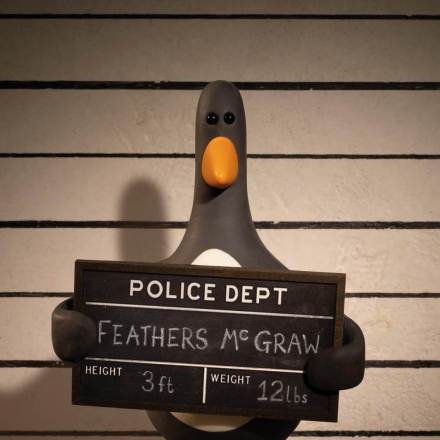
Wallace and Gromit: Vengeance Most Fowl January 3, Netflix The panic that gripped the McMorris household in November 2023 was rivaled by that of the great toilet paper shortage of 2020. Greater even, for this crisis could not be solved with a credit card and the willingness to fight hand-to-hand against fellow Costco members. Aardman Animations, the last bearable producer of children’s entertainment, was running out of clay. The sole remaining British factory that produced the stuff behind Wallace and Gromit and Shaun the Sheep had shuttered. Only a pitchfork would suffice. The advent of CGI has fried parental eyeballs with neon ever since Toy Story and only Aardman has resisted the trend, delivering us stop-motion Stan and Ollie routines.
culture
tour

Guiding young minds through the National Gallery of Art

"Are there any more questions?” I asked loudly. I was struggling to make myself heard above about thirty seventh-graders, whom I was leading on a tour of the National Gallery of Art. There had already been many questions that morning, even before we began looking at objects in the museum’s permanent collection. We had just finished an analysis and discussion of techniques and symbolism in a seventeenth-century sculpture from Seville, so I took advantage of the momentary lull in the hand-raising and was walking toward the next work on our itinerary when I heard an unexpected sound. Thud. Turning, I saw that one of the students had fainted, practically at my feet. Teacher and chaperones rushed in, and after a few moments the student was fine.

William Boyd’s latest novel is a smoothly gripping read

Gabriel’s Moon is William Boyd’s eighteenth novel, swiftly following last year’s The Romantic, which delightfully described the adventures of a man living through the nineteenth century in Europe. Though Boyd relates a smaller section of his new hero’s life here, many of his characteristic themes are fully at play: surveillance, deception, honor, love, art, fraud, real historical characters jostling with fictional ones, and relationships between mothers and sons. Essentially, this new book is a spy story, well within the lineage of John le Carré (complete with liberal ambivalence about duty to one’s country), and with skillfully handled layers of double-dealing.

Boyd
Lisa Marie

Lisa Marie Presley’s posthumous book exposes the horrors of celebrity

The title of this book may offer a clue to its prevailing tone. There’s a certain amount of showbiz gossip involved, but it is essentially a protracted rumination of the “What’s it all about, Alfie?” variety, with plenty of unflinching discourse on matters such as spirituality, depression, addiction and the precariousness of the human condition. “I wondered how many times a heart can break,” the authors write near the end of their tale of untold material privilege and wrenching emotional grief. All too often, is the inescapable answer. The book is freighted with a certain amount of woe from the start, because its principal author, Elvis Presley’s only child, herself tragically died in January 2023, aged fifty-four, due to weight-loss surgery complications.

One hundred years of Theodore Dreiser’s An American Tragedy

The high-water mark of the American naturalist novel lasted for about forty years — the period bookended by Frank Norris’s 1899 McTeague and John Steinbeck’s 1939 The Grapes of Wrath, taking in along the way such highlights of the form as Upton Sinclair’s 1906 The Jungle, Sinclair Lewis’s 1920 Main Street and James T. Farrell’s Studs Lonigan trilogy of 1932-35. But these are all subsidiary crags on the path to Mount Olympus, for the novel that towers above them all and draws each of them — to mix the metaphor a little — into its remorseless slipstream is Theodore Dreiser’s 1925 An American Tragedy.

Dreiser
Mailer

How Norman Mailer changed the face of biography

Many labels leap to mind in association with the prolific and controversial Norman Mailer, who died in 2007, but “biographer” is not typically one of them. He was not considered a serious practitioner of the genre in the same sense as Edmund Morris, Ron Chernow or his friend Doris Kearns Goodwin. And yet, as his own official biographer J. Michael Lennon asserts to me, “Mailer became a major biographer in the last half of his career.” Thirty years ago, two intriguing books by Mailer appeared just a few months apart: Oswald’s Tale: An American Mystery and Portrait of Picasso as a Young Man.

An insightful account of America’s decline

I wouldn’t have thought a book about America’s decline would cause me to laugh out loud, but having enjoyed its author Matt Purple’s work for years now (full disclosure: he’s a personal friend and former Spectator colleague), I should not have been the least bit surprised that his debut book is as funny as it is insightful. Decline from the Top: Snapshots from America’s Crisis and Glimmers of Hope is a veritable joy to read. Though he declares himself to be a “cranky conservative,” Purple’s humor and wit offer a diagnostic examination of the American condition that exudes warmth and obvious heartfelt concern for our nation’s wellbeing.

Purple