And Finally

And Finally

Am I an extremist?

The Communities Secretary Steve Reed recently rose in the House of Commons to unveil “Protecting What Matters,” the British government’s new “action plan” to “strengthen social cohesion” and “tackle division.” According to the accompanying press release: “Millions of families, friends and neighbors will feel a stronger sense of community, unity and national pride thanks to renewed efforts to stamp out extremism, hate and division announced today.” I was not among those millions. Conspicuous by omission in the announcement was any mention of Islamist extremism.

extremist

‘Life, Liberty and the pursuit of Happiness’ is genius marketing

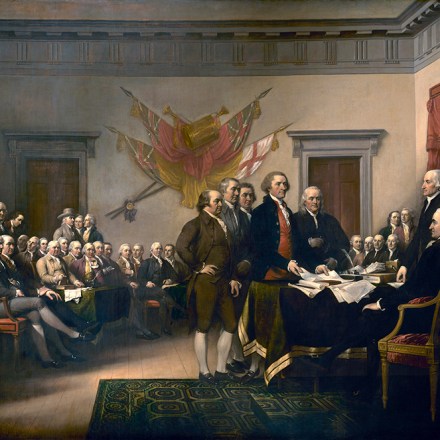
I recently delivered a speech to mark the 250th anniversary of Adam Smith’s second-best book: An Inquiry into the Nature and Causes of the Wealth of Nations. The year 1776 was a momentous one for many reasons. It saw the installation of James Watt’s first steam engine, the recognition of Captain Cook by the Royal Society for his work in preventing scurvy and his departure on his final and ultimately fatal voyage. It witnessed the publication of Edward Gibbon’s The Decline and Fall of the Roman Empire and Common Sense by Thomas Paine.

Dear Mary: how do I seat lesbians at a dinner party?

Q. I’m getting married next year and, instead of having a wedding list, my boyfriend and I would like to ask for donations toward our honeymoon. We are aiming to travel to South Korea with any proceeds. My future mother-in-law has said it would be very rude to ask people for money, but the problem is that, between us, my boyfriend and I have got everything we need to equip our flat. Any advice, Mary? – S.D., Epsom A. It’s not so much that it would be rude to ask for money but that it would be unproductive. Most wedding guests are psychologically primed to want to play their part in furnishing a happy home for the couple to live in. They therefore enjoy buying, for example, a table lamp and imagining the couple thinking of them each time it is turned on or off.

My phobia is not to be sneezed at

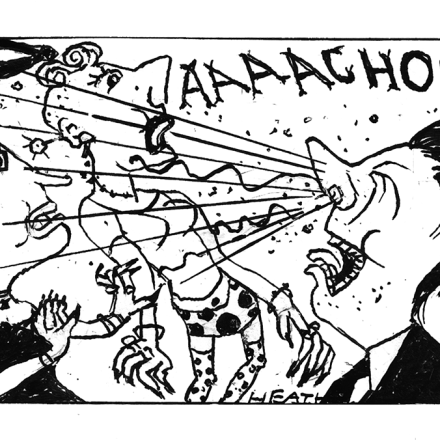
In January 1894, an assistant of Thomas Edison made a five-second silent film of Fred Ott taking snuff and then sneezing. It was the second ever film to be copyrighted – and it started with a sneeze. The sneeze is a blessing and a curse, associated with both good fortune and ill omen. In ancient Greece it was a prophetic sign from the gods – a sneeze could confirm the gods’ blessing of a decision. By the end of the 6th century, with plague sweeping through Rome, it had become associated with illness and death. Pope Pelagius II died from plague midsneeze. His successor, Gregory the Great, declared by papal decree that “God bless you” was the appropriate response of a Christian when someone sneezes, to keep the wildness and danger at bay.

A meta-analysis of meta

“That’s really meta,” said my husband, attempting to imitate a stoned hippie at a festival, but only achieving his usual character role of a tipsy retired major in a Hampstead saloon bar. I had been trying to pin down what people think they mean by meta. The dominant element is the self-referential, as in a review in the Guardian of James Acaster playing a tribute act to James Acaster and “making meta-merry in a carnival of self-satire.” We must clear the ground with a brief visit to metaphysic. This was first found in a translation made in 1387 by the estimable John Trevisa, the Cornish-born vicar of Berkeley, Gloucestershire, and Fellow of Queen’s College, Oxford.