Economy

  • AAPL

    213.43 (+0.29%)

  • BARC-LN

    1205.7 (-1.46%)

  • NKE

    94.05 (+0.39%)

  • CVX

    152.67 (-1.00%)

  • CRM

    230.27 (-2.34%)

  • INTC

    30.5 (-0.87%)

  • DIS

    100.16 (-0.67%)

  • DOW

    55.79 (-0.82%)

UBI will make us miserable

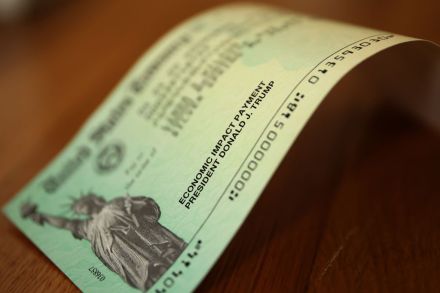
It’s hard to avoid the constant prophecies of doom about how AI is going to take our jobs – with some of these already being borne out. However, AI leaders such as Elon Musk have declared that the population will be supported by Universal Basic Income (UBI) instead, in which the government will financially support everyone through the huge revenues produced by AI. “Universal HIGH INCOME via checks issued by the Federal government is the best way to deal with unemployment caused by AI,” Musk posted on X earlier this year. Musk imagines that we wouldn’t be unemployed but rather liberated – UBI would allow us to live without the mundane tasks of everyday life, like making PowerPoint presentations, writing emails or finding synergies in our deliverables.

Spotlight

Featured economics news and data.

Cutting Britain’s giant welfare bill would be an act of kindness

Does having money really matter that much? There are those, usually with quite a bit of it, who want us to care less about materialism. But, unequivocally, money really does matter – not because of any status it supposedly brings, but for the freedom it buys: freedom to choose how we live and how we look after others. Considering this, it seems that the deep disillusionment with mainstream politicians in recent years stems from a protracted and ongoing period of stagnant living standards over which they have presided. But the truth is that the average person has not got poorer since the global financial crisis. They have got a little bit richer. Employment levels are still exceptionally high. And, both historically and internationally, we are a very rich country.

Time to crush China’s Arctic influence

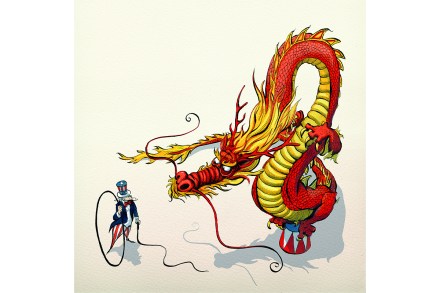
Eyes are opening to the evil of the authoritarian Chinese regime that represses its people, genocides entire cultures, and influences investments and policy all over the globe. As most of the world is under coronavirus lockdown, the Chinese Communist party detains hundreds of thousands (if not millions) of Uighur Muslims in concentration camps in east China. Not to mention the brutal occupation of Tibet, where China is also allegedly responsible for the massacre of hundreds of thousands of Tibetans over the last 70 years due to its brutal occupation.The CCP’s mishandling of the viral contagion from Wuhan may have exposed its obsession with power at all costs, but its next, greater threat is still developing in the shadows: imperialism.

arctic

How Bill Clinton junked America’s supremacy

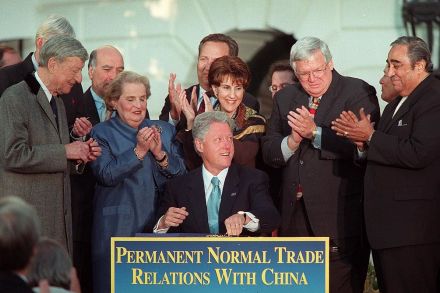
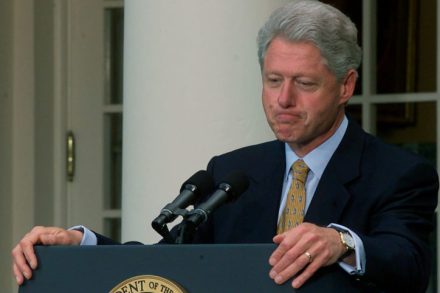
‘This is a good day for America,’ said President Bill Clinton on May 24, the Year of Our Lord 2000. ‘In 10 years from now we will look back on this day and be glad we did this.’ Clinton was talking about the House of Representatives’ vote to award normal trade relations to China. And he was right. By 2010, despite the crash of 2008, the knowledge class still largely considered the decision to support China’s entry into the World Trade Organization as a great boon. China’s rise had turbocharged globalization and made us all richer — never mind the stupefying sovereign debts. Labour unions had opposed it, but leaders and corporations were still enthralled by the gargantuan consumer markets.

President Bill Clinton speaks in the Rose Garden, May 24, 2000 in Washington, D.C. after the China trade vote in Congress.

Trump walks the recovery tightrope

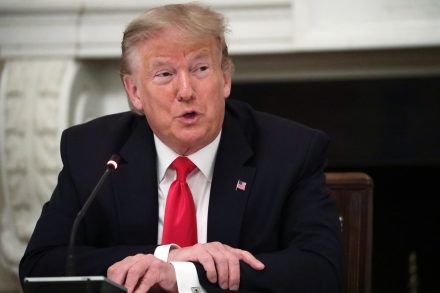
President Trump’s decision to set the United States back on the path to work will be decried as mere politics, but it is the right decision. It is the task of politicians to consider the general welfare. This consideration sets the current emergency against the coming one, the need to reduce deaths from COVID-19 against the need to forestall the human cost of an economy in open-ended limbo. The data on COVID-19 remains insufficient and will probably remain so. The economic prognosis is, however, clearer, and we have the data too.The IMF is warning that a prolonged shutdown will lead to a Thirties’-style Depression.

recovery

No, black-owned businesses probably aren’t losing out more due to the pandemic

The coronavirus has devastated many small businesses. Historically, ownership offered a solid if not prosperous choice for many white males, particularly in the postwar period. You can see evidence of their successes on golf courses, in retirement communities and on cruise lines. While white men still dominate the business-owning class, other demographic groups have a strong small business presence, particularly in immigrant-rich cities like New York. These groups are especially vulnerable to the economic impact of the coronavirus lockdown.The black business community has expanded substantially in recent years. The latest comprehensive government statistics, from 2012, estimate that there was a one-third increase from the census of 2007.

black-owned businesses

Peter Navarro blasts ‘Swamp Creature’ opponents of ‘Buy American’ order

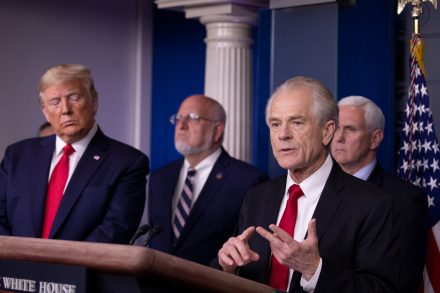
White House trade adviser Peter Navarro is hitting back at a group of Big Pharma lobbyists, medical organizations, and free trade groups for opposing President Trump's proposed 'Buy American' executive order reshoring the medical supply chain. Navarro, the assistant to the president for trade and manufacturing, told The Spectator that Big Pharma's opposition to the executive order, which would require government agencies to purchase pharmaceutical products made in the US, because it wants to 'preserve its offshore oligopoly'. 'All the EO would do is ensure that government agencies, including the VA, HHS, and DoD, Buy American,' Navarro said.

Peter Navarro

Big Pharma and free market orgs unite against Trump’s ‘Buy American’ order

The Association for Accessible Medicines (AAM), a trade association for major pharmaceutical manufacturers such as 3M, is drafting a letter to send to President Trump opposing his proposed ‘Buy American’ executive order reshoring medical supply chains. The letter currently has over 40 signatories, including PhRMA, a Big Pharma lobbying organization, dozens of medical nonprofits, and free market-oriented organizations, indicating the president will face immense pressure across the political spectrum for trying to reduce US medical dependence on China. AAM claims that signing the 'Buy American' executive order during the coronavirus crisis will harm efforts to provide doctors and hospitals with the equipment and medicines they need to stop the spread of COVID-19.

Trump coronavirus task force big pharma

After the coronavirus, who wins the recovery?

We are living through a gruesome case study in the irrationality of elites. COVID-19 is a serious disease, but the question of just how serious it is has hardly even been posed correctly, let alone answered intelligently. Yet already our leaders have assumed dictatorial airs and enacted policies that threaten to plunge the Western world into an economic crisis unmatched since the Great Depression. Eighty days into 2020, the official worldwide death toll from the coronavirus stands at somewhat over 10,000 lives. That includes fatalities from the final months of 2019 as well, when Chinese authorities initially tried to disguise rather than treat the outbreak of the new disease. The world was utterly unprepared for the virus as it spread from Wuhan.

donald trump recovery
health finance

How government should respond

Misdiagnosis can be fatal in a pandemic. Treating the economic effects of the global COVID-19 epidemic as a conventional recession means prescribing the wrong medicine and harming the patient. This is a supply-side recession, not a demand-side recession. The shortfall includes intensive care beds, ventilators, protective gear for healthcare workers, and other medical supplies. Thanks to these shortages, as well as insufficient trained medical personnel, hospitals may soon be overwhelmed everywhere by the demands for treatment of coronavirus victims. To slow the spread of the virus while augmenting existing medical supplies and personnel, governments are promoting social distancing and sheltering in place, both euphemisms for quarantine.

The coronavirus is springing the Thucydides trap

The first casualty of informational war is truth. The first American casualty of COVID-19 was the myth that the United States can ‘manage’ the rise of China as a world power through mutual interest. That mutual interest was only ever economic. Naturally, most of our politicians, business leaders and commentators explained it as strategic too: as technocracy calls GDP the index of human happiness, so it identifies strategic interests with economic ones. The coronavirus crisis has, however, exposed an essential strategic antagonism between the United States and China.'‘What made war inevitable was the growth of Athenian power and the fear which this caused in Sparta,’ Thucydides wrote in History of the Peloponnesian War.

thucydides

We’re all Chinese now

I didn’t know this was what they meant by ‘cancel culture’. Sports events, theatre shows, plane flights, weddings, funerals: everyone is in a mad rush to cancel everything. Governments are ordering citizens to remain indoors, with Spanish police even deploying drones to catch miscreants. I don’t know whether it is the best way of tackling coronavirus — the UK government, which has gone to greater lengths than others to explain the scientific modeling behind its decision-making, has come to the conclusion that banning things and forcing the entire population into lockdown will have minimal effect and may even be counter-productive, at least at this stage. But it is going to cause a global recession, if not depression.

chinese

Coronavirus’s biggest victim? Money

The first victim of war, they say, is truth. The first victim of coronavirus, by contrast, is fiscal discipline. Yesterday, President Trump started negotiating with the Senate over a proposal to suspend payroll taxes, possibly until the end of the year. Wall Street certainly liked it: markets shot up by five percent. Whether future Americans will enjoy paying the bill is another matter. The government’s proposal is not just targeted help for a few industries like travel and tourism, which stand to lose out heavily as people stay at home. It is not a modest tax cut to encourage Americans to go out and spend a little more. Even to call it a 'stimulus package' — as these things are pat to be called — seems pathetically inadequate.

coronavirus money

Market hysteria is not all down to coronavirus

Is this really about a virus? Oil has plunged 30 percent, the S&P Index seven percent. What is happening on the markets today has less the feel of a rational reaction to world events than one of the periodic panics which grips world markets — with coronavirus a mere excuse for a sell-off which was perhaps coming anyway. The deadliest words for world markets are not ‘coronavirus’ and ‘Covid-19’ but ‘decade-long bull market’. The latter idea has planted in many investors’ heads that the good times could not have gone on much longer — there had to be a correction or crash. It is true, as well, that the US, in common with many developed countries, has not suffered a recession for over 10 years. That, too, feels unnatural.

market

Coronavirus is a chance to buy cheaper — but it comes with a health warning

If anything, stock markets have been slow to respond to the spreading coronavirus outbreak. Stories of Chinese supply interruptions, from JCB digger components to plastic toys, have been circulating since mid-February, while hedge funds have been hard at work short-selling cruise-operator shares: Royal Caribbean and Carnival are both down 30 percent. Now airlines have taken a pasting too, with easyJet and Ryanair among the big fallers in Monday’s sell-off of European stocks, following news of a cluster of virus cases in northern Italy. Meanwhile, a turning point may or may not have been reached in the rate of reported cases in Wuhan, where the outbreak began.

coronavirus

Coronavirus could be ‘black swan event’ that costs Trump the presidency

Donald Trump is, as we know, a noted germophobe. It would be richly ironic, then, if he missed out on a second term owing to the germ of the moment: coronavirus. Over the past 24 hours, something remarkable has been stirring in the normally wayward kingdom, Trump Tweet Land. The president has started lavishing praise on the Centers for Disease Control (CDC) — a government agency which he has previously treated in a rather less than admiring way. In 2017 he famously sent it a list of banned words like ‘transgender’ which he didn’t want to see in official documents. And he has since been attacked for cutting its budget. Suddenly, they are heroes who are doing a GREAT job of tackling coronavirus VERY VERY quickly.

Is it worse to be an environmental polluter or a moral one?

So farewell Bernie Ebbers, former chief executive of WorldCom, the long-distance phone operator that became America’s biggest-ever bankruptcy case in 2002. Ebbers has died aged 78, having been released on health grounds in December from a 25-year jail sentence for his part in an accounting fraud that concealed the perilous state of WorldCom’s finances, misleading investors after a series of high-risk acquisitions by the bejeweled ‘telecom cowboy’ Ebbers during the dotcom boom. By repute, US justice aims to make examples of high-profile corporate miscreants, starting with the humiliating ‘perp walk’ into court and concluding with harsh sentences and scant hope of parole.

polluter

After Brexit

This article is in The Spectator’s February 2020 US edition. Subscribe here. The US-China trade war is easing; a new trade deal with Canada and Mexico has been passed by a large cross-party majority in the House of Representatives — largely unnoticed, as it happened in the same week as Donald Trump’s impeachment. The idea that the president is taking the world down a blind alley toward an era of protectionism is beginning to fade. So what now of the prospects for that other trade deal that Trump has promised: between the US and Britain?

brexit

There’s a long way to go before Trump can declare victory in his trade war

There is no shortage of quotes by Donald Trump that his opponents have tried to use against him — few of which have so far damaged him politically, still less embarrass the man himself. But there is one which really does have the potential to cause him harm in this year’s presidential election: his claim, in March 2018, that ‘trade wars are good, and easy to win’. That isn’t looking quite so clever now, two years later when the trade war that Trump started with China is still far from won. The deal signed today by Trump and Chinese vice premier Liu He brings a respite in hostilities, but there is a long way to go before the US can be claimed to have won, or even to have restored trade to what it was prior to 2018.

trade war

All forecasts are off if Iran shuts the Strait of Hormuz

Just when you thought it was safe to go back in the water…late last year, a range of forecasts suggested that the likelihood of recession in the US, with knock-on effects for the rest of the developed world, had significantly diminished. Last summer, many economists were putting the chance of a substantial downturn at 50 percent but by November, Goldman Sachs had marked it down to 24 percent and Morgan Stanley to ‘around 20 percent’. Underlying this shift were strong corporate earnings and consumer spending, plus rising hopes of a settlement of US-China trade tensions. Last month saw a sell-off of safety-first government bonds reflecting the mood, and the FT’s end-of-year forecasts included a confident ‘No’ to ‘Will the US go into recession?

hormuz

The Chinese trade deal is a Christmas gift to Xi

If Donald Trump wanted to deliver a seasonal gift to his ‘good friend’ Xi Jinping, the ‘Phase One’ trade deal reached this weekend fits the bill pretty well.  From the viewpoint of the Beijing leadership, it vindicates the Chinese refusal to budge during the long months of trade negotiations despite the threat of escalating duties. What has resulted is less the kind of overall trade agreement originally aimed at by the Trump administration and feared by China as interference in its economy —  and more of a purchase agreement accompanied by reduced tariffs.

xi

Trump’s Chinese tariffs are simply a scare tactic

Ever since Donald Trump began his trade war with China there have been two possibilities: firstly, that he intends tariffs to form a permanent feature of the landscape in relations between the US and China: a protectionist device designed to protect American jobs indefinitely; or secondly, that he sees his tariffs as a shock tactic devised to draw China into talks which it would otherwise be loathe to join, and with the ultimate aim of freeing up trade. The latest development, halving a set of tariffs which had been in place since September and canceling another set which had been due to come into place this week, points heavily to the latter.

chinese tariffs