If Trump picks Amy Coney Barrett tonight, prepare for all hell to break loose
Feminists will be lining up to prevent the appointment of the Catholic mother of seven.
At 7 p.m., panting, I knocked on the door of room 201 of the Hotel InterContinental, Marseille, expecting it to be opened by Patrick Woodroffe, the man who has splendidly lit Rolling Stones gigs for the past 33 years, who would, I believed, hand over two tickets. With any luck, and on the strength of our slender acquaintance, I hoped these tickets would be upgraded to seats a little closer to the action than the ones we had paid quite enough for. Eventually, the door was opened instead by a timid woman wearing a hijab. She blinked at the words ‘Rolling Stones’ but they meant nothing to her. We ran
How we love our homes: we make them cosy and secure, protected from the outside world, defended by locks, bolts and burglar alarms. But we haven’t always had our own private dwellings, and under the invasive influence of the internet, home, as we’ve come to understand it, may well soon be a thing of the past. In early medieval times, a home was often just a basic tenement, a shelter shared with cattle, owned by an employer. As prosperity spread, so a sense of the private developed. Common areas subdivided into individual ones; pieces of furniture (chests, bookcases, beds, wardrobes) marked areas for particular activities and specific people. At the
I was worried that going to the autonomous vehicle exhibition in Stuttgart would be tantamount to an atheist walking into St Peter’s while the Pope was conducting a mass. There is something religious about the fervour with which adherents to the driverless credo practise their faith and promise us a new kingdom. Their proselytising has indeed convinced many. Politicians are making outlandish statements, such as Jesse Norman’s two weeks ago, that ‘Our entire use of roads is to be revolutionised by autonomous vehicles’, and pouring large sums — a promised £180 million so far — into bizarre research projects such as the development of strange robot cars slower than a
Anxious to find out what food they served at the Red Hen restaurant in Lexington, Virginia, I clicked on the relevant site and was transported immediately to a discount motorcycle website entirely in Korean, or Japanese, or maybe Chinese. I don’t know — I can’t tell the difference between those respective hieroglyphics. Maybe that was the point: the restaurant was weeding out people like me who have never bothered to distinguish between different oriental alphabets and are therefore racist and banned from the Red Hen, probably for life. More likely, though, is that the site has been hacked by clever and jubilant Trump supporters. The Red Hen is where the
I write this on my last day in the Bagel, and it sure is a scorcher, heat and humidity so high that the professional beggars on Fifth Avenue have moved closer to the lakes in Central Park. Heat usually calms the passions, but nowadays groupthink pundits are so busy presenting fake news as journalism you’d think this was election week in November. Here’s one jerk in the New York Times: ‘The court’s decision was narrow…’ The decision in question is the Supreme Court ruling that a baker could refuse a gay couple’s request for a cake on religious grounds. The writer who described the result as narrow, one Adam Liptak
Dear 2016 WriteNow mentees, Thanks so much for your open letter to me. It seems only good manners for me to write back. You’re rightly proud of having been admitted to a challenging programme at Penguin Random House that mentors gifted young minority authors and helps to cultivate their talents. My own publisher, HarperCollins, runs a similar programme, which enjoys my full support. Such proactive outreach is exactly the approach I endorse for helping to vary the voices on our bookshelves. That is why my column of a fortnight ago said not one discouraging word about WriteNow. Indeed, I made no reference to your programme whatsoever. Apologies to Spectator readers,
When the Romanian dictator Nicolae Ceausescu visited London in 1978, the British government did some serious sucking up. Ceausescu was an egomaniac and possibly crazy. When he went hunting outside Bucharest, his body-guards shot game with machine guns so he could be photographed at the end of the day with a shoulder-high pile of dead animals. He was also said to be a germophobe, sterilising his hand with pure alcohol if it touched a door handle. The French president telephoned the Queen to warn her that when the Ceausescus came to the Élysée, lamps, vases, ashtrays and bathroom taps went missing from their rooms. But Ceausescu got a state visit
Sexual intercourse, Philip Larkin famously wrote, began in 1963. And listening to contemporary commentators, you’d think that it came to an end in 2017 with the birth of the #MeToo movement. For these voices of doom, the end of the erotic is nigh; Britain is on the brink of sexual apocalypse. The recent news that Netflix has banned flirtation from film sets — along with lingering hugs, requests for phone numbers and extensive touching — is for these commentators just the latest example of #MeToo sexual correctness gone mad. They fear we are witnessing the making of a bland new world where the rules and regulations governing social relations between
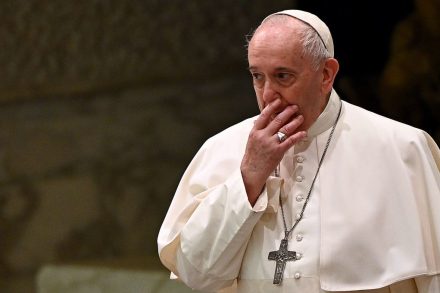
In an interview with Reuters, the supreme pontiff uses Trumpian rhetoric to criticize the migrant children scandal.
Is ‘the perfect American food’ soaked in imperialism and all-male white chumminess?
The provinces of the Anglican Communion today have little in common beyond a historical connection to the Church of England.
You can tell when Donald Trump has just achieved something: he starts being strangely amiable, and his critics start frothing at the mouth. He’s just met supposedly one of the most dangerous, evil men in the world — and made him look like a sweet overgrown child. He and Kim Jong-un signed an agreement and all the rolling news anchors talking about how ‘historic’ it is are for once not exaggerating. ‘Today, we had a historic meeting and decided to leave the past behind and we are about to sign the historic document,’ Kim said. ‘The world will see a major change.’ He also thanked Trump for the summit. ‘We’re
New York This week 50 years ago saw the assassination of Robert Kennedy, a man I met a couple of times in the presence of Aristotle Onassis, whom some Brit clown-writer once dubbed Bobby’s murderer. (Bad books need to sell, and what better hook than a conspiracy theory implicating a totally innocent man?) I once witnessed Bobby, at a Susan Stein party, asking Onassis for funds — the 1968 election was coming up — and Ari showing Bobby his two empty trouser pockets. Bobby’s assassination did alter American politics. Violence, black anger and despair spilled out on to the streets of American cities. His death caused far more grief among
I’d been suffering under the misguided illusion that the purpose of mainstream publishers like Penguin Random House was to sell and promote fine writing. A colleague’s forwarded email has set me straight. Sent to a literary agent, presumably this letter was also fired off to the agents of the entire Penguin Random House stable. The email cites the publisher’s ‘new company-wide goal’: for ‘both our new hires and the authors we acquire to reflect UK society by 2025.’ (Gotta love that shouty boldface.) ‘This means we want our authors and new colleagues to reflect the UK population taking into account ethnicity, gender, sexuality, social mobility and disability.’ The email proudly
By 74 it is easy to feel that you have seen it all, done it all, that nothing much surprises you any more. Striving gives way to coping. Drop a pencil and it rolls under the sofa. What you have to do is think about the best way to find it and pick it up. Problem. Do you get down on your knees and reach in under, which of course means you will have to get up again, or do you simply push the sofa away? Such problems don’t really bother you. You cope with it. You don’t reflect on growing decrepitude. It has been so slow coming, you have
Donald Trump got bad reviews in the press — no surprise — when he announced that Rudy Giuliani, the former New York City mayor and federal prosecutor, would join his legal team in the Trump-Russia special counsel investigation. The 74-year-old Giuliani is not as sharp as he was, some said, and isn’t really a practising lawyer any more. How can you effectively defend the President by slipping out of fatcat dinners at New York steakhouses for quick hits on Fox News? That was then. Now, it appears hiring Giuliani was a key part of a new and effective Trump strategy. Just a few months ago, Trump was cooperating with special
Just before Ireland voted overwhelmingly to end the country’s constitutional ban on abortion, Catholics in the fishing village of Clogherhead could be seen storming out of Sunday mass halfway through the service. Why? Their parish priest had come on too strong. He had not only ordered them how to vote but also supplied grisly details of an abortion procedure. Presumably some of them voted to repeal the eighth amendment. The ‘Yes’ campaign couldn’t have won its two-thirds majority without the support of practising Catholics. Very few of these, we can assume, were militantly pro-choice. Instead, they were reassured by promises that any future law would be limited in its impact
The film awards season is over and Cannes has been handed back to wealthy holiday-makers, yet the #MeToo movement shows no signs of slowing down. Morgan Freeman is the most recent addition to the ignominious list of film producers, directors and actors who have had accusations of sexual harassment made against them since #MeToo took off in October last year. Allegations against the 80 year-old Freeman, star of The Shawshank Redemption, emerged last week on the day before Harvey Weinstein handed himself into police in New York on charges of rape. The charges against Weinstein are serious; he should stand trial and, if found guilty, face a lengthy prison sentence. Yet the #MeToo label puts
If the BBC really is, as Steve Bannon says, a communications department of the global elite, they messed up badly last night. Emily Maitlis’s 20-minute long interview with Bannon on Newsnight was mesmerising television — even, or especially, if you can’t bear the subject. It was also the longest advertisement for economic nationalism yet delivered to British viewers. No doubt Raheem Kassam, the close Bannon associate who’s just left Breitbart and has been on Newsnight a few times himself, had something to do with it.By airing the discussion, the Beeb disproves the Bannonite idea that it is part of an elite conspiracy to silence populist points of view on immigration.