Politics

Read about the latest political news, views and analysis

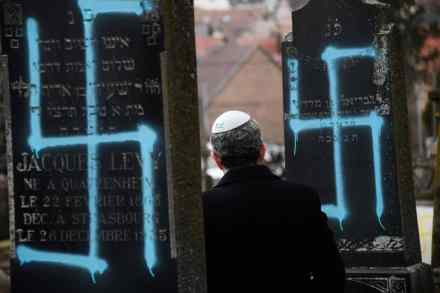
France can’t keep its Jews safe

France is home to roughly half-a-million Jews. The country's Jewish community is the largest in Europe, and the third largest in the world behind Israel and the United States. You might assume then that Jewish life in France is flourishing. But you’d be wrong. Over the weekend, news broke of the murder of Eyal Haddad, a Tunisian Jew living on the outskirts of Paris. What happened is still shrouded in mystery: the family’s lawyer denied earlier reports that the victim’s body had been burned and that the perpetrator had confessed to killing Haddad over a 100 euro debt, and because he was Jewish.
Westminster grapples with TikTok craze

Whoever wins the Tory leadership on Monday will face a mountain of problems from day one. War, inflation, spiralling costs and a mutinous party: the in-tray will be veritably groaning. One issue that won't perhaps be at the top of the list will be the future of the Prime Ministerial TikTok account: 10downingstreet. Officials have spent the past 11 months running the account, uploading videos of Boris goofing around to the page's 292,000 followers. His presumptive successor though takes a rather more dim view of TikTok, whose parent company ByteDance has been criticised for its ties to Beijing.

Will Marine Le Pen betray her voters the way Boris did?

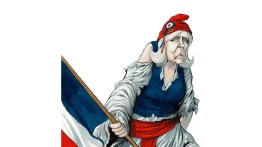
How do you solve a problem like Jean-Marie? That is dilemma facing Marine Le Pen as her National Rally party prepares to mark the 50th anniversary of its creation next month. The party has evolved a great deal in that time, especially in the decade since Le Pen succeeded her father, Jean-Marie, as leader of a party that for most of its existence has been known as the National Front. The rebrand to the National Rally occurred in 2018, the most significant action taken by Marine Le Pen in her bid to leave behind the malodorous legacy of her father.

What the defenestration of Ravil Maganov says about Russia

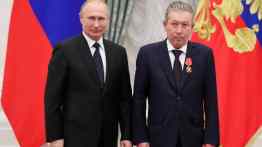
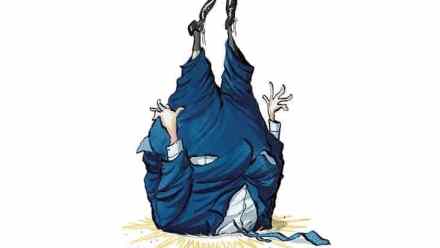
In my travels when I was still persona grata in Russia, I never got the sense that their windows were unduly flimsy or inviting. Nonetheless, the tally of Russians and Russian-connected individuals who have met their end by jumping or falling out of windows is such that it has become a rather tacky and tasteless meme. Most recently, Ravil Maganov, chair of the Lukoil conglomerate died after falling out of a window in Moscow on Thursday. This follows on the heels of the death in Washington DC of Dan Rapoport, an American businessman who used to be active in Russia before leaving and becoming a critic of the regime. He apparently jumped from an apartment building in Georgetown.

US lockdowns wipe out decades of maths and reading progress

In Britain, the damage of lockdown was easily covered up by grade inflation: with 45 per cent of A Level students being given A or A*. In the United States, there are large-scale independent studies published today. It’s pretty devastating. Educational performance scores for nine-year-olds have fallen to levels last seen in 1999: so two decades of progress wiped out. It’s the first time on record that performance in maths has fallen at all, and reading ability fell further than it has at any point in the last 30 years.  The National Assessment of Educational Progress, released today, measures the long term ability of 14,800 nine-year-olds in the US in core reading and maths skills. Average scores fell five points in reading and seven points in maths compared with 2020.

Who will fill the Boris void?

Boris Johnson’s last set piece speech today was typical him. There were references to Ladybird books, attempts to blame the last Labour government, not much detail but lots of optimism about how things are about to get better. Johnson has so dominated British politics these past few years that it is hard to imagine it without him. (Of course, he won’t disappear – which will cause its own problems for his successor – but he’ll no longer be PM). As I say in the magazine this week, his absence will reshape the political landscape because his presence defined it. Keir Starmer has relished attacking Johnson, but he must now pivot.

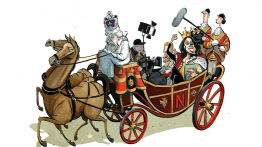
Drama queens: the return of Harry and Meghan

36 min listen

In this week's episode: We look ahead to Harry and Meghan’s UK tour next week, how will they be received? Freddy Gray and Tanya Gold join the Edition podcast to discuss (01:01). Also this week: In the Spectator magazine, our Economics Editor Kate Andrews sat down with the three economists, or 'Trussketeers', that are informing the would-be PM’s economic plan. She joins us along with Julian Jessop, one such economist that has been advising Liz Truss (13:51). And finally: can successful writers be friends with less successful ones? Cosmo Landesman asks this question in the magazine this week and is joined by the author Ian Rankin (27:07). Hosted by Lara Prendergast and William Moore. Produced by Oscar Edmondson.

Truss’s Oxford Europhilia revealed

Throughout the leadership contest, Liz Truss has been all too keen to paint herself as a Brexit queen, keen to slay the dragons of Brussels. Yet Mr S has been doing some digging into the Foreign Secretary’s past and it transpires she was rather more of a Europhile than previously revealed. Truss even headed up a pro-EU group that backed the Maastricht Treaty while a student at Oxford University doing PPE. Despite being a late convert to the Brexit cause, the PM-in-waiting was once an active Liberal Democrat and pro-European. As a blue stocking girl in the mid-1990s she was a key player in the federalist Oxford Reform Club, even being snapped alongside Theresa May's controversial EU negotiator Olly Robbins when the pair were students.

Poll: voters don’t want Boris in Truss’s cabinet

The Tory leadership race is almost over and at last a new PM will be announced. Most expect that next Tuesday it will be Liz Truss, the Insta-loving, Beyonce-quoting, cheese-bashing Foreign Secretary, who will be stutting her way up Downing Street to the famous door of No. 10. Her first order of business – after kissing hands with the Queen and giving her nuclear instructions – will be the appointment of a new cabinet: a chance to reward friends and purge rivals. Steerpike thought it only fair therefore to see what the public makes of the prospect of several well-known Westminster faces making a return under Truss.

The V&A’s Tory troubles

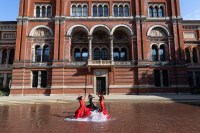
All political lives, famously, end in failure: but not so for Tristram Hunt, the former Labour education spokesman now recast as Director of the V&A. Back in 2017, Hunt managed to leverage his academic credentials to trade in life on the backbenches under Jeremy Corbyn to run one of the world's largest art museums instead. He now gets a cushty £200,000 in salary, bonus and pension benefits. Not a bad swap! But is Tristram overcompensating somewhat in a bid to break with his Labour past? For in recent months, the intellectual athenaeum has been lambasted in, unusually, the Guardian of all places, with the liberal organ bemoaning the V&A's current direction of travel.

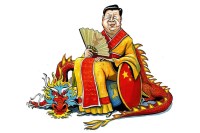
The truth about Xi Jinping’s ‘One China’ policy

As the representative of Her Majesty’s Government in Beijing entered the room through the tall and heavy doors, he was met with a sight of Imperial splendour. At the far end of the glorious room were two comfortable chairs facing down the room, separated by a marble table on which sat a huge vase of flowers. The Chinese government representative sat impassively in one chair, while to his left, a harsh wooden bench stretched down the side of the room, occupied in strict hierarchy by various government functionaries numbering about 15. The British minister took his seat in the other seat, his view of his counterpart blocked by the flowers, while his rather smaller contingent of officials began to occupy the parallel wooden bench, and not in any hierarchical order.

‘Those Jedi mind tricks don’t work on me’: Dominic Raab on Truss, Sunak and his own future

If Liz Truss is named prime minister next week, her administration will look rather different to the government of the past few years. Rishi Sunak has suggested he won’t accept any job offer. Michael Gove, a Sunak supporter, has pre-emptively ruled himself out. Other prominent backers are expected to join the pair on the backbenches – such as the Deputy Prime Minister and Justice Secretary, Dominic Raab. Truss’s allies say he deserves what’s coming his way for having likened her economic plans of immediate tax cuts to an ‘electoral suicide note’. Yet for a man on political death row, Raab is remarkably cheery when we meet at The Spectator’s offices.

What Rishi Sunak gets wrong about lockdown

Rishi Sunak presents an alarming picture of what happened during lockdown in last week’s Spectator interview – one echoed by lockdown sceptics who claim that Covid policy was a disaster, stoked by fear and based on questionable scientific advice. Worst of all, they cry, the trade-offs were not even discussed. But none of this is true – it is Covid revisionism. I know because I sat around the cabinet table as politicians, scientists, economists and epidemiologists agonised over the extent to which lockdown would devastate lives and livelihoods. It was not an easy decision for anyone. We locked down because we knew the cost of 'letting Covid rip' was far more damaging to both the health and wealth of the nation.

Is university good value for money?

Opinion polls these days don’t normally raise more then passing interest. But there are always exceptions worth a second look. One such was a YouGov survey out on Wednesday on what people thought about university finance. The big question was whether they believed nearly £30,000 for three years at college was good value for money. Among graduates, many of whom will have paid these fees, the answer (by a margin of well over two to one) was clear. They didn’t. For good measure, nearly half of the graduates polled thought most degrees actually left them worse off overall, against just over a third who thought they led to financial benefits. Many, no doubt, will draw a predictable conclusion.

Trussonomics: a beginner’s guide

When polls started to show Liz Truss miles ahead of Rishi Sunak in the Tory leadership contest, her team adopted a cautious campaign strategy. Why gamble on another interview with Nick Robinson when last time she had struggled to name a single economist who backed her economic plans? Eventually she landed on Professor Patrick Minford, an academic at Cardiff Business School and a bullish Brexiteer. Minford went on the record calling for interest rates to rise to 7 per cent, which Truss then had to defend and deflect. But that moment in the Robinson interview, widely reported as a humiliation, turned out to be one of the most helpful points in her campaign. Within days, like-minded economists were grouping together to praise her tax-cutting agenda.

Liz Truss should aspire to emulate Thatcher in Russia

The Russian political and media establishment have got Liz Truss in their sights once again. As well as analyst Igor Korotchenko’s crude declaration that Truss ‘doesn’t belong in politics, but in the kitchen’, a clip currently doing the rounds on Russian TV shows her shocked reaction in July when presenter Kate McCann fainted and keeled over in a TV debate. Vladimir Solovyov, a key Kremlin propagandist, has argued that the same stunned helplessness would be Truss’s reaction ‘when Britain falls’ and accused her of ‘delusions of grandeur’.

Will Russians soon realise how remarkable Mikhail Gorbachev was?

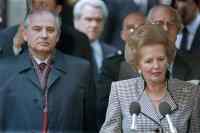
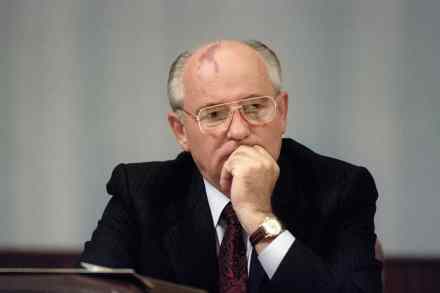
Mikhail Gorbachev, the final president of the Soviet Union who died last night, was remarkable both as an international politician and as a domestic reformer. I first met him when he came to London in December 1984, when Mrs Thatcher said that she liked him and could do business with him. He was open, friendly, and spoke without notes: the opposite of his predecessors. Some of Thatcher’s own officials suspected that he was merely an old-fashioned communist who had learned new tricks, and that his charm was seducing her from her clear view of the Soviet threat. Thatcher was right, and the sceptics were wrong. By that time, the Soviet system was in serious trouble. It could just about keep up with American military technology.