World

The failure of Marine Le Pen

Following her second-round loss to Emmanuel Macron in France’s presidential elections last month (it was her third loss on the national stage), Marine Le Pen has announced her candidacy for the National Assembly. She hopes to win Pas-de-Calais’ eleventh constituency in June — a seat she won in 2017 — to oppose Macron’s policies in the French parliament, along with her National Rally (RN) colleagues. But she is unlikely to have much leverage. In the last parliamentary elections, the National Rally (then the National Front) won eight seats out of 577. The latest poll by Harris Interactive has them winning 65 to 95 seats this year, compared to 338 to 378 seats for Macron’s re-branded Renaissance party, which would give Macron an absolute majority.

Putin’s Victory Day speech shows he’s not backing down

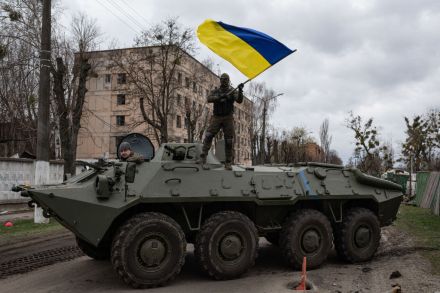
“Victory Day” is one of the most solemn events on the Russian calendar. Every year on May 9, the country gets together to celebrate the defeat of Nazi Germany in what Russians call “the Great Patriotic War,” in which as many as 26 million Soviet troops and civilians perished. It’s a time for reflection, for an appreciation of history, and, yes, for pomp and circumstance, with Russian troops decorated in dazzling uniforms marching in unison throughout Moscow's Red Square. This year’s Victory Day celebrations, however, had much of the world on edge. In next-door Ukraine, Russian forces were taking a beating, with smaller but nimbler and more determined Ukrainian units continuing to mount stiff resistance against a Russian military offensive in the Donbas.

Where will the war in Ukraine go next?

Almost every night in Russia, it seems, a government building bursts into an unexplained fire. Fuel depots, office buildings, infrastructure hubs — and once a bridge. No doubt people have their theories. Insinuation abounds. "Karma is a cruel thing," one Ukrainian official has said on Telegram. But in the main, both the Russian government and Ukraine maintain an eloquent silence. The metaphor is apt. The fires are an unexpected consequence of Russia’s war in Ukraine, an eventuality, no doubt, that no one in the Kremlin inner circle anticipated, or planned for. And yet they burn merrily nonetheless.

The Taliban’s Afghanistan quagmire

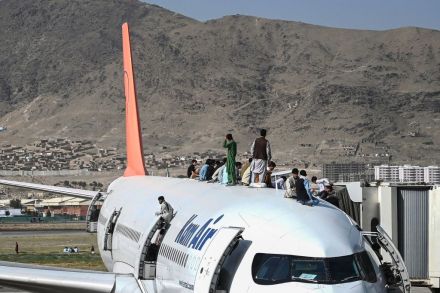
Hibatullah Akhundzada is a secretive man who is only occasionally heard and seldom seen. But on May 1, the Taliban’s supreme leader was delivering a sermon in Kandahar’s central mosque, bragging about his organization’s supposed successes. “Congratulations on this victory, freedom and success,” said the reclusive Akhundzada, surrounded by armed bodyguards. Nine months after the Taliban captured Afghanistan and forced the hapless Ashraf Ghani to flee the country in a helicopter, its chief official remains content with relishing the past. But truth be told, the Taliban has nothing to brag about.

Among Moscow’s lost generation

Vladimir Lenin famously said that there are “weeks where decades happen.” He was talking about the Bolshevik Revolution, but the panic-stricken weeks after Vladimir Putin shocked even his own people by invading "brotherly" Ukraine will also be remembered as an intensely transformative period in Russia’s history, when the ground shifted and Moscow was yanked back to its Soviet past. Those crazy weeks when my phone rang non-stop now feel like decades in retrospect, especially from the perspective of New York. The changes were apparent even after the first mad days of the "special operation." Anti-war Russians had panicked at Putin’s cruel gambit and fled the country by the tens of thousands, along with thousands of Western expats.

Is NATO about to get even bigger?

The last time NATO inducted a new member was in 2019. The alliance agreed to accept North Macedonia’s request for membership. The small Balkan country was an odd choice to become the alliance’s thirtieth member state. At roughly 7,500 troops, North Macedonia’s military was smaller than the Los Angeles Police Department. Its entire population was smaller than Brooklyn's and its economy was one fifth the size of North Dakota’s. Three years later, NATO is set to become even bigger. Finland and Sweden, two Nordic nations with a decades-long policy of military neutrality between the West and Russia, will very likely submit their own membership bids as early as next month. Before Russia’s invasion of Ukraine, neither power was especially interested in becoming full-fledged members.

The end of the last Arab Spring success story

Visibly, and with very little pretense, Tunisia is sliding into tyranny. In the last two years, its president, Kais Saied, has frozen and dissolved the country’s parliament and threatened its former members with prosecution. He has dismissed an errant prime minister. He has ruled by decree. He has quashed the high judicial body attempting to scrutinize his changes to the constitution and replaced it with a new organization filled with hand-picked appointees. Accusing his opponents of planning their own coup attempt, Saied has faced down months of protests over each of these individual changes with uncommon steeliness. Saied’s hold over the instruments of government and his comradery with the brass of the army appears near total.

Emmanuel Macron’s fleeting win

In France’s presidential runoff vote on Sunday, incumbent Emmanuel Macron defeated nationalist contender Marine Le Pen. This makes the center-left Macron the first president since 2002 to get a second term, though he is also one of the least popular politicians in French history. Compared to 2017, Macron dropped by more than seven percentage points from 66 percent to just 58 percent. In turn, contender Marine Le Pen upped her score from 34 percent to 41.5 percent. Meanwhile, the abstention rate is the highest it’s been in more than 50 years, at 28 percent, higher than in the runoff vote compared to the first round. This explains why Macron lost a lot of the lead he had five years ago, and why Le Pen’s National Rally party registered its strongest support to date.

Russia becomes a lost cause

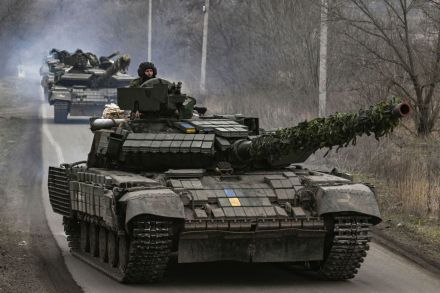
After an embarrassing two-month start to its war in Ukraine marked by pictures of abandoned armored personnel carriers, destroyed tanks and stalled armored columns outside Ukraine’s major cities, the Russian army is re-tooling and re-arming itself for a more manageable fight in the east. I use the word “manageable” not because the battle in the Donbas will be easy for Russian forces, but because the objective of expanding Russian control over the entirety of Donetsk and Luhansk is more realistic than overthrowing the Ukrainian government and occupying the entire country. Capturing, let alone holding, Kyiv, Kharkiv and Chernihiv would have entailed a massive number of personnel and a long-term commitment Russia doesn't have the resources to sustain.

U.S. President Joe Biden and Russian President Vladimir Putin (Getty Images)

Remember Afghanistan?

For Americans, neglecting Afghanistan has long been the norm. Almost from its inception, it was the forgotten war, fought “over there so we do not have to face them” here, as President George W. Bush once put it. It was a campaign to crush the Taliban only to abruptly become a democratic nation building project and then just as quickly be sidelined for the “real war” in Iraq. Even as far back as 2009, when the United States still had 62,000 troops in the country, David Folkenflik, NPR’s media correspondent, was asking, “Hey, Media: Where’s the Afghanistan Coverage?” This all appeared to change last August — at least for a time.

Cold War

Springtime for Cold War nostalgics

My favorite spy movie cliché of all time is the secret agent stuck in the 1980s. The threats have gone asymmetrical, terrorists slip across borders, but our hero longs for the simple days when the world was divided between good Westerners and bad Russians. “You’re a fossil!” sneer his girlboss department administrator, his vegan drone pilot, his tech whiz who has just hunted down a non-state actor by crosschecking the latest SIGINT with a Yelp! review of an Iraqi yoga studio. Cut to him muttering under his breath à la Judi Dench in Casino Royale: “Christ, I miss the Cold War.” Now, suddenly, those who miss the Cold War are having a moment.

asia

What Ukraine means for Asia

If Asia has entered the debate over the war in Ukraine, it is primarily through questions over the role China is purported to be playing in supporting Russia. Given the now-infamous declaration of a “partnership without limits” by Vladimir Putin and Xi Jinping during the Beijing Olympics just weeks before the invasion, many observers have searched for signs of Chinese aid, military or economic, to Russia in the conflict. The scope of devastation in Ukraine and the probable war crimes being committed by Russian troops understandably mean less attention has been paid to how the conflict might affect geopolitical stability in the Indo-Pacific region. The exception is Taiwan — there has been considerable speculation over the influence of Ukraine on Beijing’s calculations there.

presidents

How to avoid World War Three

The Russian assault on Ukraine has awakened the West to the fact that we may be back in a Cold War — or worse. After a few decades’ respite in which the United States did not find itself in conflict with any nuclear powers, presidents must consider a world in which nuclear-armed Russia and China actively oppose US interests and deliberately test American resolve. This reality will become even more complicated if a hostile Iran gets its hands nuclear weapons too. The return of Cold War-style geopolitics means the return of Cold War-style statecraft. Presidents will once again face the difficult task of calibrating their actions to advance US goals while avoiding escalation toward possible nuclear confrontation.

Marine Le Pen takes on the king of Europe

Last Sunday marked the beginning of the French presidential vote; the runoff election will take place on April 24, and incumbent president Emmanuel Macron winning again is no sure thing. If she plays her cards right, challenger Marine Le Pen has a legitimate shot at becoming the next president of France. Macron emerged victorious in the first round with 27 percent of the vote, followed by Le Pen with 23 percent. For the nationalist Le Pen, it is the second time she has qualified for the runoff, and thus the second time she is running against Macron. In 2017, she lost to Macron 66 percent to 33 percent, crushing once again the ambitions of her National Rally party. This year, however, will be a much closer call.

Putin’s imperialism in Africa

Last week, at roughly the time that photographs and stories began to filter out of liberated Bucha in Ukraine, the NGO Human Rights Watch published a report of similar massacres which took place contemporaneously in rural Mali. What linked the two was the identity of the perpetrators. In Ukraine and across Africa, these atrocities are committed by Russians. In combination with the Malian military junta, foreign soldiers "summarily executed an estimated 300 civilian men," in the town of Moura in late March. These soldiers did not speak French.

China: one bully to rule them all

Several years ago, I visited the War Remnants Museum in Ho Chi Minh City, Vietnam. It’s located, a bit surreally, in the former United States Information Agency building. Formerly called the "Museum of Chinese and American War Crimes," it showcases various captured US military equipment. What was particularly jarring to me was learning of the millions of Vietnamese civilians killed during the Vietnam War era. Of course, there’s a bit of irony here: a building formerly dedicated to projecting American public diplomacy and messaging in Southeast Asia now serves the different propaganda purpose of seeking to portray America as a violent aggressor guilty of war crimes.

The Kremlin’s clown prince

The beginning of the year has not gone as well as it could have for Vladimir Zhirinovsky. Mostly because he is now dead, but also because Zhirinovsky, a Russian politician of the “managed” (pro-Kremlin) opposition, predicted and vigorously supported Russia’s invasion of Ukraine. If Zhirinovsky were able to follow the campaign from his hospital bed, it could not have met his expectations. The imperial Russia of his imagination ought to have come into glorious existence, but its armed forces instead suffered reversal and humiliation. Zhirinovsky was the long-time leader of the Russian Liberal Democratic Party — a grouping that, as many wags have separately concluded, was under his leadership neither liberal nor democratic nor, in some lights, a party.

Is France set for another Le Pen-Macron showdown?

The first round of voting in the French presidential election will happen Sunday — and despite expectations of the last few years, the run-up appears increasingly anti-climactic. But not all is said and done in the campaign. Over the last few weeks, Emmanuel Macron has extended his lead in the opinion polls, bolstered by the uncertainty of the war in Ukraine. The most recent poll has Macron ahead at 28 percent, in front of far-right candidate Marine Le Pen at 23 percent, and far-left contender Jean-Luc Mélenchon. Far-right independent hopeful Éric Zemmour (9 percent) and Republican nominee Valérie Pécresse (8 percent) had experienced boosts in the campaign’s early stages, which have both since died down.

Don’t blame the West for its Ukraine hesitance

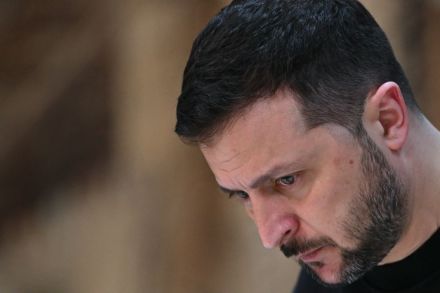
As Ukrainian President Volodymyr Zelensky addressed the UN Security Council today with all the anguish you would expect from a wartime commander-in-chief, he could nonetheless be relatively pleased about several things. Sure, Zelensky and his advisers are constantly making the point that Ukraine needs bigger and better weapons to resist Russia’s invasion, but the West has been quite responsive to Kyiv’s requests. The Biden administration’s latest weapons shipment, announced last week, adds to the $1.6 billion in military aid the US has sent to the Ukrainian military since the war broke out on February 24.