Books

Tori rebel

In her new book, the singer-songwriter Tori Amos advises aspiring artists to be wary of those who would lead them astray. ‘Most people cannot raise their hand and say, “Your expression, your piece, your song, your art, is not to my taste; in fact I have an aversion to it, but I think it’s brilliant.” And that means that... some people judge something to be good or not good by what they personally like. Beware of this, I say to all artists.’ The simple sentiment encapsulates why so much creative potential is stifled before it can flourish. An artist whose principal goal is to please an imagined audience, or to adapt his or her work to critical trends, is no kind of artist at all.

tori amos
covid

How to work out the real COVID death toll

Maybe the most important questions of all: how lethal is SARS-COV-2? Whom does it kill? Are the death counts accurate — and, if not, are they over- or understated? Estimates for the lethality of the coronavirus have varied widely since January. Early Chinese data suggested the virus might have an ‘infection fatality rate’ as high as 1.4-2 percent. A death rate in that range could mean the coronavirus might kill more than six million Americans, although even under the worst-case scenarios some people would not be exposed, and others might have natural immunity that would prevent them from being infected at all. As we have learned more about the virus, estimates of its lethality have fallen.

The fatwa artists

On June 3, the New York Times published a very bad op-ed. By itself, this is not breaking news. The Times opinion page has long been a kind of stagnant water cooler for conventional center-left opinion, a hospice care ward for America’s remaining pleats-panted, open-collar Blairites. Sure, they’ll occasionally publish something interesting — an essay by the deputy leader of the Taliban, for example, or an admission by David Brooks that he once tried the ganja. But generally the Gray Lady’s opiners tend to be tucked in bed by nine, dreaming of the things globalization might accomplish the next day.This piece was not that. It was, first of all, written by a Republican, Sen.

fatwa twitter

Speak up for J.K. Rowling

Nerds everywhere are frantically googling tattoo removal services this week, as the author who inspired their ink failed to STFU about the most cancelable offense of our time. In other words, she told the truth. I'm talking about J.K. Rowling, of Harry Potter fame, who has dared to suggest that women are adult human females and therefore not men. She did not specifically say 'men are not women,' thereby saving herself from Twitter expulsion. She did question the accepted trend among progressives and media outlets everywhere of replacing the dreadful word, ‘woman’, with the much more pleasant, ‘people who menstruate’, or, if you prefer brevity, ‘menstruators’.

j.k. rowling

Articles of War

Universal genius is a law unto itself, but the personalities presented in Signatures at least deserve to be remembered by generations yet unborn. Ernst JüngerJournals, 1951 Researching for my book Paris in the Third Reich, I was just in time to catch some German officials or soldiers who had played a part in the occupation. Understandably, they tried to put themselves in the best possible light. Ernst Jünger was different. A staff officer, exceptionally intelligent and exceptionally observant, he kept a day-by-day record of his life in Paris. Much more than a timely self-portrait, these diaries fix for posterity the historic moment when the long-drawn contest for power in continental Europe appeared to have ended conclusively in German victory and French defeat.

war

Rach’s progress

Oh, to hell with the Olympian book review, that distanced and disinterested critique pronounced from on high. Our muses may dwell on a mountaintop, but we writers live on the molehill of our trade. An ant heap, actually, where every trifling insect in the little colony is kin. We’re constantly caressing each other with our feelers, trading morsels of wit with our mandibles and pushing each other under the passing shoes of the reading public. There’s no such thing as a book review without an agenda, any more than there’s such a thing as an ant that will leave your picnic lunch alone. My agenda here is to lavishly praise Rake’s Progress by Rachel Johnson. I like her, and she’s my friend. I freely admit to my affection for Rachel.

rachel johnson

Can we believe Ilhan Omar’s autobiography?

Political autobiographies are written to conceal, not to reveal. They come in two eminently pulpable forms. One is the twilight apologia of the retired or defeated politician, the other the resumé-polishing pitch of the rising star. Which category Ilhan Omar’s autobiography falls into depends on whether you, like her, think she’s a cruelly traduced beacon of hope in a land of benighted bigotry; or whether, as one investigative journalist concluded, she has committed the ‘worst spree of felonies by a congressperson in history’.‘I’m not here to undo or rewrite history,’ Omar tells us. But the truth slips away from her like a greased pig.

ilhan omar

How Onofrio Panvinio made the popes history

Just over 500 years ago, in June 1519, the castle hall of the German city of Leipzig was expecting a throng of spectators. The room had been specially decorated: two pulpits stood dramatically facing each other. Under the eyes of the Duke of Saxony, Martin Luther was challenged to defend some of his writings by which he attacked abuses in the Church. The scene was set for an intellectual battle — a rebellious friar, Luther, taking on the Catholic establishment. Physical threats made the atmosphere all the more tense. Two hundred axe-wielding students accompanied Luther. His opponent, the Catholic theologian Johann Eck, protected himself with 76 armed guards. Their ensuing debate dealt to a large degree with history.

onofrio panvinio

A time for Ice and Fire

No one likes to watch television with me, because I am that sick pedant who delights in pointing out anomalies and plot-line errors, never more so than when the show in question is connected in some way to a cherished book. That’s when my pedantry enters an almost superhuman phase, as I educate the room about literally every single deviation from the original literary source. HBO’s Game of Thrones series was an absolute gold mine in this respect, because it came out just after I’d finished devouring the books in George R.R. Martin’s epic series. If you haven’t read those books, you should do so now — as you may never again have this much spare time on your hands.

a song of ice and fire

Going both ways

Probably most of the world is bilingual, or more than bilingual. It is common in many countries to speak a national language alongside an international lingua franca such as Arabic, Spanish or English. On top of that, there may be a mother tongue that is not the same as a national language. A Nigerian, for instance, may be at once one of the million speakers of Berom, one of the 64 million speakers of Hausa and one of the 1.13 billion speakers of English. The same pattern is repeated across the globe.

bilingual brain

Dave Rubin’s ode to the so-called ‘independent thinker‘

Dave Rubin loves to talk about ideas. In his new book, Don't Burn This Book, he tells the reader:‘I want you to walk into a bar and order yourselves a full-bodied opinion. I want you to get absolutely wasted on facts until 3:00 a.m., and then, when you’re just about ready to pass out, I want you to get another large glass of reality and chug it.’It's telling that Rubin suggests that we order the opinion before the facts. Would it not make more sense to suggest, say, blending a cocktail of facts into an opinion? Rubin’s advice seems backwards to me.But it would be wrong to take this suggestion seriously. Don't Burn This Book is not a serious work. It is, in fact, extremely lazy, bearing all the hallmarks of a project that was knocked together over a few wet weekends.

dave rubin

Why men don’t read books anymore

When John F. Kennedy was dating Jacqueline Bouvier, he gave her two books. One was Pilgrim’s Way (1940) a memoir by the British spy and author John Buchan. The other was The Young Melbourne (1939) by Lord David Cecil, which describes the raffish exploits and political intrigues of a Whig aristocrat, and later prime minister, in the early 19th century. Quite what Jackie thought of this is unrecorded. Later President Kennedy told Life magazine what his favorite books were. Both of the titles above were in this proto-listicle, along with works about Byron, John C. Calhoun, Talleyrand and Gibbon’s The Decline and Fall of The Roman Empire.

read books

Dedicated to literature

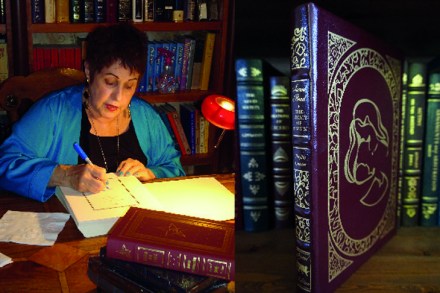
The convention is that if you happen to meet authors and have just bought or acquired a book of theirs, you ask them to sign it. Particularly stuffy authors might refuse, but in most cases they feel flattered and duly inscribe your name and theirs on the title page or the flyleaf of the book in question. If the mood is right, they may add ‘with best wishes’ or something of the sort. At a superficial level, of course, such signatures are only the equivalent of an autograph album. There’s more to it than that, however. Added value perhaps, but association certainly. The human race lives by the stories we tell ourselves about our identity and our purposes, and that signature helps to make the author’s story part of the reader’s story.

signatures david pryce-jones

The wisdom of Salman

‘Things that would have seemed utterly improbable now happen on a daily basis,’ Sir Salman Rushdie tells me. ‘The implausible has now become everyday.’ Isn’t this a problem for a writer whose books derive from the fantastical traditions of magic realism and science fiction, where crazy stuff happening is what sets them apart? ‘It is.’ The active threat to Rushdie’s life from radical Islam is two decades behind him. His novels have a way of dealing in sour, sometimes apocalyptic ironies. His latest, the Booker-shortlisted Quichotte, is set in what it describes as ‘the Age of Anything-Can-Happen’.

salman rushdie

It’s different for girls

‘Buy pink baby clothes,’ Kim Jiyoung, the protagonist of this best-selling South Korean novel is told at the obstetrician’s office. Jiyoung’s mother responds: ‘It’s OK, the next one will be a boy.’ There are numerous births in this book. Births of girls are met with disappointment. The births of sons are celebrated. When Jiyoung is born in 1982, ‘abortion for medical problems had been legal for 10 years...aborting females was common practice as if “daughter” was a medical problem’. Her younger sister is ‘erased’.

jiyoung
warhol

Magus of mass production

‘If you want to know all about Andy Warhol,’ the artist said in the East Village Other in 1966, ‘just look at the surface: of my paintings and films and me, and there I am. There’s nothing behind it.’ This quotation re-appeared in 2002 on the US Post Office’s commemorative Warhol stamp. It’s fabulously fitting for a stamp that reproduced a self-portrait, but when scholars recently compared the audiotapes of the interview with the printed version, the passage wasn’t on the tapes. Warhol sometimes invented interviews from whole cloth. He answered questions with a gnomic ‘yes’ or ‘no’ or, refusing to speak at all, allowed proxies like his ‘superstar’ Edie Sedgwick to answer for him.

Cosmopolis

Every history of London, and there have been many, has looked at the importance of migration to the city. Failing to mention that would be as inconceivable as not mentioning the River Thames. Both, after all — one literally, the other metaphorically — flow directly through the city’s heart. In this new and scholarly study, the difference is that London’s history of migration — its patchwork of settlement, its Irish ‘rookery’, its ‘colored quarter’, Huguenot silk-weavers, Jewish street-sellers, German bakers, Italian waiters, Chinatown, Banglatown — is put center-stage. The movement of all these people to London, the city’s extraordinary national, then continental, then international pull, is the story.

migrant

The lockdown list: books to read during quarantine

Now we’ve got time on our freshly cleaned hands, The Spectator’s literary luminaries are lubricating the wheels on time’s wingèd chariot and seizing the chance to boost their morale and brain function, reflect on the meaning of life and catch up on a good book or six. Each day, the Lockdown List carries our bibliophilic recommendations. Day 74: Indian summerRoss Clark The success of Black Lives Matter has deflected attention from a group which has no less a cause for grievance over its treatment throughout US history: native Americans. Indeed, to this day Native Americans, thousand for thousand, have an even greater chance of being killed by police officers as do African Americans.

custer

Apocalypse soon

An age demands a name when it’s an age of upheaval. The name should describe the ills of society and even suggest their cure. Ross Douthat’s The Decadent Society aims to do exactly that — and succeeds in ways that he might not have intended. Douthat rejects the common view of decadence as Caligula-inspired orgies or Marquis de Sade-style perversion, or even excessive consumption of chocolate cake by women. For him, decadence is ‘neither empty of any judgment nor excessively deterministic’. He finds this sweet spot in the work of Jacques Barzun, who defined decadent times by their ‘deep concerns’ and ‘peculiarly restless’ mood.

decadence douthat
metternich

Prince of Europe’s long peace

This is a giant Teutonic forest of a book, to be progressed through with determination as if by seasoned infantry; it is as far as biography can get from a Viennese waltz. But it has its rewards. It is an extensive and wellresearched chronicle of Klemens von Metternich’s monumental career — 39 years as foreign minister of the Austrian Empire, the last 27 of them also as state chancellor, and an extensive diplomatic career prior to all that. Wolfram Siemann presents and argues for a new and rather liberal interpretation of ‘the Metternich system’ instead of the normal view of Metternich’s influence as rigid and reactionary.