Books

A Scottish Paradise

As every Italian schoolchild knows, The Divine Comedy opens in a supernatural dark wood just before sunrise on Good Friday, 1300. Dante Alighieri, a figure in his own work, has lost his way in middle age and is alone and frightened in the darkness. The ghost of the Roman poet Virgil is about to show him Hell: ‘Midway in the journey of our life I found myself in a dark wood, for the right path was lost.’ Begun in the early 14th century, Dante’s poem is, for many, the greatest single work of western literature. With its dramatic chiaroscuro of hellish fuming mists and paradisal stellar regions, the poem is ‘awful’ in the archaic sense of the word (still valid in the Italian terribile), meaning to inspire awe.

dante paradise

An unquiet life

Kikuko Tsumura is a multi-prizewinning Japanese author whose mischievously deceptive new novel takes us into what purports to be the office world of Tokyo. The routine at first seems familiar, but intriguing disparities emerge: the present is also a foreign country. There’s No Such Thing as an Easy Job gives us the minutiae of everyday working life — but not as we know it. Think Nicholson Baker’s Mezzanine, freed from lunchtime restrictions. A burnt-out young woman wants a job without responsibility — no stress, no demands. First up: a surveillance assignment observing a novelist suspected of receiving contraband goods.

tsumura

Playwright at play

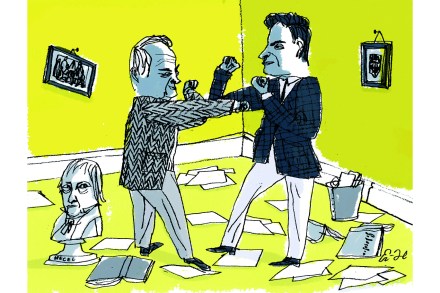
Gilbert in Oscar Wilde’s dialogue ‘The Critic as Artist’: ‘Every great man nowadays has his disciples, and it is always Judas who writes the biography.’ Not here. Hermione Lee’s immensely long Tom Stoppard: A Life is expert, engrossing, entertaining and sympathetic to its subject. At its heart is a writer steely in his determination to entertain, an inexhaustible mine of mots, a nonstop genius of jokes, capable of winning the Nobel Prize for the interview as an art form. It comprehensively replaces Ira Nadel’s Double Act (2002), a biography which Stoppard hoped would be ‘as inaccurate as possible’. (Indian Ink and Arcadia are both explicitly hostile to biography and its hubris.

stoppard

Alison Lurie, 1926-2020

I first experienced Alison Lurie’s generosity remotely. In December 1989 my friend Janet Hobhouse was renting Alison’s tiny house on Stump Lane, Key West, and I visited. Janet was terrified after a break-in. Alison, away teaching at Cornell, Kindly arranged for a private security guard. I first sighted the celebrated novelist on her deck in February 1996, breakfasting on what looked like cereal and Marmite. Stump Lane was sold, and she had bought a house on Reynolds Street, near the Casa Marina Hotel — opened in1920 for travelers on the Flagler Railway from Miami to Key West. The poet Judith Kazantzis and her husband Irving Weinman had arranged for me to rent the second part of Alison’s house, across her deck. She invited us to dinner.

alison lurie

Oracles of the Sybille

In 1975, I was commissioned to interview Sybille Bedford, by then a leading light in the literary world. She lived in a small house in Chelsea. As I got out my notebook, she said, ‘I hope you are not going to ask me about my life.’ She spoke freely about her work, though. A Legacy, the novel she published in 1956, had become an instant classic. Evelyn Waugh had reviewed it in The Spectator with all the authority at his disposal: ‘We gratefully salute a new artist.’ In a letter to Nancy Mitford he further praised the novel: ‘What a brilliant plot!’ A Legacy was high art at a time when the Angry Young Man and the kitchen-sink style were low art or no art at all. We found that we had friends in common.

sybille bedford

Make the audience happy

His name was Igor Michael Peschkowsky. When he was five he lost his body hair after an allergic reaction to a whooping cough vaccination and wore a hairpiece and false eyebrows for the rest of his life. In 1939, aged eight, he escaped from Nazi Germany on an ocean liner bound for New York. He never mastered cursive handwriting. He was a cousin of Albert Einstein. Richard Avedon became his social mentor. He dated Gloria Steinem. He passed on directing The Exorcist. In the end he became an EGOT, having won an Emmy, a Grammy, an Oscar and a staggering 10 Tony Awards. In this exhaustive, emphatically chronological biography, Mark Harris recounts Mike Nichols’s rags-to-riches life and professional and personal highs from birth in 1931 to memorial service in 2014.

mike nichols

The travels of Robert D. Kaplan

Robert Kaplan’s new book, The Good American, takes as its epigraph V.S. Naipaul’s observation that ‘Pessimism... can drive men on to do wonders.’ It’s tempting to remark that this dry aphorism is as true about Kaplan’s life and work as it is of his subject, the humanitarian Robert Gersony. But in both cases this would be, if not exactly wrong, then incomplete. Robert Gersony is a man who indeed did wonders. The son of Holocaust survivors, he dropped out of high school, earned a Bronze Star in Vietnam and then, Kaplan writes, ‘spent 40 years interviewing... over 8,000 refugees, displaced persons, and humanitarian workers in virtually every war and disaster zone on earth’.

robert d. kaplan

Epic of gossip

Staying with Peregrine Eliot (later 10th Earl of St Germans) at Port Eliot in Cornwall, Lucian Freud remembered that the Eliots ‘ate off solid silver plate, even shepherd’s pie’. In 1968, Freud was having an affair with Perry’s wife Jacquetta. According to her, it was an addiction: ‘Completely hooked, a dreadful drug.’ After two turbulent years, Jacquetta decided to have a baby by Lucian, ideally to be born on his birthday. Her husband agreed to bring up the child as his own, provided the matter was not mentioned again. The laissez aller attitude is partly accounted for (though not by William Feaver) by the 1960s, and the way the young aristocracy embraced the hippy-trippy counterculture. Jacquetta mentions smoking an opium spliff in Paris with Freud.

lucian freud

Kurt Vonnegut: atheist, socialist, trad

Kids who read Kurt Vonnegut in high school are often the kind of people who have trouble being earnest about anything. These arch-ironist teens sneer at the narrow-mindedness of their families and hometowns and place basketball pep rallies on the same continuum of fascist conformity as the Iraq War. They aren’t what you’d call ‘joiners.’ I should know. My own teenage reading habits tended toward edgy counterculture (including plenty of Vonnegut), and I half admired the kids at my white-bread Presbyterian high school who smoked cigarettes and experimented with Buddhism. Only my ingrained sense of Lutheran guilt and my distaste for excessive cynicism prevented me from truly becoming one of them.

vonnegut

Wish you were there

‘Well, that’s you shafted,’ said one friend kindly at the start of the worldwide lockdown. ‘Not a good time to be a travel writer.’ Yes and no. Obviously there’s not much actual travel possible at the moment. But the ratio in ‘travel writing’ between ‘travel’ and ‘writing’ has always been grossly disproportionate — too little time spent traveling and far too much time having to write about it when you get back. In my case, I only did just get back. I was writing a piece about the sunny beaches and boho resorts of northern Uruguay — one of those gigs which leads to envy and resentment, particularly in March — when they introduced the sudden guillotine on air travel.

travel

The man who hunted himself

The death of Joseph Conrad made Graham Greene feel, at 19, sitting on a beach in Yorkshire, ‘as if there was a kind of blank in the whole of contemporary literature’. Greene’s own death in 1991, aged 87, had a similar effect on many younger writers, myself included. For John Le Carré, his most obvious successor, Greene had ‘carried the torch of English literature, almost alone’. His cool fugitive presence, in Martin Amis’s phrase, had been there all our reading lives. In an age of diminishing faith, he had used Catholic parables in a way that lent them a power beyond their Biblical origins, mining the Gospels rather as Le Carré has mined the Cold War.

greene

Mrs Badgery

Wilkie Collins’s ‘Mrs Badgery’, rarely seen since its first publication in Dickens’s Household Words magazine in September 1857, is an enchanting little chip off the block. Like a lot of British short stories, it is absurd, very funny, and in uproarious bad taste. British writers have often enjoyed stories of making a home, and also the theatrical trappings of grief. (George Bernard Shaw commented on the national enthusiasm for requiems.) Here they collide, with richly enjoyable results. The narrator is clearly stuck with Mrs Badgery forever. In time, he might even regard her as a picturesque addition to his home, like an indoor and rather saline water feature.

mrs badgery

Dead letters

In a plea for vocational education, Sen. Marco Rubio famously remarked that we could use ‘more welders and less philosophers’. Doesn’t everyone know that ‘skills pay the bills’? If things weren’t bad enough, the rise of deconstruction and critical theory has created a generation of humanities scholars who themselves see little value in the works they study, insisting that famous art and literature emerged from racist and sexist power structures. What sensible young person would borrow $100,000 to be educated in these pointless disciplines? Eric Adler, a classicist at the University of Maryland, has the answer: anyone who wants to understand his own humanity. Adler’s invaluable survey not only defends the humanities: it even lays out how their allies have fallen short.

classics

Hate in a damp climate

When Ross Clark was writing this excellent novel about climate change, he couldn’t have known that by the time we read it the world would be paralyzed by a pandemic. Now that’s happened, it adds a whole new layer to The Denial’s themes of hysteria, self-righteousness and dodgy statistics. Bryan Geavis is a retired meteorologist living in the south of England in ‘the near future’. He used to work for a large oil company, though has to keep this quiet as there are prison terms for anyone who worked in the industry. A storm blows up in the North Sea which causes flooding in London.

denial

The Spectator’s Books of the Year 2020

Our turkeys were stuffed and now we are too. Reclining helplessly in the recovery position, our thoughts turn to feasts future. What better way to show your friends and family that you love them, and also that you have impeccable taste, than sending them a book? In The Spectator’s stocking-stuffing December issue our staff, writers and friends make their seasonal suggestions for Books of the Year: stack upon stack of the most riotous reads, bibliographical beauties and pandemical page-turners. P.J. O’Rourke The Decline and Fall of the Roman Empire, Volume I, by Gibbon, because in this year of scourge and collapsing polity it seemed apposite. And only Volume I, due to reader fatigue after 582 pages and the shift in Volume II to the history of Byzantium.

books of the year 2020

The Ryan Gattis guide to Lynwood

In 2015, after a 10-year hiatus that followed his debut, the novelist Ryan Gattis published a masterpiece. All Involved is a compulsive, symphonic novel set during the Los Angeles riots of 1992, telling the stories of gang members, a firefighter, a nurse and a graffiti artist, among others, as they try to navigate six notorious, brutal days in LA. This month, Gattis returns to this milieu with The System. Much of the novel is set in troubled, entrepreneurial Lynwood, South Central Los Angeles, where Gattis has spent many hundreds of hours on painstaking research.

ryan gattis lynwood

A tinpot Caesar

In 1919, an obscure political agitator called Benito Mussolini assembled a ragbag of Blackshirt diehards in the Lombard capital of Milan and launched the movement that was to become, two years later, the National Fascist party. The party took its name from the classical Roman symbol of authority — an ax bound in rods, or fasces. Once in power, Mussolini introduced the stiff armed Roman salute after the handshake was deemed fey and unhygienic. At times he wore a richly tasseled fez and thrust out his chin pugnaciously for the cameras. For all his posturing and demagoguery, Mussolini was widely admired in pre-war Britain, where Lord Rothermere’s Daily Mail routinely carried flattering portraits of him.

mussolini

The author in full: Tom Wolfe

I was introduced to Tom Wolfe in the late 1970s, a year or two after I had begun my journalistic career as the literary editor at National Review, by Timothy Dickinson — an Oxford man working for Lewis Lapham, then editor of Harper’s — who was (as he doubtless remains) the sole ambulatory compendium of the British Museum. As Wolfe was fond of Middle Eastern cuisine, we met for lunch at a Lebanese place in Manhattan’s Garment District. While saying goodbye on the sidewalk out front of the restaurant after the meal, Timothy dropped his walking stick which was headless; only the screw that had once fastened the missing head in place protruding from the top of the shaft.

tom wolfe

Why should The Strand survive?

On Friday book-loving New Yorkers got a shock as the city’s largest bookstore — The Strand — announced that it risked going out of business. A post on Twitter from the company said: ‘We need your help. This is the post we hoped to never write, but today marks a huge turning point in The Strand's history. Our revenue has dropped nearly 70% compared to last year, and the loans and cash reserves that have kept us afloat these past months are depleted.’ https://twitter.com/strandbookstore/status/1319686649798905856 What followed included an appeal to the public to return to the store to ensure that the 93-year-old business could keep trading. Prominent writers and pundits rallied around, and in recent days lines have appeared outside.

strand

Their Majesties the Presidents

For anyone who’s a little bit worried about the current state of the Union, Andrew Gimson’s book is a godsend. Donald Trump is often called the 45th president, but he’s actually the 44th — Grover Cleveland, president from 1885- 89 and 1893-97, is counted as the 22nd and the 24th. Among his 43 predecessors, you’ll find plenty of drunks, philanderers and incompetents. Suddenly, the teetotal President doesn’t look so bad after all. Gimson is a British journalist, but don’t let that put American readers off. He’s worked for the Daily Telegraph and The Spectator and knows politics well. He previously wrote books about the 40 British monarchs since 1066, the 55 British prime ministers since 1721 and a biography of Boris Johnson.

presidents