Arts Reviews

The good, bad and ugly in arts and exhbitions

Remembering Jean-Luc Godard

In March 2021, during his last major interview, Jean-Luc Godard reiterated a previous point about the coronavirus being a form of communication. “At first, I thought that production was the main aspect of cinema, and I realized distribution was more important, today more than before. Distribution has choked production by pretending to be at the service of the audience...The virus in its own way, distributes. Today, it would be interesting to know how the virus produces, but we only care about what it distributes.

Godard

Could Avatar 2 flop at the box office?

“Who asked for this?” asked the New York Times in November of the coming Avatar sequel, The Way of Water. Not me. I’m not the audience for this film. I did not contribute to Avatar's $2.92 billion global box office. I don’t, for example, post in the "Tree of Souls" forum, which has 2,093 members (a tiny number). Does Avatar have an army of fanatics waiting to be unleashed at the box office? I don't know anyone obsessed with Avatar, do you? Is it as meme-friendly as Minions: The Rise of Gru? No. Will it draw as many teens as an MCU movie? Probably not. Avatar does not have the built-in fanbase you need to carry a franchise. It requires a global audience — it needs mainstream buzz. It needs the press raving that it's a "visual masterpiece." But is that enough?

Violent Night is more than just Christmas carnage

The pitch meeting for Violent Night must have been fun: why not make a big-budget film where Santa Claus himself (David Harbour) must protect a spoiled rich family from a home invasion? It might even settle the age-old debate about whether Die Hard is a Christmas movie: this is what a Die Hard-style Christmas really looks like! Violent Night largely delivers on that premise, serving up high-octane holiday mayhem for the grownup set. Here, we get a disenchanted (and borderline alcoholic) Kris Kringle, who’s grown tired of modern kids requesting only cash and video games and is contemplating hanging up his hat. We’re a long way from the jovial protagonist of The Santa Clause or even the crankier iteration of Elf. Years of munching Christmas cookies haven’t made this Santa soft.

Kirstie Alley, the woman left out in the cold

Towards the end of her life, the Cheers and Look Who’s Talking star Kirstie Alley, who has died of cancer at seventy-one, did something that made her a pariah among her Hollywood associates: she tweeted support for Donald Trump. On October 17, 2020, Alley wrote, "I’m voting for @realDonaldTrump because he’s NOT a politician. I voted for him 4 years ago for this reason and shall vote for him again for this reason. He gets things done quickly and he will turn the economy around quickly. There you have it folks there you have it." The public response was swift and merciless. Writer and director Judd Apatow remarked, "Shelley Long was way funnier than you"; the actress Patricia Arquette announced, "Well my vote for Biden canceled yours out. I have done my civic duty of the day.

An unapologetically Jewish Fiddler on the Roof returns to New York

Fiddler on the Roof is a study of Eastern European Jewry: it is based on Yiddish writer Sholem Aleichem’s short stories and is set in a Yiddish-speaking village in early twentieth-century Imperial Russia. Yet, in the hit musical, which premiered on Broadway in 1964, Sheldon Harnick’s lyrics only feature a handful of Yiddish words. Harnick later confessed that the creators downplayed the Jewishness of the story — something they thought might be too sticky; too specific — in order not to put off American audiences. As scriptwriter Joseph Stein said: “These were stories about characters who just happened to be Jewish.

The cast of Fiddler on the Roof (New World Stages)
meghan trailer

Thank God: Netflix releases Harry and Meghan doc trailer

Sorry for the delay: Cockburn has been busy bleaching his eyes after watching the trailer for Meghan Markle and Prince Harry’s newest venture, a Netflix documentary on "their story." https://twitter.com/netflix/status/1598287753774477312 People magazine claimed, “It's Meghan Markle and Prince Harry like you've never seen them before,” which makes Cockburn question if the publication has had its eyes and ears shut for the last two years. The documentary series, which is composed of six episodes and will premiere in December, includes personal footage of the pair at their wedding reception, on a trip to Africa and while Meghan is pregnant. But what’s a Meghan and Harry venture without the doom? The trailer also includes footage of Meghan wiping away tears. Perfect timing!

Tár is more than a #MeToo story

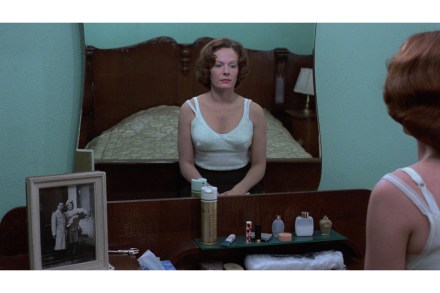
Life imitated art to a depressingly predictable degree when a clip from Todd Field’s Tár circulated online. It’s part of a scene where the film’s title character, superstar conductor Lydia Tár (played by Cate Blanchett), leads a masterclass at Juilliard. She haughtily dismisses students’ reluctance to learn the classical canon because of their difficulty “identifying” with its composers. To some, Lydia’s monologue was a vindication: a righteous tirade against "wokeness." To others, the speech exemplifies Lydia’s abuse of power, which includes not only dressing down students and mentees but sleeping with many of them and torpedoing their careers.  But oversimplified views of Lydia as a crusader or villain flatten the film’s wrenching complexities.

tar

The Menu serves up clever and tangy social commentary

Several years ago, after I passed the bar exam, my wife and I went to dinner at Pineapple and Pearls — probably Washington, D.C.’s second swankiest restaurant. I recall eating some excellent duck, as well as imbibing a selection of craft cocktails served in ever-more exotic glasses and alembics. But what I remember most was dessert: a single gooseberry lacquered with honey. Yes, a single berry. (We ordered Domino’s when we got home.) The Menu is a lacerating bit of social commentary that doubles as a satire of this kind of fine dining — not all that surprising a blend, given the presence of Adam McKay on the production team.

Is Glass Onion a victim of its own success?

Screen adaptations of Agatha Christie mysteries never go out of style. The problem is that they're so often concerned with literal fidelity that they get bogged down in self-seriousness, so desperate to “update” everything that they veer into the ludicrous. With 2019's Knives Out, Rian Johnson successfully updated the Christie-style whodunit because he had a deep knowledge of its formula and he played it with a pitch-perfect, kooky sensibility. For Knives Out’s sequel, the newly released Glass Onion, Johnson does what you should do when Netflix gives you buckets of money to make a whodunit. There are expensive locales and production design, a bevy of great character actors and a twistier murder plot.

The Oirish Question

Sweeping down and around the Aran Islands, The Banshees of Inisherin begins as any Irish film would. The official trailer had given little away, besides a couple of strong-sounding accents and weak-looking Guinness. Very Irish; too Irish, perhaps. Despite my respect for Martin McDonagh and reverence for In Bruges, even I felt trepidatious. My father, too, had an air of skepticism about him. The line between Irish and Oirish is so fine — so easily and often overstepped — that when the film opened on gray cliffs and green fields, you could be forgiven for fearing the worst. For despite the accelerated evolution of contemporary Irish cinema, Hollywood still speaks fluent Oirish.

inisherin

‘Alice’s Restaurant’ and how the hippies blew it

Traditions are good. If you don’t have any for Thanksgiving — or if you’re severed by space and circumstance from the people with whom you do share traditions — you could do worse than “Alice’s Restaurant.” Radio stations across the country play Arlo Guthrie’s rambling, folksy, satirical, eighteen-minute 1967 anti-Vietnam ballad at noon sharp on Thanksgiving Day. Wherever you are, scan through your radio, and I’ll bet you'll find it. The song tells the (mostly) true story of eighteen-year-old Arlo, the son of folk legend Woody Guthrie, attending “a Thanksgiving dinner that couldn’t be beat” at a deconsecrated Episcopal church in Great Barrington, Massachusetts. Ray and Alice Brock, a hippy couple who taught at Arlo’s high school, own the church.

Thirty-five years of crying to Planes, Trains and Automobiles

No piece of art has ever affected me quite like John Candy’s face in Planes, Trains and Automobiles. It has made me cry for thirty-five years, rivulets of tears. It has shown me that nothing evokes loneliness like a face. John Candy's face simultaneously reveals warmth and fatalism (it's the face of a man who always feared he'd die young — and did). His unibrow is childlike and genuine. His smile is never fake. But Candy’s shower curtain ring peddler Del Griffith is smiling through pain. He’s hiding behind the mask of a gregarious family man and "best in the world" salesman (with a bowtie and bristly mustache). His smile hides a secret: Del Griffith is a grieving widower, and his home is inside an old trunk he carries around like luggage.

Murillo the masterful

Murillo: From Heaven to Earth, an exhibition at the Kimbell Art Museum in Fort Worth, Texas, is, at its core, a cunning display of institutional braggadocio. How much better to amplify a mainstay of the permanent collection — that would be “Four Figures on a Step” (c. 1658-60) — than to mount a show dedicated to the artist responsible for it? “Four Figures on a Step” is, if not Murillo’s masterpiece, then a distinctive painting all the same. It is distinctive because it is odd: though attempts have been made to peg the image as some-or-other lesson in morals, the canvas has consistently resisted explication. The title, a bland descriptor superimposed by an outside source, points up how the picture’s thematic basis remains firmly contained within its own peculiar logic.

Murillo

Why is there no great Thanksgiving movie?

In about a month’s time, one of the most boring conversations in social media discourse will begin (assuming Elon Musk hasn’t taken Twitter away from us out of pique). "X is a Christmas film." "X is not a Christmas film." And so on, as keyboard warriors angrily debate whether the eclectic likes of Die Hard, Lethal Weapon and Love, Actually qualify for this designation, as purists claim on endless Reddit threads that a Christmas movie can only be so-called if the plot and events are entirely driven by the festive season itself. Even for those of us who would argue that Die Hard and It’s A Wonderful Life make the perfect Christmas double bill — wider designations of the term be damned — there is considerably less debate as to what makes a Thanksgiving film.

lohan

The return of Lindsay Lohan

Falling for Christmas has a ridiculous logline: “Newly engaged, spoiled hotel heiress gets into a skiing accident, suffers from total amnesia and finds herself in the care of a handsome, blue-collar lodge owner and his precocious daughter in the days leading up to Christmas.” The Netflix romp is notable only as it marks Lindsay Lohan’s return to a genre that made her famous. “It’s such a refreshing, heartwarming romantic comedy and I miss doing those kinds of movies,” Lohan told Netflix, in earnest, while describing her character as, “Extravagant. Temperamental. Glamorous.” You could build a campy slasher flick or porno off such plot scaffolding; none would be great cinema. And yet Falling for Christmas is more complicated than that. Why?

bowie

David Bowie is bigger than ever

On Sunday, November 10, 1991, the band Tin Machine played a gig at Brixton Academy in south London. Brixton then was far from the gentrified area it has become; it remained a hotbed of simmering social and racial unrest. The notorious riots of a decade before were still a recent memory, and those who ventured to the Academy did so in the knowledge that fights and aggravation were highly likely, especially after alcohol had been consumed. But if on-street scuffles were a price that gig-goers had to pay to see their musical idols, the world of Tin Machine was a much less happy one. At the beginning of the Nineties, David Bowie had to consider, for the first time since the success of the single “Space Oddity” in 1969, that he might be a spent force.

Taylor Swift is one of America’s great storytellers

"Every single song is like a road map to what that relationship stood for, with little markers that maybe everyone won't know, but there are things that were little nuances of the relationship, little hints,” Taylor Swift told Yahoo! Music in 2010. A decade of songwriting turned those “little hints” into complicated numerology, a scarf metaphor at the centerpiece of her canon, coded song titles, storytelling scattered with cardigan sweaters, Shakespeare references, faded blue jeans, true crime, YA tropes (e.g., witches, cats, prom dresses, teen love triangles and evil alter-egos) and glitter-glue covered diary pages — sealed with red lips. Taylor Swift was fifteen when she began incorporating easter eggs and (wink-wink) secret messages into her work.

Blockbuster is the best argument in favor of That ’90s Show

Blockbuster is a single-cam sitcom about the last Blockbuster (located inside a strip mall in Michigan). The set is dressed in authentic signage, fluorescent lights, blue walls and an oddly prophetic Howard the Duck poster. The employees have real Blockbuster name tags and uniforms (the producer, John Fox, acquired the rights and handed it over to established showrunner Vanessa Ramos: I have the rights to Blockbuster. Would you like to develop a workplace?). Every episode is packed with movie references and checkout-counter humor. The transitions between scenes are scored to hip-hop beats that sound like something you’d hear on Nickelodeon in the Nineties. You’re inside a Blockbuster for the first time since Carol Danvers fell through its roof in Captain Marvel.

blockbuster

Happy birthday Martin Scorsese, the Don of movies

Later this week, probably the world’s greatest living film director will celebrate his eightieth birthday. However he celebrates — whether in the company of friends and family in his no doubt opulent Manhattan home, or working on his eagerly awaited new film Killers of the Flower Moon — Martin Scorsese can reach his milestone age in the confidence that his position in cinematic history is assured forever. For a man so steeped in the art and practice of filmmaking — and who has made several excellent documentaries about movies — it must be intensely gratifying for Scorsese to be aware that he is that rarest of persons, a living legend, whose contributions to film will live forever.