Arts Reviews

The good, bad and ugly in arts and exhbitions

The vicious genius of Adam Curtis

In an interview back in 2021, Adam Curtis explained that most political journalists couldn’t understand his films because they aren’t interested in music. Having known a fair few political journalists, I can say with some certainty that he was right. Most politically motivated types are – not to be unkind, but it’s true – total losers. This cuts across left and right, all ideologies and tendencies, from Toryism to anarchism to Islamism and back: whatever you believe, if you believe it too strongly you were probably a weirdo at school. The other kids went out clubbing; you stayed at home, drawing pictures of Lenin or von Mises on your satchel.
Dua Lipa sparkles at Wembley – but her new album is pedestrian

If, as is said, there are only seven basic narratives in human storytelling, then there should be an addendum. In rock and pop there is only one: the dizzying rise, the imperial period, the fall from grace (either commercial or ethical, sometimes both), and the noble return (historically prefigured with a glossy music mag cover proclaiming: ‘Booze! Fights! Madness! How Rubbish Band went to hell – and came back’). All three were on view in London this past fortnight. Waxahatchee was the one on the way up: this was, Katie Crutchfield announced proudly from the stage, the ensemble’s biggest-ever show. Dua Lipa was the one entering her imperial phase –

Owen Matthews, Bijan Omrani, Andrew Hankinson, Laurie Penny & Andrew Watts

29 min listen

On this week’s Spectator Out Loud: Owen Matthews says that Venice’s residents never stop complaining (1:11); Bijan Omrani reads his church notebook (7:33); Andrew Hankinson reviews Tiffany Jenkins’s Strangers and Intimates: The Rise and Fall of Private Life (13:54); as 28 Years Later is released, Laurie Penny explains the politics behind Alex Garland’s film franchise (18:25); and, Andrew Watts provides his notes on Angel Delight (25:09).  Produced and presented by Patrick Gibbons.

The politics of horror

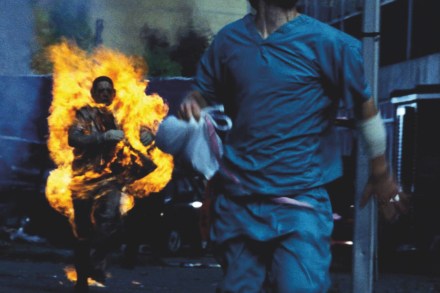
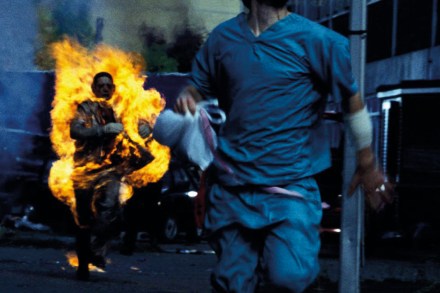
Everyone forgets the actual opening scene of 28 Days Later, even though it’s deeply relatable, in that it features a helpless chimp strapped to a table and forced to watch doomreels of ultraviolence until it loses its little monkey mind and eats David Schneider. But it’s eclipsed by the famous sequence that follows where Cillian Murphy wakes in a hospital bed to find that he has slept through a deadly pandemic and the ensuing collapse of civilisation. As Murphy drags his not-yet-world-famous cheekbones through an eerily abandoned metropolis, we see Piccadilly plastered with the names and faces of the missing and the dead. Audiences in 2002 were reminded of the

The cheering fantasies of Oliver Messel

Through the grey downbeat years of postwar austerity, we nursed cheering fantasies of a life more lavishly colourful and hedonistic. Oliver Messel fed them: born into Edwardian privilege, the epitome of well-connected metropolitan sophistication, he doubled up as interior decorator and stage designer, creating in both roles a unique style of rococo elegance and light-touch whimsy that sweetened and consoled – ‘a gossamer world of gilded enchantment’ as Roy Strong soupily put it. ‘Marie Antoinette would have felt at home in any of his settings.’ Like his rival Cecil Beaton, Oliver Messel sums up an era Posterity has not been kind to Messel. Only a little of his art has

London’s best contemporary art show is in Penge

If you’ve been reading the more excitable pages of the arts press lately, you might be aware that the London gallery scene is having one of its periodic ‘moments’. A fair few spaces, mostly concentrated around Fitzrovia, have sprouted up since the pandemic, notable for their bacchanalian openings and tantalisingly gnomic Instagram posts. Their online presence is at best spectral: the most hyped of the bunch, a Smithfield gallery called Ginny on Frederick, has a holding page in place of a website. Still, I like a scene, and London Gallery Weekend, an annual June event, presented a good opportunity to investigate. Niso gallery, on New Cavendish Street, has put on

If you think all orchestras sound alike, listen to this recording

Grade: B+ These are gloomy days, so here’s a burst of melody and colour to cheer you up. Back in the LP era it wasn’t unusual for classical recordings to be put together like a concert that you might actually want to hear: a sequence of works by different but complementary composers, offering the possibility of a happy discovery. Come for the Strauss, stay for the Reznicek – that sort of thing. This lively new disc from the Borusan Istanbul Philharmonic adopts the same principle. The unifying theme is early-20th-century eastern European nationalism – the folksong-collecting variety, not the Archduke-assassinating kind. But it’s the opposite of monotonous. The Bartok is

Astonishing ‘lost tapes’ from a piano great

These days the heart sinks when Deutsche Grammophon announces its new releases. I still shudder at the memory of Lang Lang’s 2024 French album, in which he drooled over Ravel’s Pavane pour une infante défunte; when I reviewed it I suggested that if the poor girl wasn’t dead when he started, then she certainly was by the time he’d finished. Now she’s been killed again, this time by the guitarist Robin Scherpen, whose Ravel Reimagined offers us ‘a peaceful and serene soundscape’. Then there’s Rêverie from Nemo Filou, a trio whose cocktail-lounge noodling allows ‘the listener to drift off into bliss’, and Sleep Circle, a ‘re-recorded version of the 2012

Style, wit and pace: Netflix’s Dept. Q reviewed

Can you imagine how dull a TV detective series set in a realistic Scottish police station would be? Inspector Salma Rasheed would have her work cut out that’s for sure: the wicked gamekeeper on the grisly toff’s estate who murdered a hen harrier and then blamed its decapitation on an innocent wind turbine; the haggis butcher who misgendered his vegetarian assistant; the Englishman who made a joke on Twitter about a Scotsman going to the chippy and ordering a deep-fried can of Coke… It would get lots of awards, obviously, but I doubt it would do that well in the ratings. As with Slow Horses, this is about enjoying the

The artistic benefits of not being publicly subsidised

Paralysed rather than empowered by the heavy hand of Big Brother Arts Council, the major subsidised dance companies are running scared and gripped by dismally risk-averse and short-termist attitudes. Free from the deadening metrics of diversity quotas and targeted outcomes, smaller more independent enterprises – London City Ballet and New English Ballet Theatre among them – can be lighter on their feet: they have inherited something of the pioneering spirit of Marie Rambert and Ninette de Valois a century ago and they deserve support. Another such is Ballet Nights – a series of one-off galas masterminded by Jamiel Devernay-Laurence, who doubles up as an embarrassingly brash compère, introducing each performer

Superb: Stereophonic, at Duke of York’s Theatre, reviewed

Stereophonic is a slow-burning drama set in an American recording studio in 1976. A collection of hugely successful musicians, loosely based on Fleetwood Mac, are working on a new album which they hope will match the success of their previous number one smash. This is an absolute treat for anyone who appreciates subtle, oblique and quietly daring theatre The studio could almost be an orphanage because the characters keep squabbling and bickering like siblings in need of a parent. The self-appointed leader is Peter (Jack Riddiford) who dresses in classic hippy mode with a kaleidoscopic shirt and a droopy moustache. But he rules the studio with a rod of iron.

Magnificently bloodthirsty: 28 Years Later reviewed

First it was 28 Days Later (directed by Danny Boyle, 2002), then 28 Weeks Later  (Juan Carlos Fresnadillo, 2007) and now Boyle is back at the helm with 28 Years Later, which is, as I understand it, the first in a new trilogy. This post-apocalyptic horror franchise could go on for ever. As the last film was generally (and rightly) regarded as a desultory cash grab, there is much riding on this one. The verdict? It’s entertaining but not outstanding. The biggest surprise is its tonal swerve into sentimentality. Jodie Comer and Ralph Fiennes, however, bring character and heft and, just to put your minds at rest, yes, it’s as

The Renaissance master who rescued polyphonic music

Last month I watched conductor Harry Christophers blow through what sounded like an arthritic harmonica but in fact was a pure-toned pitch pipe, which handed the singers of his vocal group the Sixteen their starting notes. Then the Kyrie from Giovanni Pierluigi da Palestrina’s Missa Regina coeli unfolded inside the resonant splendour of St James’s Church in Mayfair and, 500 years after his birth, I grasped why Palestrina, maestro di cappella of St Peter’s Basilica in Rome from 1551-5, still has the capacity to surprise. Christophers and the Sixteen are celebrating this greatest of the late Renaissance composers in his anniversary year with three concerts promoted by the Wigmore Hall

Darkly comic samurai spaghetti western: Tornado reviewed

Tornado is a samurai spaghetti western starring Tim Roth, Jack Lowden and Takehiro Hira (among others). Samurai spaghetti westerns aren’t anything new. In fact, we wouldn’t have spaghetti westerns if it weren’t for the samurai genre – Sergio Leone’s Fistful of Dollars (1964) was, as Clint Eastwood conceded, an ‘obvious rip-off’* of Akira Kurosawa’s Yojimbo (1961) – yet this may be the first one set in 1790 and filmed in Scotland. It may also be the first one to feature thick woollens and tweed. That makes it sound twee which it isn’t. It’s a super-bloody revenge story filmed in just 25 days with a running time of 90 minutes. We

The charm of Robbie Williams

What could it possibly feel like to be a sportsperson who gets the yips? To wake up one morning and be unable to replicate the technical skills that define you. To suddenly find the thing you do well absolutely impossible. Golfers who lose their swing, cricketers whose bowling deserts them, snooker players who can’t sink a pot. Stage fright – something both Robbie Williams and Cat Power have suffered from – is much the same. Williams took seven years off touring last decade because of it, which must have been devastating for someone whose need for validation is so intense that he has made it his brand. Chan Marshall, the

Why disaffected actors often make excellent playwrights

Actors are easily bored on long runs. Phoebe Waller-Bridge once revealed that she staged distractions in the wings to amuse her colleagues. On the last night of Hay Fever, egged on by another actor, she bent over ‘and showed [her] arsehole’ to the on-stage actors. Nabokov’s plays are seldom performed. But he was alive to middling, mediocre dramatic clichés, fashions long-forgotten, but invaluably preserved in his 1941 lecture ‘The Tragedy of Tragedy’: ‘The next trick, to take the most obvious ones, is the promise of somebody’s arrival. So-and-so is expected. We know that so-and-so will unavoidably come…’ This is the lost convention, the stand-by that Beckett was frustrating in Waiting

Summer opera festivals have gone Wagner mad

Another week, another Wagner production at a summer opera festival. This never used to happen. When John Christie launched Glyndebourne in the 1930s, he hoped to stage the Ring. So he gathered a team of refugee musicians from Germany, who quickly assured him that it was impossible and he should stick to Mozart. The man who changed all that was Martin Graham, the plimsoll-wearing founder of Longborough Festival Opera, who died in April at the age of 83. Graham was irrepressible; a self-taught enthusiast. With no one around to tell him it couldn’t be done, he pushed ahead regardless, staging the Ring cycle twice in as many decades. And now

Ingenious: the Globe’s Romeo & Juliet reviewed

Cul-de-Sac feels like an ersatz sitcom of a kind that’s increasingly common on the fringe. Audiences are eager to see an unpretentious domestic comedy set in a kitchen or a sitting-room where the characters gossip, argue, fall in love, break up and so on. TV broadcasters can’t produce this sort of vernacular entertainment and they treat audiences as atomised members of racial ghettos or social tribes. And they assume that every viewer is an irascible brat who can’t bear to hear uncensored language without having a tantrum. The result is that TV comedy often feels like appeasement rather than entertainment. Theatre producers are keen to fill the gap, and the