Arts Reviews

The good, bad and ugly in arts and exhbitions

Unhappy days

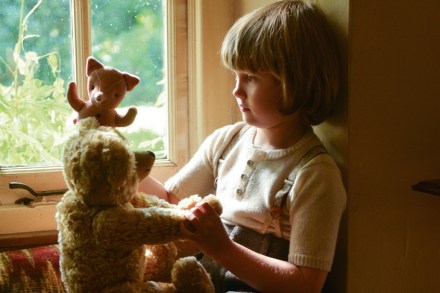
Scriptwriters love to feast on the lives of children’s authors. The themes tend not to vary: they may have brought happiness to millions of children but their stories — sob — were fertilised by unhappiness. Saving Mr Banks: Mary Poppins author was a bossy shrew because her alcoholic father died young. Miss Potter: Peter Rabbit creator never found love. Finding Neverland: Peter Pan playwright cheered up grieving family. Enid (made for BBC Four): Miss Blyton was a monster traumatised by her upbringing. And so it will presumably go on. We can probably not expect a family film about Charles Dodgson taking cute snaps of little Alice Liddell, but one day,
Vital signs

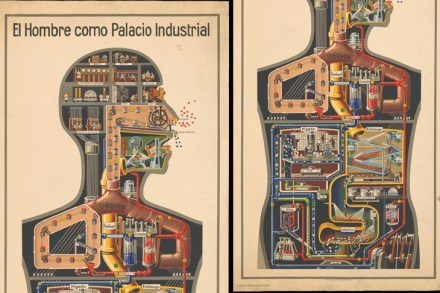
Exhibit A. It is 1958 and you are barrelling down a dual carriageway; the 70 mph limit is still eight years away. The road signs are nearly illegible. You miss your turning, over-correct, hit a tree and die. The following year, graphic designer Margaret Calvert is driving her Porsche 356c along the newly built M1. The motorway signs are hers. It is information design of a high order, possibly even life-saving. The clarity and intelligence of Calvert’s British road signs remain unmatched nearly 60 years later. And the font she created became the NHS, and later rail and airport, standard. Exhibit B. The French are worried about nuclear waste. Given

iAddicts

For many years The Spectator employed a television reviewer who did not own a colour television. Now they have decided to go one better and have asked me to write a piece to mark the tenth anniversary of the iPhone. I have never owned an iPhone. (In the metropolitan media world I inhabit, this is tantamount to putting on your CV that you ‘enjoy line dancing, child pornography and collecting Nazi memorabilia’). But, even though I’m a diehard Android fan, I still cannot help paying attention to every single thing Apple does and says. I don’t think this happens in reverse. I doubt Apple owners pay any attention to the

Mothers’ ruin

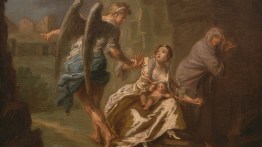
At the heart of Basic Instincts, the new exhibition at the Foundling Museum in London, is an extraordinarily powerful painting of a mother and baby. At one time the ‘Angel of Mercy’ was sold as a greetings card by its owner, the Yale Center of British Art in Connecticut, presumably intended as something you might send your own mother or child. But take a second glance and you might well wonder who bought the card and who they might have sent it to. In Joseph Highmore’s Georgian scene, a young, fashionably dressed woman is splayed across the canvas, her feet in delicate silk shoes, a tiny baby, naked, resting precariously

Speech therapy

Oslo opened in the spring of 2016 at a modest venue in New York. It moved to Broadway and this imported version has arrived at the National on its way to a prebooked run at the Harold Pinter Theatre. It’s bound to be a hit because it’s good fun, it gives a knotty political theme a thorough examination, and it’s aimed squarely at the ignorant. In the early 1990s Norwegian diplomats set up ‘back-channel’ talks between the PLO and Israel. The play follows that process and it treats geopolitics like a flat-share comedy. The bickering partners are hauled in by the lordly Norwegians and forced to hammer out their differences

No balls

Borg vs McEnroe is a dramatised account of one of the greatest tennis rivalries of all time — between Bjorn Borg and John McEnroe (the clue was always in the title) — that doesn’t hit nearly as hard as it should. It does the job. It gets us from A to B. But it doesn’t dazzle. It doesn’t have the dramatic smarts to lend either surprising tension or excitement to otherwise familiar events, or shed any new light on them. It’s more the pt-pt-pt-pt of a stolid baseline rally and now, you will be thankful to hear, that’s it with the tennis puns. (I only had two anyhow.) The film

Loose ends

On Sunday night, Holliday Grainger was on two terrestrial channels at the same time playing a possibly smitten sidekick of a gruff but kindly detective with a beard. Even so, she needn’t worry too much about getting typecast. In BBC1’s Strike, she continued as the immaculately turned-out, London-dwelling Robin, who uses such traditional sleuthing methods as Google searches. On Channel 4, not only was she dressed in rags, with a spectacular facial scar and a weird hairdo, she was also living in an unnamed dystopian city, where her detective work relied on a handy capacity to read minds. This was the first and highly promising episode of Electric Dreams, which

Small wonders

It has been a reasonably good week for peripatetic opera-loving female-underwear fetishists. In La bohème at Covent Garden Musetta slipped out of her knickers and swung them round, as everyone, except me, mentioned in their reviews; and now, in Leeds, in the first of Opera North’s ‘Little Greats’, what laughter the actors in the drama got was from Tonio and others trying on Nedda’s bra. This new production of Pagliacci by Charles Edwards, sadly under-attended, was possibly too ingenious. It is set in a rehearsal room, and we see the first day of rehearsals and then the final run-through. It kind of works, but anyone unfamiliar with the opera would

Fickle fortune | 21 September 2017

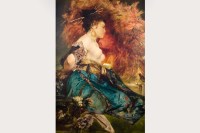
Here’s an intriguing thought experiment: could Damien Hirst disappear? By that I mean not the 52-year-old artist himself — that would be sensational indeed — but the vast fame, the huge prices, the hectares of newsprint, profiles, reviews and interviews by the thousand. Could all that just fade from our collective memory into a black hole of oblivion? The answer is: yes, quite easily. Artists vanish all the time. Take the case of Hans Makart (1840–1884). He was a contemporary of Monet, Manet and Degas, but enormously more acclaimed in his lifetime than any of those. A period of Viennese life was dubbed the ‘Makart era’, a fashionable idiom was

Frills and furbelows

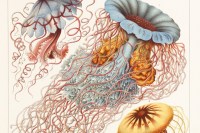
Over the winter of 1859–60, a handsome young man could be seen patrolling the shores of the Gulf of Messina in a rowing boat, skimming the water’s surface with a net. The net’s fine mesh was not designed for fishing, and the young man was not a Sicilian fisherman. He was the 25-year-old German biologist Ernst Haeckel from Potsdam searching for minute plankton known as Radiolaria. In February he wrote excitedly to his fiancée, Anna Sethe, that he had caught 12 new species in a single day — ‘among them the most charming little creatures’ — and hoped to make it a full century before leaving. Haeckel had a degree

The icemen cometh

You wouldn’t want to stumble upon the Scythians. Armed with battle-axes, bows and daggers, and covered in fearsome tattoos, the horse-mad nomads ranged the Russian steppe from around 900 to 200 BC, turning squirrels into fur coats and human teeth into earrings. At their mightiest, they controlled territory from the Black Sea to the north border of China. They left behind no written record, only enormous burial mounds, chiefly in the Altai mountains and plains of southern Siberia. Chambers that weren’t looted in antiquity were preserved in the permafrost only to be discovered millennia later. It is thanks to Peter the Great and the expeditions he launched that so many

Art of darkness | 14 September 2017

Stephen King, 69, has sold more than 350 million books, and tries not to apologise for being working-class, or imaginative, or rich. The snobbery has ebbed a little, though; in 2003 he won the National Book Foundation’s Medal for Distinguished Contribution to American Letters, and now the BFI is screening a series of adaptations of his novels, which show how versatile he is. Why can’t you write stories like Rita Hayworth and Shawshank Redemption, a woman asked him once. I did write it, he told her, but she did not believe him. King has published 59 novels, but he is a recovering addict and can’t remember writing them all. Most

Rockies horror show

Tin Star, the latest Sky Atlantic drama, has a comfortingly familiar premise: Jim Worth (Tim Roth), an ex-detective from London with an alcohol problem, heads out to rural Canada with his family to start a new life only to find himself embroiled in crime, violence and personal tragedy far worse than anything back home. It begins well. There’s a lovely establishing scene where Roth walks down the street with his new Canadian sheriff’s badge and everyone greets him, as people presumably do in sleepy Canadian Rockies towns like Little Big Bear, where everyone’s got time for one another. In the police station, his two junior officers have so little crime

Age concern | 14 September 2017

Stephen Sondheim’s Follies takes a huge leap into the past. It’s 1971 and we meet two middle-aged couples who knew each other three decades earlier at a New York music hall. The building faces demolition and the owner is throwing a party for his old dancing-girls. Dominic Cooke’s lavish production of this vintage musical boasts 58 performers, 160 costumes and 200 production staff. Yet it’s a curiously small show that could be performed, with a few cuts, in a pub theatre. There are four main characters and a smattering of cameos. Phyllis and Ben are rich New York grandees, unhappily married. Their chums Bud and Sally are also wealthy and

DIY Bohème

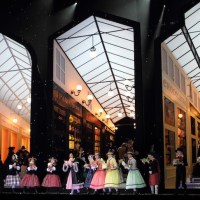
The Royal Opera’s one production that, it has always confidently been claimed, need never be replaced has been replaced. John Copley, vintage 1974, has given way to Richard Jones, in a production full of his trademark quirkinesses and mischief, though he is respectful enough of Bohème to keep his irony out of sight for the last two acts. Stewart Laing is the designer, with a separate movement director (I thought that’s what directors did) in Sarah Fahie. Snow falls continuously before the curtain rises, but the set of Act One inevitably strikes you as a gauntlet thrown down to Copley. Flat 7b, which is the abode of the bohemians, is

Nut job

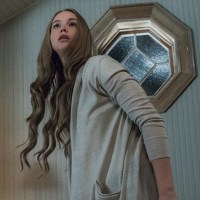
The film-maker Darren Aronofsky says he wrote Mother! in five days as if in a ‘fever dream’ and, as a general rule, what happens in a fever dream should stay in the fever dream, as the content will be plainly nuts. This is plainly nuts. This is even plainly nuts with an exclamation mark. Plainly nuts! However, it’s never plainly dull, so it does have that going for it. I think. Described as a psychological horror thriller, the set-up has a poet and his younger wife living in a magnificent, isolated house in the countryside that she is doing up. She is Mother (Jennifer Lawrence) and he is Him (Javier

Ave, Maria

Anyone who thinks that an artist’s life is irrelevant to their artistic achievement, and for that matter anyone who thinks that it isn’t, must be given pause by Maria Callas. It is now exactly 40 years since her death and everything she recorded is available on multiple pressings. But of the huge body of material that has appeared about her, only a small percentage concerns itself with the recordings. There are innumerable biographies, memoirs, refutations of memoirs, studies of the influence of her fluctuating erotic life on her singing, her meteoric rise, the Great Decade, the tragic decline, and so on. All of these might be fascinating, but they draw