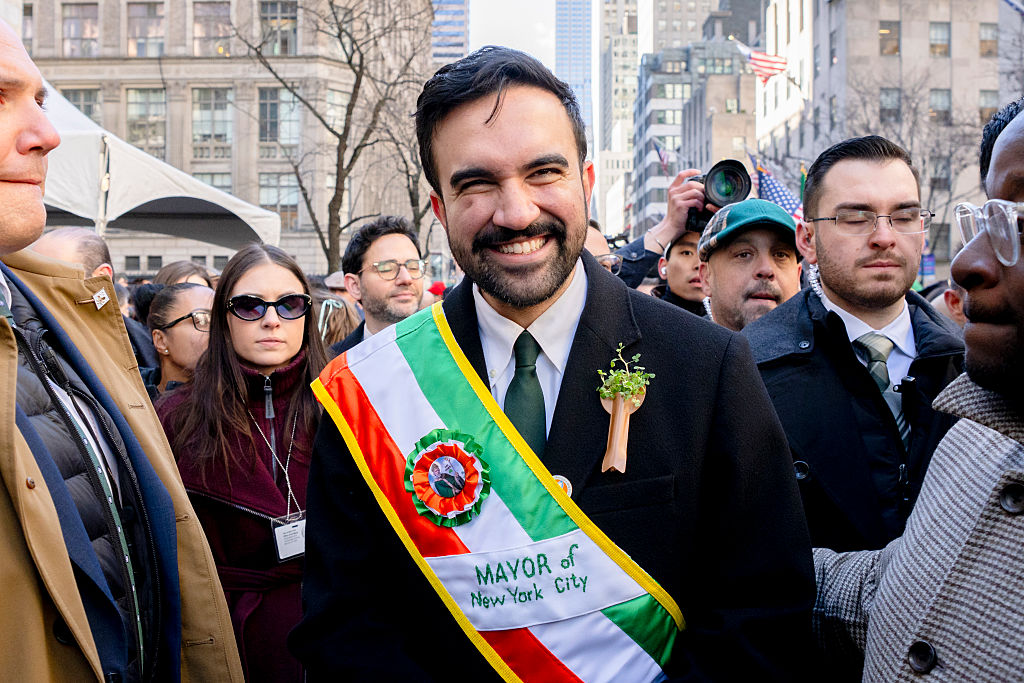
When asked about a united Ireland earlier this week, Zohran Mamdani admitted that he “hadn’t thought enough on that question.” The Mayor of New York then recited a stiff set of platitudes about “solidarity” in language that he repeated word for word in his St. Patrick’s Day address.
There was an incongruity between his comments and his attendance at the James Connolly Irish-American Labor Coalition’s annual luncheon, where he schmoozed for selfies with Sinn Féin politicians. There was incongruity, too, with past mayors like Ed Koch and David Dinkins, the latter of whom lobbied for Irish republican prisoners.
Context is everything, though, and both the city and the Irish national struggle have changed over the past 30 years. Mamdani’s indifference to the Irish question signals the passing of two worlds: that of old New York and old Ireland.
Most important for Mamdani is that Ireland was the first EEC member state to call for Palestinian statehood
An Irish-American friend who’s a veteran of New York politics told me an anecdote about Congressman Joe Crowley’s loss to Alexandria Ocasio-Cortez in 2018. That race was, in many ways, a trial run for Mamdani’s victory over Cuomo. Crowley supposedly told him “There used to be 20 Irish pubs all up and down this neighborhood and I could campaign by just visiting each one on St. Patrick’s Day, now there’s only one.”
At the time, the Democratic Socialists of America member Ross Barkan called AOC’s victory “seismic”, asking “Is this the sound a dying political machine makes?” He compared Crowley’s defeat to the “defeat of Tammany Hall,” and said Crowley’s “tentacles were everywhere,” recalling 19th century political cartoon levels of anti-Irish rhetoric. Conspicuously, Barkan never uses the word “Irish” once – instead using phrases such as “old machine,” “corruption,” “Tammany Hall” and “behind-the-curtain…power-brokers.” We all know what he was referring to: Irish and Italian Democrat New York.

Similarly, when Mamdani beat Cuomo, very few on his team openly framed it as dismantling old white ethnic New York, but that was what they were doing. They constantly telegraphed their knowledge of it through talk of “new coalitions.” Indeed, long term trends like white flight, looser immigration laws, and increases in global refugees over the past 20 years have changed the demographics of New York City.
In the mid-19th-century, following the famine, the Irish made up a quarter or more of the entire population of New York. NYC was the largest Irish city in the world by the 1871 census, with its 300,000 Irish beating Dublin’s 267,000. This shifting of the entire Gaelic world west across the Atlantic was not limited to New York. Massachusetts and Pennsylvania received large numbers of Irish migrants as well, with Philadelphia’s Irish population reaching 97,000, significantly larger than Cork City’s population of 76,000.
There are now 376,000 Irish-Americans in New York City, fewer than the 410,000 there were in 1890 when the city had 1.5 million people versus the 8.5 million it has now. As a percentage of the population, they have dropped from 27 percent to 4.4 percent, far lower than the 12 percent Muslim share of the population.
Italians have fared better, with around 800,000 remaining in the city, but Little Italy has been dead for decades; with all the gentrification around Lower Manhattan, the real Little Italy migrated up to Arthur Avenue in the Bronx. Indeed, it is in the outer boroughs that you’re most likely to catch glimpses of the old New York peeking through, with Woodlawn Heights being one of the only authentically Irish neighborhoods left in New York.
Not only have Irish and Italian numbers declined, but the social glue that held these old ethnic neighborhoods often no longer exists in the first place. Many Irish and Italians are no longer getting union jobs from their cousins and uncles – the guy who knows a guy. Instead, they’re working in the regular labor market as perfectly ordinary, middle-class professionals.
Many Italian-Americans and Irish-Americans simply moved from the places that sustained their political machines and cultures. Once you’re an upper-middle class professional, your primary allegiance becomes institutional, not ethnic or personal, and American deracination is a powerful process. It is not simply that there are fewer Irish and Italians left, but also that the ones who remain are very different politically from their grandparents who donated to NORAID. These days, you’d sooner find such ethnic whites working at Goldman Sachs and JPMorgan Chase than financially sponsoring foreign terrorism.
And what of the national struggle for a united Ireland? Aside from the disarmament of the Provisional IRA, the most important part of the Good Friday Agreement was that the Republic of Ireland dropped its claim to Northern Ireland. The only mechanism for reunification now is a vote, which happens only if and when one British official appointed by the Prime Minister, the Secretary of State for Northern Ireland, decides to call one.
This arrangement, along with total disarmament, is what Gerry Adams, Sinn Féin and the IRA themselves agreed to almost 30 years ago. In some ways, Mamdani reflects this reality. Sinn Féin have fully embraced the platitudes-about-self-determination-style of Irish nationalism. Why would anyone expect the Ugandan-Indian Democrat Mayor of New York to sound like a dissident republican when those people barely exist anymore?
Once you disarm and relinquish your claim, then it loses all force internationally. This is why Ukraine refuses to acknowledge Russian annexation of Crimea, even though it has been an established fact for more than a decade. The Irish national struggle died a long time ago, and Irish New York has been dying along with it. What’s actually left?
Mamdani began his St. Patrick’s Day address with a thinly veiled allegory for Palestine, recounting an episode where a British warlord “laid waste” to Ireland, leading Patrick to beg him to stop. Afterwards, Patrick said it was time to “Weep with those who weep.” Weepiness is extolled as the greatest Irish virtue, for “who can better understand those who weep, than those who have wept for so long?” This supposed virtue requires “sacrifice” and “subjugation of self,” according to Mamdani. One can only imagine the uproar if he had talked about how Palestinians need to practice “subjugation of self.”
Mamdani and Irish liberals think being a teary-eyed mick and permanent loser is a good thing
Mamdani then mentioned bridges and tunnels, built of course by Irish union men, before coming out with the statement, “If solidarity has often been withheld from the Irish, it has never been withheld by the Irish.” Of course, unrequited solidarity is an oxymoron. If it’s one-way, then it’s charity or exploitation, and often, both. Most important for Mamdani, however, is that Ireland was the first EEC member state to call for Palestinian statehood.
I feel obligated to mention that Mamdani, to use his kind of language, perpetuated stereotypes about the Irish: that we’re all sad, sentimental creatures permanently depressed from subjugation and defeat. What both Mamdani and Irish liberals have in common is that they think being a teary-eyed mick and permanent loser is a good thing. Both of them want to turn Irishness into a form of soft, domesticated liberalism rather than anything with any ethnonational teeth. They both want to keep the Irish on the Paddystinian Plantation. What do the Irish get out of this?
Mostly a preening, obnoxious, and totally unearned sense of moral superiority. This is designed to hide the abandonment of the Irish national project, both in the Gaeltacht and the North. It’s supposedly a good thing that the Irish keep offering solidarity to people who offer them nothing in return. And it’s a good thing to succumb to Anglo liberalism, to be a chump and a cuck for foreign nationalisms while disowning your own diaspora.
None of this is about the dignity of the Irish people. It’s about how a thin version of Irishness can be instrumentalized and exploited by progressive politics. But I still enjoyed St Patrick’s Day. And I’m certainly not weeping about it.

Comments