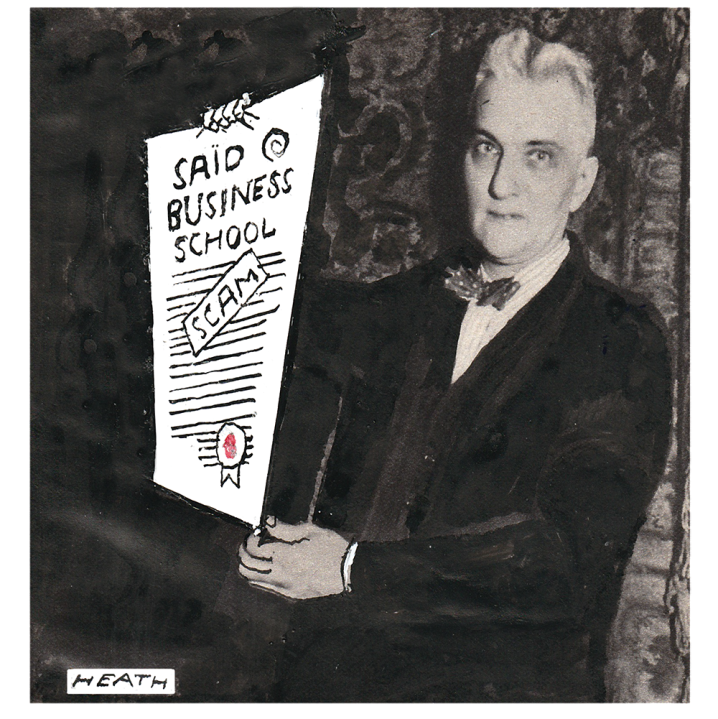


How do you get into the University of Oxford? It is a question asked by thousands of young people every year. In Martin Amis’s The Rachel Papers (1973), Charles Highway discovers that the key is to feign socialism and memorise a few book reviews. It turns out there is an even better ruse: the Saïd Business School.
Saïd has, at best, a dubious origin story. In 1996 the project was forced through at Oxford’s Congregation, the university’s legislative body, despite concerns that naming a school after Wafic Saïd, known for his role as a ‘fixer’ in the al-Yamamah arms deal, in return for £20 million might not do wonders for the university’s reputation. Its first director departed before completing a single term. Last year, the dean of the school, Soumitra Dutta, was forced to resign after the university upheld three harassment claims against him.
There are frequent complaints that students can barely speak the language in which they are taught
Students now complain about something else. The school claims to be ‘an integral part of the University of Oxford’. Those who attend – and pay fees – are attached to an Oxford college. Unlike undergraduates, who must fork out £343, life membership of the Oxford Union is free for those studying at Saïd. By undertaking an MBA at the institution, you can become a fully fledged Oxford University student.
There’s just one problem: the whole thing appears to be a bit of a sham. Students are concerned that while applicants must have an undergraduate degree and undergo various assessments, it can seem like the main eligibility criteria for the one-year MBA is having £88,800 (this is the budget option; the more important-sounding ‘Executive MBA’ is £132,420). For the price of a hefty deposit on a house, applicants are promised ‘a world-leading programme that delivers a uniquely transformative experience’. And perhaps more importantly, they can put Oxford on their CV.
Of the MBA’s 2025/26 332-strong cohort, 96 per cent were international students from 63 countries. The school claims to be creating ‘a truly diverse community with a multitude of backgrounds’. Formally, applicants are meant to prove their English language capacity, but this requirement can be waived if they can show they’ve used English in a work environment. Consequently, there are some complaints that students at Saïd can barely speak the language in which they are taught, and allegations that many are reliant on essay mills or AI to complete coursework.
The system is so prone to abuse that Saïd has stopped using the Test of English as a Foreign Language exam this year, in part, I’m told, due to the number of pupils un-able to participate in seminars.
While some students I spoke to praised Saïd, others did not share their high view of the teaching experience. One says: ‘Yes, it’s that bad’; another that it is simply a ‘year break, [and an opportunity to] experience the Oxford campus’. In an online forum, one former MBA candidate explains that the ‘bottom line’ is that ‘the parent university obviously has a great name and storied history, but the MBA is quite mid. It’s not a particularly impressive class any way you slice it (experience, academics etc) and outcomes are OK.’
Saïd offers a variety of programmes delivered through its ‘innovative online campus’. For just shy of £3,000, participants can learn to ‘develop [their] authentic leadership style and explore core leadership themes’ or ‘study artificial intelligence’ to ‘become an informed decision-maker’.
Register to undertake one of these programmes as a high-school dropout, and you will immediately receive an email offering flexible payment options for your ‘digital education experience’. No qualifications required. Saïd even sent me a 20 per cent discount code after my registration of interest. All I needed was ‘a current email account’ and ‘access to a computer and the internet’.
The school claims these programmes ‘offer a rich, guided experience that mirrors Oxford’s rigorous approach to education’. There is one live tutorial event a week, but don’t worry, this is ‘optional (but highly encouraged)’.
Maybe it’s worth it. Hand over your money and receive a ‘CPD-certified, crypto-graphically verifiable Oxford credential’ which presumably one hopes some employers might mistake for an Oxford masters.
Oxford is not naive. It knows exactly what it’s selling to bright-eyed would-be consultants looking to launch their careers. The Saïd Business school, situated on Park End Street slightly away from the real faculties, looks a bit like a WeWork. It functions like one too. Inside, aspirational members of the global managerial class are left to do their own thing, occasionally getting to take some pictures in sub-fusc in front of the Bodleian Library or meddle in student societies.
Maybe this is how universities will survive the funding crisis. Unable to rake in enough international fees on their real courses, universities know that a business school importing the distinctly American MBA, and with it hundreds of students prepared to pay ten times the cost of an ordinary masters programme, is undeniably a good financial move. Oxford isn’t alone. Cambridge launched the Judge Business School in 1990 (incidentally also named after a wealthy benefactor). Its interior resembles a soft play centre and the intellectual demands of its courses reflect that.
The University of Oxford says:
The Saïd Business School is rated amongst the world’s leading business schools and offers a wide range of business and leadership programmes, including MBAs, degrees and diplomas. Students on the Oxford MBA undergo a rigorous admissions process that requires all applicants to submit an online video assessment as part of their application. If successful, candidates are invited to a formal admissions interview to take place either online or in person.





Comments