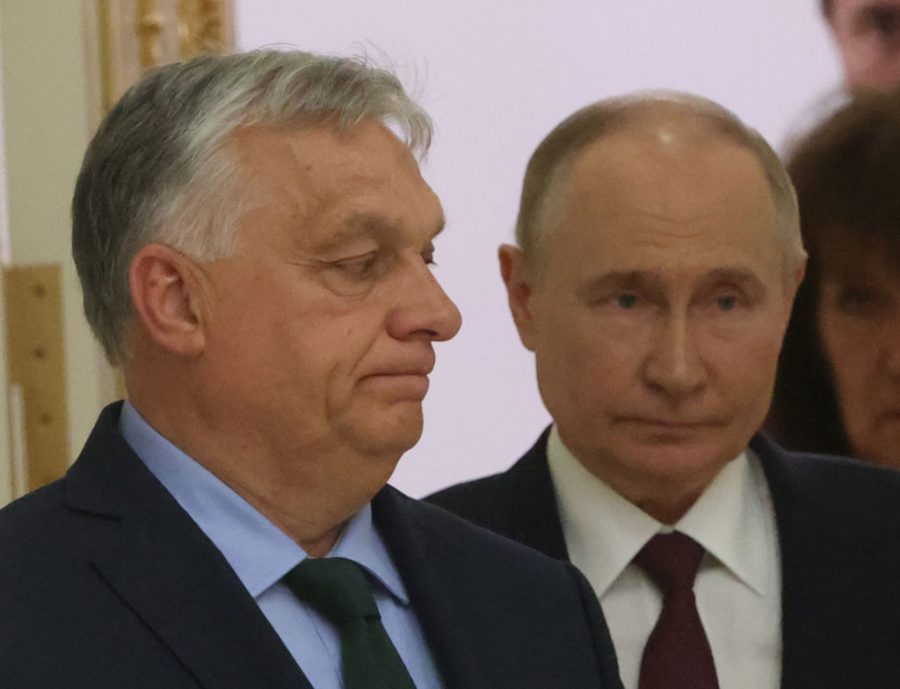
Péter Magyar’s landslide victory over Viktor Orbán is not just political earthquake for Hungary. It is Moscow’s worst result in the European Union since the war began.
Orbán served Russia in a way no overt ally could. He was never Putin’s puppet – he was something far more useful: a democratically elected, Brussels-based veto-wielder who could slow sanctions, obstruct aid to Ukraine, and dress it all up as principled neutrality. A leaked call recorded him telling Putin that Hungary was like a mouse to Russia’s lion. Leaked tapes of his foreign minister, Péter Szijjártó, conversing with Sergey Lavrov revealed the same cringing loyalty.
Yet Orbán always extracted payment for his services – cash from Brussels, energy exemptions, transit compensation – which meant Moscow could never rely on him fully. He was a brake on EU policy, not a stopper. Magyar’s arrival removes even that.
Orbán’s most tangible service to Russia was institutional. Hungary held a veto in the European Council, deployed repeatedly to slow sanctions extensions and block military aid to Kyiv via the European peace facility. Last month, three weeks before the election, they vetoed the 20th sanctions package and a €90 billion ($106 billion) EU loan to Ukraine, ostensibly over a dispute regarding the damaged Druzhba oil pipeline.
Hungary is important to Moscow primarily for energy and financial reasons
Now, Moscow will lose that brake. It will be important for Magyar to rebuild relations with Brussels, not least to access almost €20 billion ($24 billion) in various grants and funding that the EU froze in response to Orbán’s refusal to implement reforms and reverse his dismantling of Hungary’s democratic institutions. He won’t hinder EU policy on Ukraine and Russia in the way Orbán has. We should not expect a complete U-turn on Ukraine, given divisions in the Hungarian electorate and the country’s continued energy dependency on Russia, but Hungary’s permanent veto will come to an end.
The ideological damage to Russia is almost as significant. Orbán was living proof that illiberal democracy is sustainable inside the EU – a model Moscow has actively promoted. His fall shatters that narrative and sets an uncomfortable precedent for Russia’s other standard-bearers: those already in power, like Slovakia’s Fico; those with partial influence, as in the Czech Republic; and those with aspirations further west. Each is linked by nationalism and hostility to Brussels. Each will now have to reckon with what happened in Budapest.
The economic losses are real but more constrained. Hungary is important to Moscow primarily for energy and financial reasons. Magyar cannot simply cut those ties – some are locked in by contract, others by political reality.
Take gas. Gazprom and Hungary’s MVM Group signed contracts to deliver up to 272 billion cubic feet a year until 2036. At European prices, that is roughly $2.5 billion ($3 billion) annually – not critical to Russia, but vital to Gazprom, which has lost almost every other European buyer. The contracts are take-or-pay: walk away and Hungary faces years of arbitration and billions in penalties. Since Russian gas remains cheaper than alternative LNG, Magyar would struggle to explain higher energy bills to the voters who just put him in office. The gas contracts with Moscow will almost certainly survive.
Oil is more complicated and mostly already lost. Hungary has been the EU’s biggest buyer of Russian crude, taking around 10 million tons a year via the Druzhba pipeline. Druzhba has been out of action since January, damaged by a strike Ukraine attributes to Russia. Even if Ukraine fixes it as it had promised, the EU is already planning to shut the route by next year at the latest – a deadline Orbán fought and Magyar is unlikely to. Russia would, in theory, lose some $6 billion ($7.1 billion) a year in sales – but since the pipeline is already idle, the immediate loss compared to now is close to zero.
Also likely dead is Russia’s plan to sell a controlling stake in Serbia’s oil company NIS – currently held by US-sanctioned Gazprom Neft – to a consortium led by Hungary’s MOL. The consortium offered less than rival suitors, but for Moscow, it was never purely commercial. Russian Foreign Ministry spokeswoman Maria Zakharova called it a ‘strategic reformatting’, not a withdrawal: a way to keep Russian energy embedded in the Balkans, in new clothes, making it harder for Brussels to use sanctions as leverage against Serbia, or Russia for that matter. A new pro-EU government in Budapest dropping the deal would be the easiest possible demonstration of changed allegiances – costless to Hungarian consumers and painful to Moscow.
The Paks-2 nuclear plant, being built by Rosatom, is similarly immovable. Construction started formally in February; commissioning is not expected until 2033 at the earliest. The project costs €12.5 billion ($15 billion), of which €10 billion ($12 billion) was loaned by Russia. Walking away would mean repaying that loan plus penalties, plus a replacement would be needed for a plant aimed at providing the lion’s share of the country’s energy. No government could absorb those costs. Magyar may slow the expansion or halt new agreements with Rosatom, but the plant itself will almost certainly continue.
The financial channel is where Moscow’s losses could be sharpest. Hungary’s OTP Bank is the 20th largest bank in Russia and one of the few European-owned institutions that faces neither US sanctions nor European pressure, since Hungary is outside the eurozone. Under Orbán, OTP became a uniquely convenient channel for cross-border operations – so much so that when an Austrian bank, Raiffeisen’s Russian subsidiary, curtailed currency transfers in late 2024, OTP was briefly overwhelmed by the influx of Russian corporate clients. A Brussels-friendly government in Budapest would be unlikely to shield OTP from EU pressure. That channel, at least, looks vulnerable.
Russia is losing its most reliable brake on EU policy, its most useful institutional veto in the union, and its ideological showcase – all at once. The energy contracts will mostly survive, the nuclear plant will keep rising and the gas will probably keep flowing. But none of that is the point. Hungary was Russia’s foothold inside the EU: simultaneously a banking channel, an energy lifeline and a permanent spanner in the Brussels works. None of these functions will collapse overnight. But Orbán’s departure sets in motion a process that Moscow will find very hard to reverse.




Comments