
This is a fraught moment, perhaps the most dangerous since the end of the Cold War. Two major wars are being fought, one threatening European security, the other the world’s energy supply. In East Asia, China continues to threaten Taiwan, and North Korea is reportedly upgrading its military technology with Russian help.
Put simply, the bad guys are on the march, fighting for their regimes’ survival, their malign domestic projects, and as much regional domination as they can achieve.
Although the wars in Ukraine and Iran have remained largely separate, there have been several intersections recently and a gnawing fear they could merge into a global conflict. That grim possibility is still a longshot, but there is real danger because the coalitions fighting the two wars overlap.
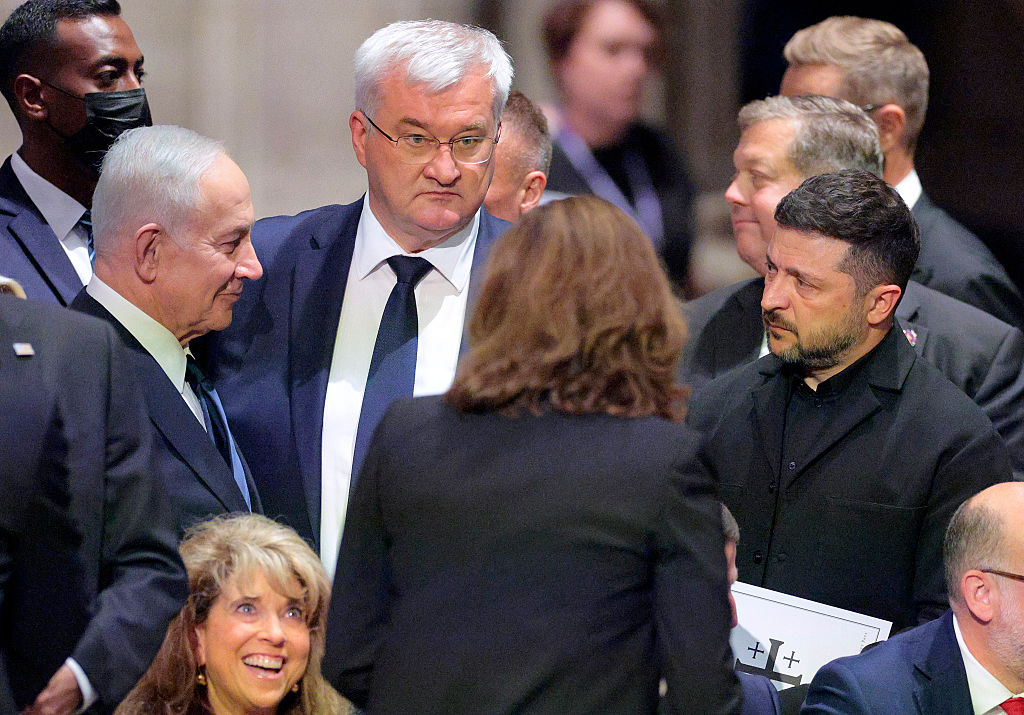
That connection was underscored Tuesday in Washington when President Trump met with Ukraine’s President Volodymyr Zelenskyy and Israel’s Prime Minister Bibi Netanyahu. It was underscored recently when Ukrainian drone experts traveled to the Persian Gulf to share their hard-won knowledge. And it was underscored again last week when Ukraine took out a Russian-Iranian shipment in the Caspian Sea. Iran would dearly love to hit back but is limited because any attack on Ukraine would likely need to cross over Türkiye, which would respond forcefully and has the military capability to do so.
The allies supporting Tehran and Moscow in their respective war have far fewer resources than their Western counterparts and are less technologically advanced, but they are far more unified. In the Ukraine War, Russia is backed by China, Iran, and North Korea. In the Iran war, the same countries line up the same way. The Islamic Regime is backed by Russia, China, and North Korea.
The West, by contrast, has formed different counter-coalitions in the two conflicts. The only common denominator is the United States. In Iran, America is fighting without help from its longtime partners in Europe and Asia, even though they, not the US, rely on oil and petrochemicals transiting the Strait of Hormuz. The Europeans have stood on the sidelines despite the looming danger of an Iranian nuclear arsenal atop missiles that could reach Berlin and Paris, all controlled by a fanatical regime.
In the war with Iran, America’s most important partner is not France, Germany, Britain, or Japan. It is Israel, though the Jewish state has stayed out of the recent fighting (presumably at Trump’s behest and because Iran has been deterred from attacking). The Gulf States joined the fighting recently after suffering Iranian strikes. The Iranian Revolutionary Guard Corps, which now controls the state, undoubtedly believed the attacks would force the Gulf States to cower and press the US for compromise. That strategy backfired. Most of those states are now pushing the US to go big and seek regime change, words that chill American politicians and voters after costly failures doing exactly that across the region.
“Stepping back and looking at the two conflicts, the danger is that neither war is likely to end with a stable, negotiated peace any time soon.”
The danger of “going big” in Iran is three-fold. The most immediate is that Iran will respond by attacking its enemies’ oil refineries, ports, and desalinization plants. If it does launch such attacks, it is likely to knock out many of them. There simply aren’t enough anti-missile defenses or good ways to counter swarms of cheap drones. If Iran does choose to attack those critical sites, then it loses the deterrent threat (that is, the threat it would destroy those assets if the war expands). With the deterrent threat gone, the US and Gulf States would have nothing more to lose by launching a major attack.
The second danger lies in the Iranian regime’s decentralized control, making it impossible to overthrow them by decapitation strikes. The US has now taken out two or more layers of Iranian leadership and still they fight on.
The third danger is one the US is all too familiar with: the difficulty of stabilizing and governing a defeated country. That project failed in Iraq and Afghanistan, and those bitter memories are why the Trump administration is so hesitant to mention “regime change.” Instead, the US administration has repeatedly said its goals are limited to reopening the Strait and ending Iran’s nuclear ambitions.
So far, the US has been unable to secure those goals, despite significantly degrading Iran’s military and hitting most of its nuclear facilities. The US is understandably reluctant to commit ground troops to finish the job. Military experts say air power alone won’t be enough.
Meanwhile, the Islamic Republic of Iran clings tenaciously to its nuclear ambitions and believes it can now control the Strait. If the regime clings to those goals – and it has shown every evidence that it will – then Trump’s stated goal of a negotiated solution is a pipe dream.
Why is Tehran so tenacious? Because the regime is controlled by fanatics and because they believe they can withstand the American bombing and financial sanctions, outlast the Americans, and win what has turned into a war of attrition.
If Tehran does manage to achieve its primary goals – survival as a regime, control of the Strait, and resumption of its nuclear program – it will dominate the Persian Gulf, humiliate the United States, and likely spark a regional nuclear arms race. Israel, which is directly threatened by a nuclear Iran, would undoubtedly move to prevent it from building a bomb. It would fight Iran, even without US help.
If the survival of Iran’s regime blocks a settlement there, a similar problem blocks one in Ukraine. How? Because Putin still controls his country, and he surely fears he would not survive a negotiated outcome. Since Ukraine will not cede any unconquered land, a hypothetical settlement would give Putin little to show for a war that has killed or maimed over a million soldiers, deformed the economy, and left ordinary Russians without heat for their homes or gas for their cars.
Slowly, slowly, the US has taken a larger role in the Ukraine fight. Washington was reluctant to act decisively when Russia launched its second unprovoked invasion (the first one, in 2014, seized Crimea and part of the Donbas). In February 2022, as Russia assembled its tanks on the border and seemed likely to capture Kyiv within days, President Biden offered Volodymyr Zelenskyy a ride out of the country. Zelenskyy famously refused and stayed to lead the fight. The Biden Administration grudgingly backed him but slow-rolled the military aid and put tight restrictions on Kyiv’s ability to respond to Russian attacks.
President Trump was even less supportive….until recently. Now, with Ukraine showing remarkable resilience, Trump has switched from his fruitless attempts to mollify Putin and has voiced open support for Ukraine. The US military and intelligence services were already giving Ukraine significant support, but that’s ramping up now. The financial sanctions are especially effective, and Treasury Secretary Scott Bessent has wielded them adroitly. America’s NATO allies, initially reluctant to back Ukraine, have been staunch allies for several years, offering both financial help and military equipment. The greatest assistance has come from countries closest to Russia and most endangered by its military expansion. In fact, Russia’s aggressiveness led both Finland and Sweden to join NATO.
Stepping back and looking at the two conflicts, the danger is that neither war is likely to end with a stable, negotiated peace any time soon. The war in Ukraine is likely to grind on, an intense war of attrition, a test of which side can endure pain longer.
The war in Iran is likely to escalate, perhaps very soon. Iran’s missile attack Tuesday night was an ominous sign. The next stage could involve a massive US bombing campaign across Iran’s interior, plus CIA support for groups seeking to topple the regime. Iran would concentrate on hitting refineries, ports, desalinization plants, and US bases across the region. If it attacks Israel, which it has avoided in the latest round of fighting, then the Israeli Air Force would focus on killing IRGC leadership and scientists involved in the nuclear program.
Beyond the death and destruction, escalation in Iran poses another danger. The continued closure of the Strait threatens a global recession.
Amid these mounting troubles, the only good news is that wars in Iran and Ukraine have not merged and China has not seized this moment of America’s preoccupation to attack Taiwan. Amid these hot wars, that’s a little cold comfort.



Comments