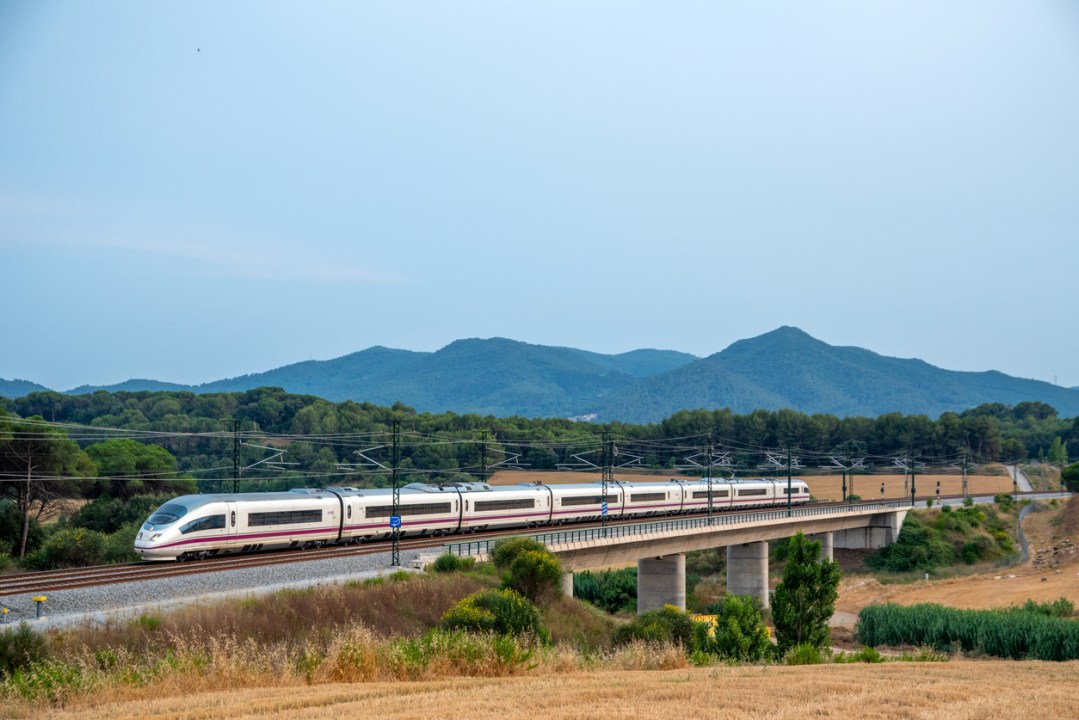
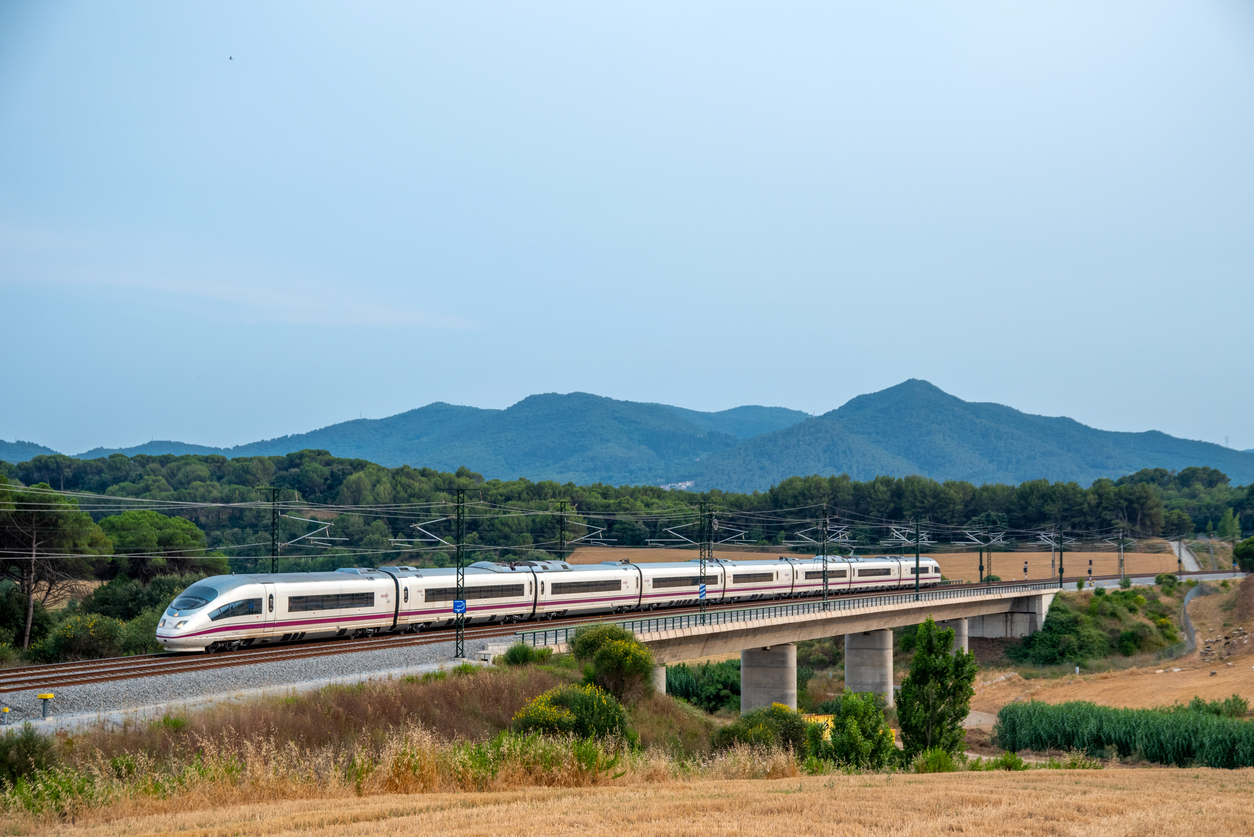
I am sitting in the nose of a high-speed AVE train from Madrid to Barcelona and the speedometer shoots up at an alarming rate. First 50 kmh… 100… then 150. It feels like we are on a rollercoaster. Soon we are travelling along the tracks at 300kmh (186 mph), while the countryside whizzes past in a blur.
The driver looks over at me and smiles. ‘Pretty good, eh?’ He’s right. This was the moment I fell in love with Spain’s bullet trains. From the 1990s onwards, these slick locomotives started to expand across Spain like a spider’s web. Now the country has the largest network in Europe – and the second largest in the world – stretching 3,900 km (2,460m) across this huge nation.
Low prices, plenty of trains and healthy competition from rival rail companies from France and Italy have meant the train network has been responsible for a mini social revolution of sorts by connecting pueblos perdidos (hick towns) in the back end of nowhere with the glamorous capital, Madrid, or other major cities like Barcelona, Valencia, Malaga or Seville.
Of course, after the tragic events of last week, when 45 people were killed in the rail collision in Amaduz, near Cordoba in southern Spain, and a driver lost his life in a separate crash near Barcelona, public confidence has been shaken in the country’s railways. Two smaller crashes, in which travellers suffered minor injuries, have only compounded worries that travelling by train is not safe.
A fracture in the rail appeared to have happened before the Amaduz crash, the Spanish rail accident investigating body CIAF said in a preliminary report published last week. In recent years, there have been no similar crashes with high fatality rates since 2013, when 79 people lost their lives near Santiago de Compostela in northern Spain. Safety checks are likely to be stringent from now on.
Nevertheless, my confidence in riding the bogey, as it were, is unshaken. My ticket is booked to travel next week from Madrid to Barcelona on the AVE (Spanish for bird), perhaps one of the busiest high-speed rail routes in Europe, after the London-Paris corridor and Amsterdam to Frankfurt line. In the wake of recent crashes, authorities may put a dampener on the train’s speed, but if all goes well, we will be racing along at a princely 350 kilometres per hour (217 mph).
Some may think me foolhardy, but the statistics bear me out. Other countries like Poland, Germany had the highest number of railway accidents in 2024, according to Eurostat figures. In terms of fatality rates per kilometre of track or per million inhabitants, countries like Greece and Slovakia, had higher rates among European countries in recent years.
Safety aside, what makes me such a fanboy of the Spanish railways has nothing to do with backing a greener form of travel or shunning the car or the plane because of the damage they do to the planet.
I am won over by how good they are in comparison to the shoddy British version. When I returned to London last weekend, travelling from Luton airport to north London by train would have been more expensive than taking an Uber – double the price in fact. And it would have taken one change and an hour-long trek for a journey which should take about 40 minutes. So, I shunned the train and grabbed an Uber.
This vignette tells the story of a railway system which is beset by problems, from the perennial engineering works, frequent strikes or to leaves on the line which seem to paralyze large swathes of the network despite the fact Britain is a rainy country which should be prepared for this kind of thing.
Then there is the cost. The HS2 railway line, which was announced more than 15 years ago as a high-speed connection between London, Leeds and Manchester, is the best example of the exorbitant sums heaped on a service which might be a good idea but has yet to materialize.
Now the curtailed line is on course to cost £100 billion, making it the most expensive strip of railway track per kilometre in the world. That despite the fact the new line, which is planned between London and just beyond Birmingham, is barely half the distance from the original version.
The average price of tickets is another story. Compare similar routes like the journey from London to Manchester, 200 miles (321km) to Madrid to Malaga, which is 258m (416km). Travellers in Britain pay between £29.50 and £45 for a single ticket while Spanish rail passengers pay an average of £7.80-£57. As a regular rail user in Spain, my experience is that it is possible to get a single train ticket from Madrid to Barcelona, roughly the same as journeying from London to Edinburgh, for between £9.30 and £41. The same journey in the UK might cost between £25 and £140.
Costs aside, gliding across the country in the comfort of the train takes some beating. There is easy access to Wi-Fi, plugs to charge your phone, little oppressive security at the station, and you can turn up within minutes to catch a train.
Compare that to the hassle of getting a plane; trekking to the airport, all that extra security and the logistics which await you at the other end to go from a remote airport to a city centre. So for me the (Spanish) trains keep a rolling.





Comments