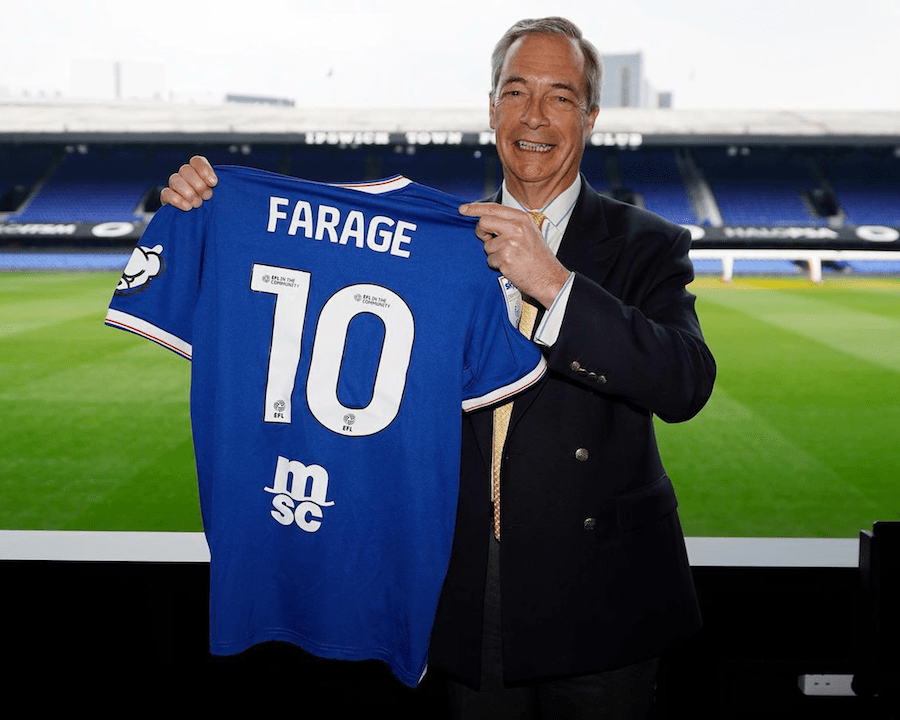
Nigel Farage’s social media posts from his visit to Ipswich Town’s football ground have caused exactly the sort of meltdown you’d expect. The Reform UK leader filmed himself inside the home dressing room at Portman Road, held up a replica shirt with the number 10 and his name on the back and quipped that he was in the mix for the manager’s job at the Championship club.
Cue howls of outrage online. Ipswich Town supporters have been particularly livid, describing the episode as ‘shameful’, ’embarrassing’ and ‘PR suicide for a family club’. Some have threatened to boycott the club shop or cancel their season tickets. The club felt obliged to issue a statement insisting it is ‘apolitical’.
I’m no fan of Farage, beyond a few reluctant sniggers when he says or does something amusing. But I’m also not keen on the rather fatuous mantra that always emerges when things like this happen: keep politics out of the game. You might as well demand that we keep the weather out of the sky – football is political and it always will be.
If you can’t have a good barney at the football, then where can you have one?
Consider the game’s recent past. The hooliganism and racism that scarred English football in the 1970s and 80s did not emerge from nowhere; they mirrored deeper social disorders. The callous treatment of Liverpool supporters after the Hillsborough disaster revealed attitudes that extended far beyond the terraces. Even the overrated ‘modernisation’ of the 1990s – cleaner stadiums, higher prices and a more sanitised spectacle – was no apolitical evolution occurring in a vacuum but a mirror image of the economic and political mood of the age.
Even today, regimes exploit football to improve their international image, using hosting rights or club ownership to obscure poor human rights records. Policing, ticket pricing, and stadium development all involve public policy.
Many clubs have been formed on political foundations as a result of population upheavals and migration. Some are linked to ethno-national and religious communities, political ideologies and parties. These are usually the clubs with the strongest identities: Celtic, Barcelona, FC St Pauli, Rangers.
Then there are the players themselves – global figures whose actions and words reach millions. To demand their silence is not to remove politics from football, but to enforce a particular kind of politics: one that favours the status quo. As the world goes to pot, silence is itself a political act.
Modern football has been drained of vitality. For all the videos of fans losing themselves in wild ‘limbs’ goal celebrations, there are countless images of spectators passively scrolling through their phones, barely engaged with the match unfolding before them. Stadiums, once cauldrons of noise, are subdued. Attempts to get chants going are met not with enthusiasm, but with awkward glances. My God, people actually wear half and half scarves.
The players have largely become media-trained to within an inch of their lives. They give post-match interviews which are so anodyne that they’re an insult to everyone involved. England players have told the Professional Football Association that they’re worried about this summer’s World Cup in America because they might be asked to comment on political issues like Donald Trump’s immigration crackdowns, the militarisation of policing or the war in Iran. Memories of the rows around the Qatar World Cup linger on.
I can understand why players are keen to avoid speaking out. When the likes of Gary Neville, Gary Lineker and Marcus Rashford shared their thoughts about political issues, they were pounced on by people who said they should ‘keep politics out of football’ but actually meant ‘keep politics I disagree with out of football’.
It’s the same with political gestures: some of those who cheered as English clubs expressed support for the people of Ukraine then shrieked with horror if anyone in the game expressed concern for the civilians of Gaza. Like it or not, poppies are as political as rainbow laces.
People say ‘the game’s gone’. Well, the edge certainly has and trying to keep politics away from football will only make it more of a yawn. If you can’t have a good barney at the football, then where can you have one? So maybe we need more politics in the game, to inject a bit of fire into it again. It’s no coincidence that the two most political clubs in Britain – Celtic and Rangers – also have the most passionate fan bases and thunderous matches.
So, by all means, let Farage visit Ipswich. Let supporters boo national anthems and let players campaign on issues they believe in. Then let’s argue about it, without the pretence that football exists in some hermetically sealed world. It does not, and never has. And if recognising that makes the beautiful game a little uglier, it may also make it rather more alive.



Comments