

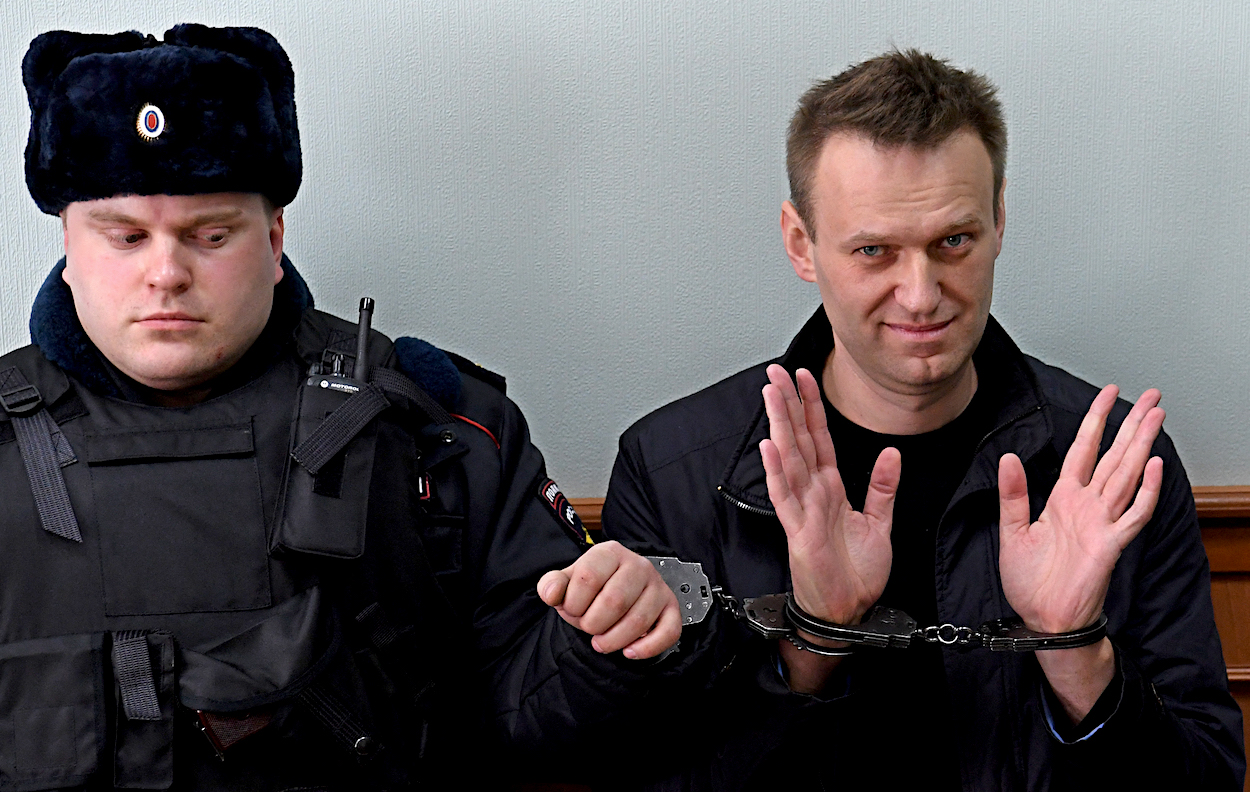
When leading Russian opposition figure Alexei Navalny died two years ago, the only real question was not whodunnit, but howdunnit?
His widow, Yulia Navalnaya, quickly blamed poison and said that his partisans had taken tissue samples from his corpse for examination. Yesterday, the UK, France, Germany, Sweden and the Netherlands announced that a combined intelligence operation had demonstrated that he was killed with epibatidine, a nerve toxin only found on the skin of Ecuadorian dart frogs.

The announcement was followed by the inevitable stream of (not always unjustified) skepticism, trollish derision, and official denial. To be sure, making the announcement at the Munich Security Conference does highlight the degree to which this was being done as a political gesture, an attempt to shore up an anti-Putin alliance that has recently shown a degree of weariness and disharmony. The fact that the Americans were not also on the platform along with five of the more hawkish European nations can also be considered a sign of the times.
For all that, there is no specific reason to doubt the claim. The truth is that the only real question had always been whether he had been killed directly with poison, or indirectly, as a man whose system was already compromised by exposure to the nerve agent Novichok in a previous attempted assassination was unlikely to survive the notorious “Polar Wolf” Arctic prison camp.
The allegations also highlight a particular Russian bent towards the use of poison. Of course, they are by no means unique in using this method of murder: from the Borgias of Renaissance Italy to the CIA’s various attempts to kill Fidel Castro with everything from a lethal milkshake to botulinum-laced cigars, poison has long been part of the assassin’s toolkit. Nor is Moscow above using gun, bomb or ice pick when circumstances dictate.
Nonetheless, poison does thread through Russian history as far back as the chronicles recount. Prince Dmitry Shemyaka was poisoned in 1453, during the Muscovite War of Succession. Tsar Ivan the Terrible was (probably rightly) convinced that his mother Elena Glinskaya was poisoned by the boyar Shuisky family, who wanted to usurp her regency in 1538. The wheel turned when Prince Mikhail Skopin-Shuisky appears to have been poisoned by in 1610, although cyanide seems not to have been enough to kill Rasputin in 1916.
In Soviet times, this took institutional form when, in 1926, the state established a specialized poison laboratory. Since then, it has gone through a variety of names – Laboratory No. 12, Laboratory X, and now Scientific Research Institute No. 2, or NII-2 – but it has throughout often simply been known as Kamera, the Chamber. Its role was to create remedies and antidotes, but above all, to explore new lethal agents for the use of the secret services, and at the height of the Stalini era, even carried out its tests on Gulag prisoners.
This Chamber of Lethal Secrets has been behind a whole series of infamous incidents, from the murder of Ukrainian nationalist Stefan Bandera with cyanide in 1959 and Bulgarian dissident Georgy Markov in London in 1978, injected with a pellet bearing ricin, to the 2006 poisoning of defector Alexander Litvinenko in London with radioactive Polonium-210 and the use of Novichok against the Skripals in 2018 – and Navalny himself in 2020.
Why use exotic and often expensive poisons (the Polonium used to kill Litvinenko cost more than £7 million) when a bullet, a knife or a judicious push in front of a train might do the job just as well?
This performative cruelty also extends to the method
Sometimes, the answer is likely ambiguity and deniability. Foreign Ministry spokeswoman Maria Zakharova has already waved away the claims about Navalny, saying “Once there are test results, once there are the formulas for the substances, then there will be a comment.” In other words: prove it.
Yet this is often deniability with a twist. Using agents which can be tracked to the Chamber, but without the quite literal smoking gun, allows Moscow to have the best of both worlds. It can deny its role, arguing quite truthfully that it would have been possible for the CIA, the Mafia, or whoever else to have committed the deed, seeking to put blame on the Russians. Yet it is a denial with a sly wink: you know we did it really, and we don’t care that you know. You can’t prove it, and you can’t really do anything about it.
This performative cruelty also extends to the method. Poisons rarely kill instantly, let alone kindly. The sight of Litvinenko wasting away over 22 days before succumbing, or of Navalny screaming in agony on a Moscow-bound plane after his poisoning in 2020 speak to the theater of assassination. The aim was not just to kill one man, but to terrify many more. Navalny refused to be cowed and fatefully returned to Russia after his recovery in Germany, but after Litvinenko’s death, the expat and émigré “Londongrad” set became a great deal more cautious and subdued.
Poison is, after all, not just a means of murder, but an instrument of terror.




Comments