
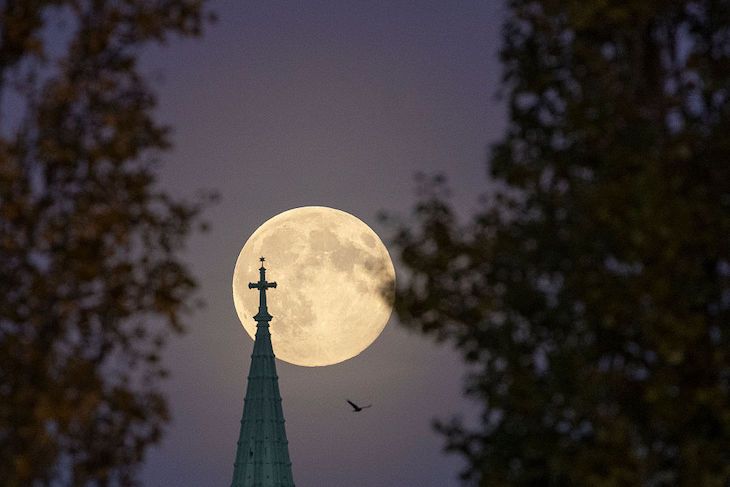
Step outside this Sunday evening, clouds permitting, and you should see a brilliant, nearly full moon climbing into the eastern sky. By Tuesday, it will swell into the ‘Super Beaver Moon’. It’s actually the same old moon that has lit the night sky since before life appeared on Earth. However, the moon’s orbit is not circular, and this full moon will be closer, and hence brighter, than most.
Today’s space race concerns rather more ambitious objectives
The supermoon looks particularly large when it is low in the sky; that is an optical illusion. If you hold a ruler at arm’s length, the diameter of the rising full moon will measure about a quarter of an inch – depending on the length of your arm. It will be the same quarter inch a few hours later when the moon is high in the sky. If you don’t believe me, you know what to do. Full moons in previous months that failed in the super stakes were further away from us and hence would have measured slightly less against the ruler.
The beaver bit, incidentally, just means November. In years gone by, North American trappers would secure warm, thick beaver pelts in the late autumn before the harsh winter closed in on them.
Until the invention of the telescope in 1608, the moon was the only object in the night sky with blemishes. Our ancestors were confident that it was closer than the sun or any of the planets and they supposed that it had picked up some of our imperfections. In the seventeenth century, those dark patches on the surface were catalogued as maria, or seas. Early astronomers believed that they were full of water; however, as telescopes improved, those misconceptions evaporated. They are dry plains filled with ancient lava flows that reflect less light than their surroundings.

Those ideas were confirmed in 1969 when Neil Armstrong and Buzz Aldrin visited. In total, six Apollo spacecraft landed on the moon, and twelve astronauts took a wander. One played golf – Alan Shepard secreted a six-iron and two golf balls onto Apollo 14 – while six others took to their moon buggies. The last moonwalkers came home in 1972; four are still alive in November 2026. Aldrin, David Scott, Charlie Duke and Harrison Schmitt are all into their 90s but live to tell the tale.
The goal of Apollo was exploration. The next visitors to the moon, however, will be less interested in raising flags and leaving footprints than fencing off territory and securing resources. Today’s space race concerns rather more ambitious objectives. Following April’s triumphant Artemis 2 mission when Reid Wiseman, Victor Glover, Christina Koch and Jeremy Hansen swung round the back of the moon, our half-century absence from the moon is over. The United States has plans for Artemis 4 to land on the moon early in 2028.
Like the 1960s, there is competition, but this time it comes from China. The Chinese have already landed robotic spacecraft on the moon and successfully returned samples of moon rock to Earth. The first crewed landing is planned for 2029 or 2030. Both the US and China have their eyes on building permanent moon bases, and that will require minerals and – equally importantly – water. Broken down into hydrogen and oxygen it is rocket fuel, literally. Lifting large volumes of water from Earth to the moon is prohibitively expensive, so both countries have been searching for it on the moon. They found it. Near the moon’s south pole, significant quantities of water ice lie protected from sunlight in permanently shadowed craters. The race for the south pole is on, and this time it’s on the moon.
Tonight, the moon will rise in the east as it has always done, home to nobody and – for the time being at least – property of all
The years following will be a stern test for diplomats as well as engineers. The 1967 Outer Space Treaty loftily declared the moon to be a ‘province of all mankind’. Parties to the treaty (which include the US and China, along with Russia, the UK and most other countries) are bound to carry out their explorations ‘for the benefit and in the interests of all countries’, and not to claim territory for themselves. But when does a fence around an engineering works – perhaps ‘for safety’ – become a de facto international frontier? And when does an engineering works become a military facility? Will the United Nations ever be able to send in inspectors to check? Those questions are for the future, but that future is almost upon us.
Tonight, though, the moon will rise in the east as it has always done, home to nobody and – for the time being at least – property of all. It is the same moon that Henry VIII, William of Normandy, Caesar Augustus and the builders of Stonehenge will have observed. The size will be the same (give or take talk of supermoons), the phases will be the same and the markings the same. You wouldn’t have been able to see the men on the moon, even in 1969 – they were far too small at that distance – but you might be able to fashion those markings into the face of the man in the moon. Try it tonight and ask yourself whether those people from history and others might have done the same thing.






Comments