
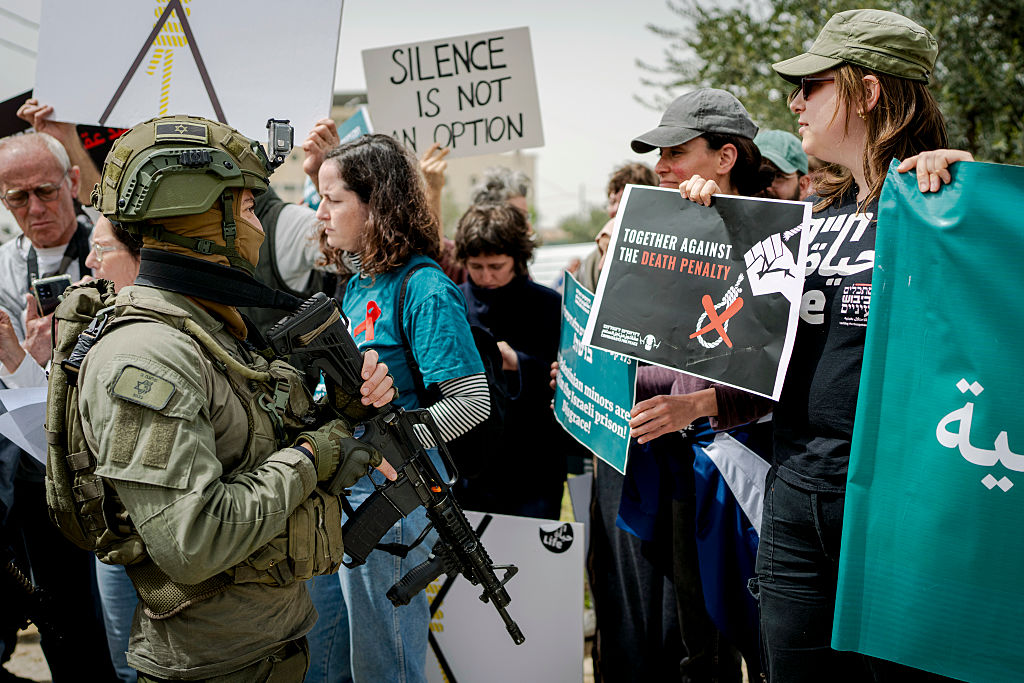
A state deciding when it may end a human life outside war is always crossing a line, even when it insists it is doing so for humane reasons. Two democracies are now approaching that line from opposite directions.
Israeli hostages are taken because Israel places such value on individual lives. Prisoners are released because Israeli society will accept painful compromises to recover its own
In Britain, MPs are moving towards legalising euthanasia. Doctors, families, and patients describe the slow cruelty of terminal illness and the desire to end it on one’s own terms. The state is asked to permit death as an act of compassion. In Israel, the argument runs in the opposite direction. There, the question is whether the state should impose death as punishment for those who have carried out acts of terrorism. The justification lies not in relieving suffering, but in preventing it: stopping future violence, disrupting hostage-taking, imposing finality on a conflict that rarely permits it.
Both societies claim, in their own way, to be acting humanely. That is where the discomfort begins. The same value is being used to justify two entirely different relationships between the state and death. One seeks to spare individuals from prolonged suffering. The other seeks to prevent further killing by those already responsible for it. The underlying pressures could hardly be more different.
Britain’s debate emerges from a century largely free of internal violence on the scale Israel has experienced. Its moral focus is on the end of life, when death comes by natural cause. Israel’s emerges from decades in which violent death arrives abruptly, often deliberately targeted at civilians, and is followed by cycles of capture, imprisonment and exchange. Its focus is on preventing the next killing, the next abduction, the next negotiation.

The new Israeli death penalty has been widely interpreted, particularly abroad, as evidence of a government embracing brutality. That reading is too simple. In legal terms, the change is narrower than the reaction suggests. Capital punishment has long existed in Israeli law but has not been used since the 1962 execution of Adolf Eichmann. The new legislation does not compel prosecutors or judges to use the death penalty, introduces no new evidentiary framework, and does not dismantle the system of imprisonment or prisoner exchange. Its reach is uneven, leaving out some of the most recent perpetrators of mass violence, including members of Hamas’s Nukhba forces who carried out the October 7 attacks. But without doubt, the headlines are justifiably furious.
The reaction has been intense, not only internationally but within Israel itself. That is because the law matters less for what it immediately does than for what it signals. It disturbs a long-standing equilibrium in which the death penalty existed but remained effectively dormant. It marks a point at which a society that had largely refused to use this power is now willing to consider it.
The arguments for and against the law are well-rehearsed. Less examined is how that shift became possible at all. What kind of pressure produces a demand for finality in punishment? The answer lies in a pattern that has defined Israeli life for decades. Violence is followed by arrest, trial, imprisonment and, often, by exchange. Israeli hostages are taken because Israel places such value on individual lives. Prisoners are released because Israeli society will accept painful compromises to recover its own.
I was reminded of this painful tension during a conversation with an Israeli-British woman who had been stabbed multiple times by a Palestinian attacker and left for dead. She survived. Post October 7th, her attacker was released as part of a deal, having been paid a stipend by the Palestinian Authority since his imprisonment. She described her anger at his release, but also her relief that hostages would return. Both feelings were real.
One of the death penalty law’s early drivers, the parliamentarian Limor Son Har-Melech, came to this position after her husband was killed in a terrorist attack during the second intifada, in which she herself was seriously wounded while pregnant. She was forced to give birth prematurely, while a perpetrator linked to the attack was eventually released in one of the biggest prisoner blackmail releases ever carried out.
That is the moral terrain in which this law sits. Over time, experiences like this produce a particular kind of pressure. It is not simply a desire for revenge. It is a refusal to accept that the same sequence will continue indefinitely, that those responsible for killings will pass through prison and, in some cases, return to it again.
The logic is stark: a dead perpetrator cannot be exchanged. It is a cold argument, but not an abstract one. And yet in reaching for that kind of finality, something shifts. A state built on a deep respect for life begins, however reluctantly, to redraw the boundaries of that principle in order to defend it.
The reaction beyond Israel only sharpens the tension. Saudi Arabia has signed a joint statement with regional partners condemning the change, even as it carried out more than 350 executions itself in 2025, many for non-violent crimes. Different societies arrive at the point of state-sanctioned killing through different pressures. But the threshold, once approached, carries the same weight.
Britain’s debate asks whether the state may help end a life to relieve suffering. Israel’s asks whether the state may take a life to prevent it. Both may claim humanity. But neither can escape the weight of what is being authorised.



Comments