
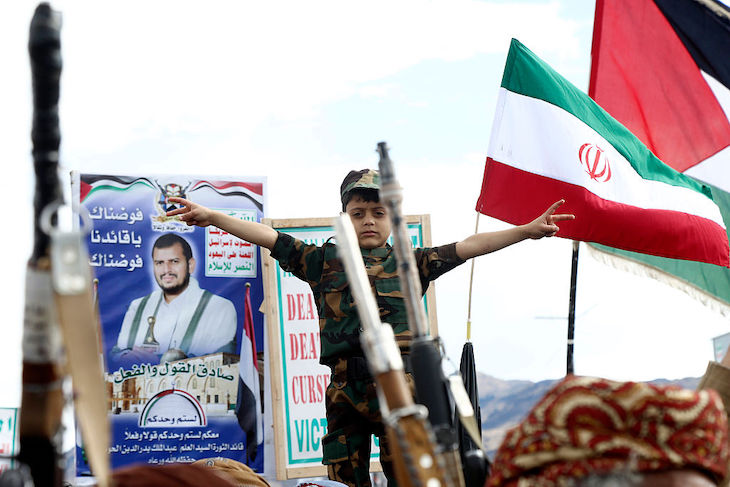
Houthi forces in Yemen have confirmed that they launched a barrage of ballistic missiles toward southern Israel overnight, with the Eilat region identified as the primary target. Their military spokesperson, Yahya Saree, stated that the missiles were aimed at sensitive Israeli military installations. Israeli air defence systems intercepted all incoming projectiles. No casualties were reported, and no physical damage was sustained.
The launch comes as Iran faces sustained pressure on its infrastructure from American and Israeli operations
The strike marks the first direct attempt by the Houthis to hit Israeli territory during the current phase of United States and Israeli military operations against Iran. Saree described the attack as the beginning of a new operational phase, coupled with a commitment to continue strikes until what he called “aggression stops on all fronts of the resistance.”
Intelligence assessments point toward a calculated move shaped within Iran’s wider regional framework. The launch comes as Iran faces sustained pressure on its infrastructure from American and Israeli operations. Until now, the Houthis had held back from striking Israel directly, largely due to limited missile stockpiles. Their entry at this moment suggests encouragement, or more likely specific direction, from Tehran.
The strike serves several purposes within Iran’s asymmetric doctrine. It complicates American military positioning in the Red Sea corridor. Any U.S. naval movement toward Iranian targets requires transit through the Suez Canal, the Red Sea, and the Bab el-Mandeb Strait. Passage through these exposed waterways carries real risk. They are within reach of attack. This is a vulnerability Iran seeks to exploit. Intelligence assessments suggest the Houthis possess sufficient capabilities to threaten this critical maritime passage, including anti-ship missiles, drone swarms, and explosive-laden speedboats, with the additional potential for naval mining operations that could severely disrupt shipping lanes.
Current U.S. naval positioning has opened up a window of opportunity which Iran hopes to use to create a strategic challenge. The USS Gerald Ford remains unavailable due to maintenance in Crete, while the USS George H.W. Bush and its accompanying strike group are en route to the Mediterranean. Any substantial American operation against Iran would likely require concentrated naval power in the Persian Gulf region, necessitating passage through Houthi-controlled waters. Even positioning forces in the northern Red Sea near Saudi Arabia fails to eliminate this threat, as Houthi ballistic missiles are assessed to maintain sufficient range to reach those areas, while the thousand-kilometre distance to the Strait of Hormuz limits operational flexibility.
The missile launch operates, then, as a deterrence signal directed at Washington’s planning cycle. It demonstrates both capability and intent. By demonstrating their active capability and willingness to engage, the Houthis are communicating Iran’s ability to maintain pressure across multiple fronts simultaneously. Even when defence systems like Israel’s Arrow and David’s Sling successfully neutralise incoming threats, the attacks achieve strategic disruption by forcing Israel to maintain heightened alert levels, divert resources across vast geographic areas, and issue civilian shelter warnings. Just as Israel and the U.S. have pre-planned, phased levels of attack, and also the ability and agility to react to new circumstances, so too do the Iranians through the calculated activation of their regional proxies.
The broader regional implications extend to critical energy infrastructure that amplifies the Red Sea’s strategic importance. Saudi Arabia’s east-west pipeline, carrying approximately two million barrels of oil daily to the Red Sea port of Yanbu, provides Europe with crucial energy supplies and serves as an alternative route should Iran continue its Strait of Hormuz closures. This infrastructure interdependency elevates every Red Sea incident into a potential energy security crisis. The Houthis’ strategic leverage is thus magnified far beyond their actual military capabilities.
The Houthis’ strategic leverage is thus magnified far beyond their actual military capabilities
If Israel responds with direct strikes against Houthi targets, to protect both Israeli territory and American naval assets, it would be formally opening up another front in an already multi-dimensional conflict. Of course, Israeli military planners have long prepared for this contingency. But their response calculations must accommodate not only Israel’s capability to respond, but also managing escalatory dynamics across simultaneous theatres while maintaining operational coherence.
The attack demonstrates the enduring effectiveness of Iran’s asymmetric deterrence strategies, even when specific tactical objectives appear to have failed. Despite Israel’s successful interceptions, the Houthis have achieved their primary goal of disrupting enemy operational planning and have demonstrated resilience after previous degradation campaigns. Historical patterns suggest that while American and Israeli strikes have temporarily reduced Houthi capabilities, the group consistently adapts, rebuilds, and resumes operations using increasingly sophisticated tactics.
This may be more than a one-off, and could signal a return to the concerning patterns observed between 2023 and 2025, when Houthi activities severely disrupted Red Sea shipping routes, creating global economic ripple effects. As Iran faces direct pressure, its proxy network’s activation serves both as strategic messaging and practical force multiplication, transforming regional geography into a complex web of interlocking vulnerabilities that complicate any comprehensive resolution to the broader conflict.
America and Israel have doubtless prepared for this eventuality. But so, too, have the Iranians. There will be more such “surprises’ to come.






Comments