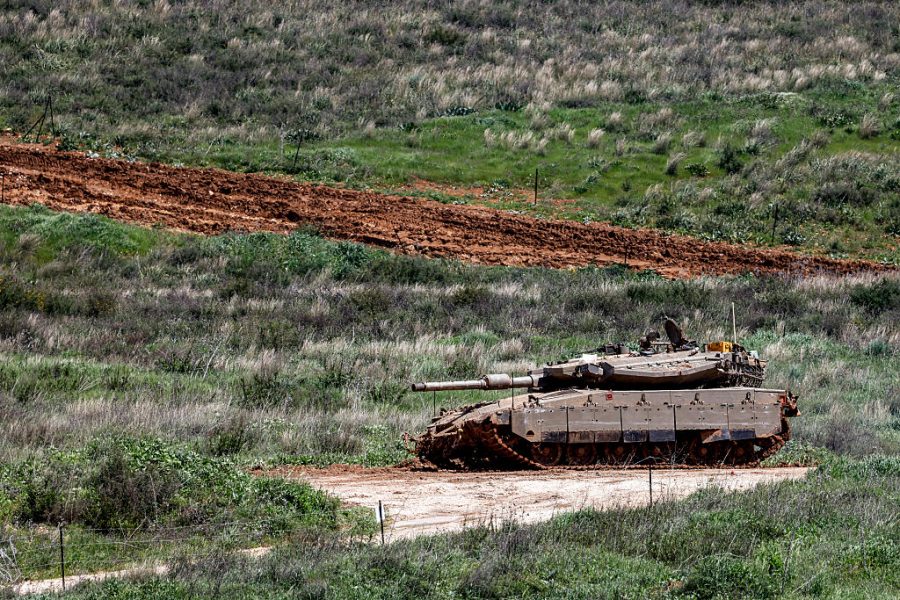
IDF troops have continued to push further into southern Lebanon this week, encountering determined but not particularly effectual resistance from Hezbollah. But while the Iranian proxy group appears unable to prevent the movement of the IDF on the ground in Lebanon, it is succeeding in launching large amounts of ordnance at Israel from further north. 600 projectiles were launched at Israel over a 24 hour period between Wednesday and Thursday. There was only one fatality thanks to Israel’s air defences and drills.
On the other side, the Lebanese government has reported over 1,000 dead. It doesn’t differentiate between civilian and Hezbollah casualties. Israel says it has killed around 700 Hezbollah fighters. A number of prisoners from the Shia Islamist group have also been taken. Four IDF soldiers so far have been killed in the operation.
The fighting in Lebanon constitutes one front in the ongoing region-wide war between Israel and Iran. This war overlaps with the US-Iran contest but is not identical to it. For the US, the de facto Iranian seizure of the Strait of Hormuz and whether and how this will be reversed now looms as the central issue of the war. The Trump administration appears to want to ‘declare victory and leave’, wrapping up the engagement in advance of the President’s scheduled meeting with Chinese leader Xi Jinping on 14 May.
In the cases of Gaza and Lebanon, the threat to Israel is from Iran-supported ‘muqawama’ militias
The current dilemma facing the US is that there is no way to credibly declare victory if the Iranians are still deciding what can and cannot pass through Hormuz. But changing that situation risks embroilment in a longer and costlier conflict that the administration doesn’t want.
Israel’s calculus is different. Ultimately, Islamist Iran’s enmity toward Washington and Jerusalem derives from the same root. Namely, the determination that Iran’s destiny is to rise to a hegemonic position in the Middle East, replacing what Tehran regards as a faltering, declining US dominance. The implication of this for the US over the last half century has been that it has a large, powerful, determined rival in the mid-East determined to frustrate its plans and act against its interests. Israel, however, views Iran’s ambition as that of a powerful regional actor which has been and remains actively committed to bringing about its destruction. Tehran has elected over the past decades to pursue this openly-stated goal through an innovative and sophisticated strategy which seeks to nullify Israel’s conventional advantage.

This strategy, which the Iranian regime calls ‘muqawama’ (resistance), has taken the form of seeking to enter areas close to and adjoining Israel and establishing and supporting political-military organisations in these areas. Their aim is to subject the Jewish state to a long war combining conventional and asymmetric elements and expected to result in Israel’s erosion, decline and eventual collapse.
Lebanon was ground zero for this strategy. Hezbollah was the prototype Iranian proxy militia. Its rise to a dominant position in Lebanon was the first great success of the Iranian strategy (later followed by comparable success in the Palestinian, Iraqi, Yemeni and for a while also the Syrian arenas). From Israel’s point of view, the war of the last two years has had the advantage of drawing Iran out from its formerly preferred behind-the-scenes role in this strategy.
Twenty years ago, for those who remember, mainstream punditry would take issue with those who tried to make the point that Lebanese Hezbollah was an Iranian creation and proxy. The local roots and supposed local loyalties of the organisation would be pointed out. Few (outside Lebanon or within it) would seek to make such a case today. Since its decision to enter the war in support of Hamas on 8 October 2023, and then again in support of its Tehran masters on 4 March this year, Hezbollah’s primary function as an instrument of Iranian regime regional strategy is plain and undeniable.
But while clarity is good, it doesn’t solve the problem. So what is Israel trying to achieve in its current offensive into southern Lebanon? According to defence minister Israel Katz, Jerusalem intends to establish a ‘security zone up to the Litani’ and to control the remaining bridges over this river (the IDF has already demolished five of these). A statement by prime minister Benjamin Netanyahu on Wednesday confirmed the Israeli goal as:
Expanding this security strip to keep the threat of anti-tank weapons away from our towns and our territory…We are simply creating a larger buffer zone.
It remains an open question as to whether the IDF will indeed push all the way to the river, which would leave Israel in control of around 8 per cent of the territory of Lebanon. Some observers expect Israel to stop some way short of that while de facto controlling the remaining area through domination of the airspace.
But the logic is clear, and it mirrors Israeli actions on other borders, in Gaza and Syria. Where no available partner exists for the negotiation of quiet borders, Israel will establish a physical barrier between its civilian population and the threat on the other side. In the cases of Gaza and Lebanon, the threat is Iran-supported ‘muqawama’ militias. In the less clear Syrian case, the potential threat is the emergent Sunni Islamist regime of president Ahmed Sharaa.
This ‘buffer zone’ strategy doesn’t address the core issue, of course. The Iranian strategy, with its accompanying nuclear and ballistic missile components, will continue for as long as the Islamic regime in Tehran exists. The purpose of Israel’s Lebanon incursion and the parallel efforts in Gaza and Syria are to make daily life and, therefore, Israel’s continued development possible, even in the context of the continued existence of this regime.
As may be seen from Hezbollah’s continued bombardment of Israel from further north, the establishment of buffer zones also doesn’t address even the immediate threat in its entirety. It does, however, have the virtue of keeping the enemy at a safe distance from Israeli civilian communities. That’s what it’s for.
Notably, there is a larger diplomatic context in Lebanon because of the clear signals given by the Lebanese government of president Joseph Aoun and prime minister Nawaf Salam that they want Hezbollah to disarm. Contact between Israel and the Beirut government is under way. From this point of view, an optimist might regard the emergent Israeli buffer zone as an intended tool of pressure on Beirut to enforce its own preference. Nevertheless, the greater military strength of Hezbollah when compared to the Lebanese Armed Forces (LAF) and the large Shia component in the latter force should be borne in mind.
Few in Jerusalem believe that the Beirut government either can or will act to disarm its unwanted Shia Islamist occupant. For as long as this remains the case, Israel will act as it deems necessary.






Comments