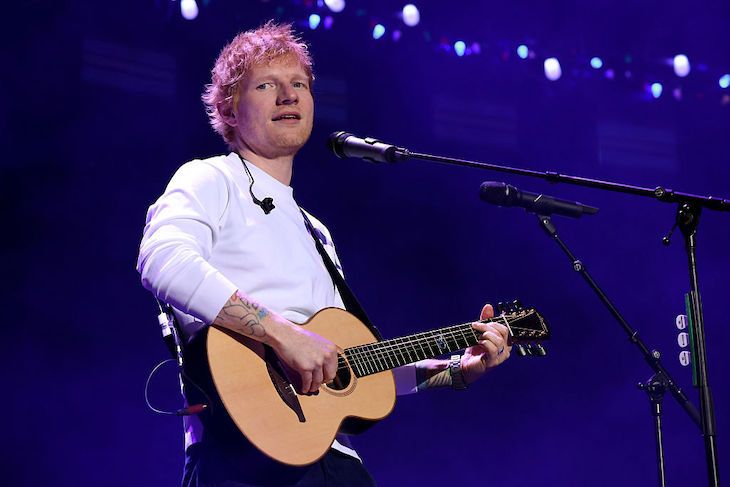
Until the past few days, no one has either known or cared what Ed Sheeran thinks about Israel. More to the point, Sheeran, who is a musician, hasn’t wanted anyone to know or care. He wants to sing his songs and bring pleasure to people. And that’s it.
That changed when the support act on his latest tour, a rapper known as Macklemore, decided to use his platform to chant ‘Free Palestine’ at the audience. Macklemore was dropped by the producers from the rest of the tour and Sheeran found himself at the centre of a global firestorm, with the Free Palestine brigade demanding that he, too, express his support.
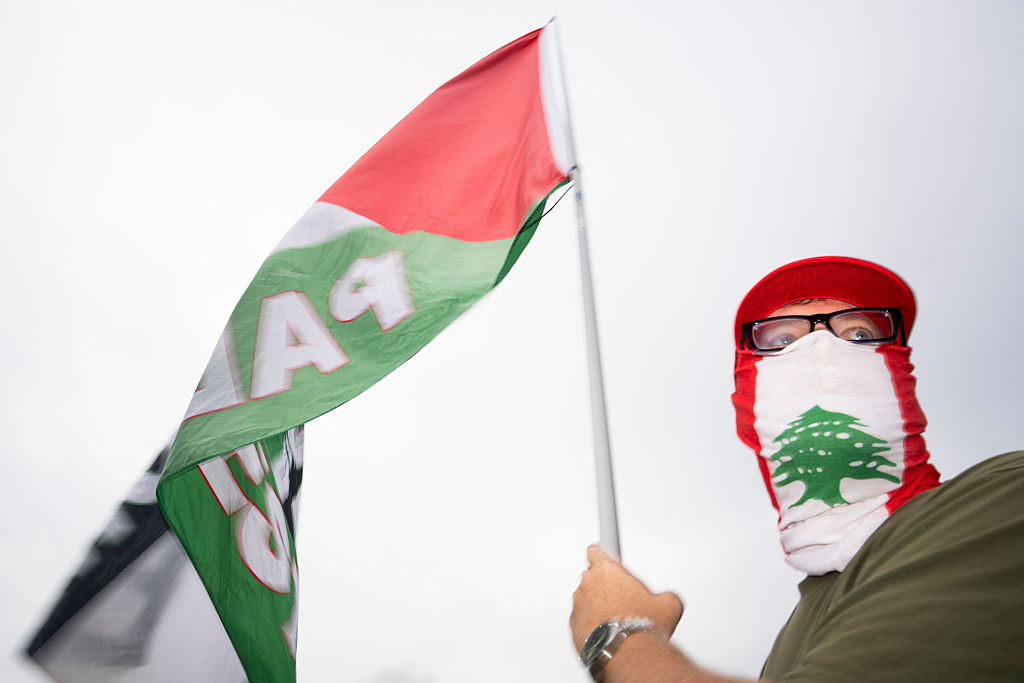
Sheeran initially said nothing in response. He could have simply carried on in that vein. It is one of the maladies of Palestinianism that adherents believe the world is binary: either you view everything through the lens of Palestine or you are evil – complicit in genocide, as they put it. The idea that you can be simply a singer who keeps his own views to himself is anathema to them. Silence is complicity.
For whatever reason, Sheeran decided that he had to address the issue and he began Saturday’s concert in Philadelphia with an obviously prepared form of words. For someone who is not political, who is not used to speaking about controversial issues and who didn’t wish to be involved in debates around Israel and Palestine, one has to say it was a remarkably well crafted speech.
“I don’t want to disappoint fans, and I’ve never wanted to be an activist musician,” he began, “but this has put me in the middle of an important and passionate argument about freedom of speech and the most complex political issue on the planet.”
Sheeran said he has tried throughout his career to avoid becoming a “political commentator” and that he wants his music to be “about unity, not division”. Platitudinous, perhaps. But surely a perfectly reasonable sentiment for a musician to express.
Then he addressed the core of the controversy: “This is a humanitarian issue, and I cannot hide how I feel about it anymore. What happened in Israel and at the Nova music festival on October 7 was horrific and compounded centuries of Jewish pain. What is happening in Gaza is catastrophic and unjustifiable and disproportionate. My heart has been broken by the scale of devastation and loss of civilians’ lives, children’s lives.”
As it happens, I disagree with him in his view of Gaza; I do not believe Israel’s actions have been disproportionate. But well-intentioned people can disagree on this, and Sheeran’s is an understandable and rational position for someone to take.
More to the point, however, Sheeran explicitly placed what has happened in Gaza in the context of the Hamas massacre on October 7 2023. That is the only understandable and rational position to take. If you only focus on Gaza – as many (most?) of his fellow artists who have spoken on this have done – then you provide a warped account and seek to push people to a warped understanding of reality. Which is, of course, exactly what Palestinianism seeks to do. So Sheeran is due great credit for his words.
But even when someone like Sheeran seeks to be balanced and clear-sighted, the obstacles to that balance and clear-sightedness being properly conveyed are immense. And one of the biggest of those obstacles is the BBC.
The BBC’s report of Sheeran’s comment in its flagship Radio 4 Sunday news programme, Broadcasting House, chose to omit half of his words. If you have been following the BBC’s coverage of Gaza, it will not surprise you which half it left out. Yes, it omitted mention of his condemnation of what happened on October 7, with its correspondent telling listeners only that he “clarified where he stood on the situation in Gaza”, followed by a recording of Sheeran saying: “What is happening in Gaza is catastrophic, unjustifiable, and disproportionate. My heart has been broken by the scale of devastation and loss of civilian lives.” And that was it. In the extract of the recording that you can listen to below, there is no mention of October 7 at all.
Imagine if the edit had been the other way round, and the BBC had reported his condemnation of the October 7 massacre but not his words about Gaza. We would never hear the end of it; I wouldn’t be surprised if the Director General had already been forced to resign.
This is, of course, typical of the way the BBC operates. But more widely, it is typical of the way the entire issue is framed.
Look, for example, at the spectacle last week when Gillian Anderson recorded a video appeal for aid to Sudan, which is on any definition the worst humanitarian crisis on the planet. She made no mention of Gaza, and has thus been monstered by the Free Palestine brigade as a stooge of the Zionists.
Palestinianism means that everything, everywhere must be viewed through the prism of Gaza. And, for the BBC, that means editing an even-handed speech to make it seem as if Ed Sheeran was concerned only with the loss of life in Gaza.



Comments