

Chelsea and her partner had been trying for a baby for two years. Following several miscarriages, she became pregnant again last spring. ‘We were overjoyed,’ the 26-year-old says. ‘We thought this time everything would finally be different.’
Joy rapidly turned to worry when Chelsea began to suffer headaches and visual disturbances and made several trips to Worthing Hospital, part of University Hospitals Sussex NHS Foundation Trust. Eventually, foetal distress was picked up during a scan; after a transfer to another hospital and an emergency Caesarean, Bonnie was born in September at just over 26 weeks’ gestation. She had suffered a brain bleed and had chronic lung disease.
‘I knew something wasn’t right,’ Chelsea says. ‘But when I tried to raise it, I often felt dismissed. I was made to feel I was overreacting because of my history of miscarriages.’
Bonnie was transferred back to Worthing Hospital after weeks in intensive care. There, Chelsea says, staff failed to keep her and her partner informed of their daughter’s health or treatment. ‘We weren’t told when she developed sepsis. We didn’t know about brain scans. And we later discovered she had received six blood transfusions without our consent.’ Bonnie died in November; ‘unexpected neonatal death’ was listed as the cause. Worthing Hospital formally acknowledged a number of failings during her care.
The UK has the third-highest maternal mortality rate in western Europe
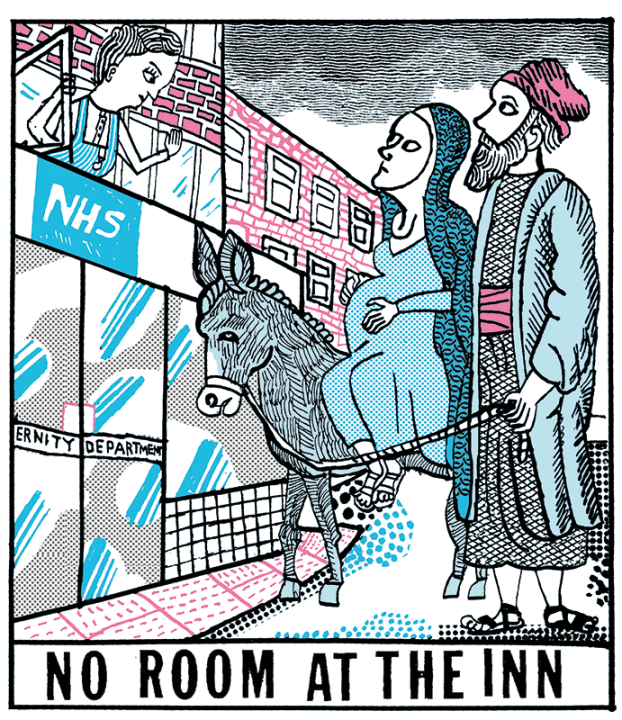
This case forms part of a terrifying picture: if you are planning to give birth in an English NHS hospital in the foreseeable future, there are only two ‘outstanding’ maternity units in the country in ‘outstanding’ hospitals, according to the Care Quality Commission: the Royal Surrey County Hospital in Guildford and Queen Charlotte’s and Chelsea Hospital in London. By contrast, 18 per cent of maternity services in the country are considered ‘inadequate’ for safety. Like 47 per cent of maternity services in England, Worthing Hospital’s maternity unit has a safety rating that ‘requires improvement’.
Maternity care in Britain is in a state of crisis. On average, a baby is born in the UK every 56 seconds. The NHS has a responsibility to see both mothers and babies safely through pregnancy and labour. In England it is failing on both counts. While the number of stillbirths and neonatal deaths is slowly dropping, a surge in childbirth legal payouts suggests that a growing number of babies are being born with life-altering injuries such as cerebral palsy and brain damage. Meanwhile, the number of women injured or dying during or after pregnancy is rising.
As of 2023, the latest year for which the World Health Organisation has complete data, the UK has the third-highest maternal mortality rate in western Europe, behind Luxembourg and Portugal. An average of 12 in every 100,000 women are dying during or shortly after pregnancy – the highest rate in 20 years.
Women who give birth aged 35 and over – the point at which they are considered to be of ‘advanced maternal age’ – are nearly twice as likely to die as those aged 25-29. Black women are nearly three times as likely to die during or after pregnancy than white women. That this disparity has decreased in recent years is not a reflection of better outcomes for black mothers but because the mortality rate for white mothers is rising.
Why maternity care in Britain is getting worse is also clear: services across the country are understaffed. In 2024, the Royal College of Midwives estimated there was a shortage of roughly 2,500 midwives in England alone. And yet one in three newly qualified midwives is struggling to find employment due to job freezes across the NHS.
Within the NHS itself, investigations have revealed that the concerns of pregnant women are being dismissed, in many cases with tragic consequences. As late as last year, midwifery colleges were still promoting the ‘normal birth’ ideology, which says that forceps, drugs and Caesareans are regarded as a last resort during delivery – despite NHS England having abandoned targets for lower C–section rates since 2022.
Meanwhile, women who experienced birth trauma have routinely reported not being properly informed by doctors of certain procedure-related risks while giving birth. A lack of compassion from medical staff is a constant refrain in the testimonies of women who have suffered during the births of their children. Time and again, it appears that the class, race and age of expectant mothers have created bias in how medical professionals have behaved towards them.

Just as alarming is the fact that training in the causes and impact of childbirth trauma, as well as injuries, is not mandatory or standardised across NHS trusts, creating a disparity in the treatment of labouring and postnatal mothers. For countless women this postcode lottery is increasingly the difference between life, injury and death.
Unsurprisingly, such medical negligence is extremely costly for the NHS and the government. Maternity-negligence claims currently account for more than 60 per cent of the health service’s clinical negligence costs. Last year, the NHS’s liabilities for medical negligence hit £60 billion, largely due to the soaring number of maternity payouts.
In 2024-25, the average compensation for obstetrics claims involving cerebral palsy or brain damage and settled with damages was £11.2 million. The government’s investment of £149 million since 2024 to make maternity and neonatal units safer appears to be a drop in the ocean. Tellingly, one barrister specialising in clinical negligence claims told me that almost all their female colleagues with children had opted for elective C-sections for their births.
The awareness that significant improvement in maternity care is urgently needed is not new. In 2015, the health secretary Jeremy Hunt set out an ambition to halve the 2010 rate of maternal deaths by 2030. The opposite has happened: the average rate of direct maternal deaths in England rose by 52 per cent between 2009-11 and 2021-23. The top three causes, in order, were thrombosis and thromboembolism, suicide, and sepsis due to pregnancy-related infections.
These statistics capture only the most extreme consequences of when pregnancy, childbirth and maternity go wrong for women. There are also the tens of thousands of women who walk out of hospital holding their newborns but who nonetheless have sustained physical and mental scars that will impact them for the rest of their lives.
The former Conservative MP Theo Clarke has been campaigning to end the postcode lottery in maternity care since the highly traumatic birth of her own daughter in 2022. A 40-hour labour left Clarke with a significant birth injury and postpartum haemorrhaging. Rushed into emergency surgery, she spent two hours awake on the operating table. ‘I thought I was going to die,’ she tells me. ‘My husband thought he was going to be a single dad.’ No one bothered to update Clarke on the welfare of her baby.
After the surgery, still paralysed from the waist down from her epidural and in great pain, Clarke attempted to summon a nurse to help her with her crying daughter. One staff member stuck their head round the door, saying, ‘Not my baby, not my problem,’ and left.
Now an author and host of the podcast Breaking the Taboo, Clarke led the first parliamentary debate on birth trauma with a moving speech about her experience in 2023. She also founded the All-Party Parliamentary Group on birth trauma alongside the Labour MP Rosie Duffield, leading an inquiry into and publishing a report on the ‘postcode lottery in perinatal care’, before leaving Westminster at the 2024 election.
Birth experiences such as Clarke’s are becoming common. One in three women in the UK describes childbirth as having been traumatic. As many as 30,000 women a year develop PTSD after giving birth. In 2024, according to one study, three in ten new mothers reported experiencing mental health issues after childbirth.
Despite this, antenatal follow-up care once women leave hospital remains desperately inadequate. The six-week check-up at the GP is usually the first medical interaction women have after going home with their babies. These visits often last not much longer than ten minutes and many new mothers say the focus is predominantly on the baby and not their own recovery.
‘The entire appointment was basically about my daughter, who was absolutely fine,’ Clarke said. ‘I was the one who’d suffered…And there was one question at the end of the appointment about me, and it was, “Do you have postnatal depression? Yes or no? And by the way, you have one minute left to your appointment.”’ Several other women I spoke to recounted similar interactions.
Clarke found herself back in parliament last month to hear MPs debate a petition she and the influencer Louise Thompson had set up for the establishment of an independent maternity commissioner to oversee reform in the sector and hold the government to account, as recommended by her inquiry two years ago. By the time MPs had agreed to debate the petition, it had been signed by more than 150,000 people.
One in three women in the UK describes childbirth as having been traumatic
‘It shows the level of public support there is and concern that there is not somebody really in charge who’s taking maternity safety seriously,’ Clarke says. Thanks to previous inquiries and investigations, there are more than 700 existing recommendations for the government on how to improve maternity care. None, she says, has been implemented.
The government says it is working to tackle the crisis. On 23 April, the NHS announced the rollout of new clinical standards, which every maternity unit in the country will have to meet by next March. Last June, the Health Secretary Wes Streeting instructed Baroness Amos to conduct a ‘rapid review’ of maternity and neonatal services across 12 NHS trusts. The government also set up a ‘National Maternity and Neonatal Taskforce’, chaired by Streeting and comprising a panel of experts and bereaved families, to implement the recommendations of the Amos review when they come.
The Amos review, as well as senior midwife Donna Ockenden’s review of maternity services at Nottingham University Hospitals NHS Trust, are due to be published next month – although the Department for Health and Social Care (DHSC) was unable to say which would come first. How the recommendations of the two reviews (one national, one regional) will mesh remains unclear.
During the debate on Clarke’s petition, health minister Karin Smyth stated that: ‘If Baroness Amos wants to recommend, for example, a maternity commissioner, then we will consider that carefully.’ But it is hard not to see Smyth’s response as indicative of the government’s unconcerned attitude to the crisis. Why must we wait for Streeting’s taskforce to publish an action plan reacting to this new review when solutions exist that have already been suggested more than 700 times?
‘Lucky’ was a word I heard over and over from the women I spoke to for this piece. Yes, it may never be possible to fully cater to all eventualities in childbirth. But how is it that in Britain in 2026 so much of the care offered to women and babies during this fundamental biological process has come down to luck? We need to know whether the government can be trusted to change this.






Comments