Almost six years ago, within hours of the imposition of a draconian National Security Law by Beijing on Hong Kong, the British government initiated a new scheme for Hong Kongers to find sanctuary and a pathway to citizenship in the United Kingdom. It was announced by the prime minister at the time, Boris Johnson, and championed by his Home Secretary Priti Patel. It received unanimous cross-party support. It was one of the few things upon which Boris Johnson and Keir Starmer agreed.
More than nine months later, Lau’s application remains undecided. The Home Office says it is still conducting “good character” checks
Broadly speaking, that consensus has continued. Indeed, despite some uncertainty caused by the current government’s review of immigration and asylum, the British National Overseas (BNO) scheme has been extended for Hong Kongers. A campaign to ensure that the government does not shift the goalposts for Hong Kongers’ path to settlement appears to have achieved its goal, with the government recently excluding BNO Hong Kongers from documents detailing new English language requirements for immigrants. This is welcome, because it is important that promises made to Hong Kongers in 2020 are kept, especially as almost 200,000 of them have uprooted their lives, left their home city, and built new lives in Britain in the full expectation that we would stay true to our word and recognise them as British citizens.
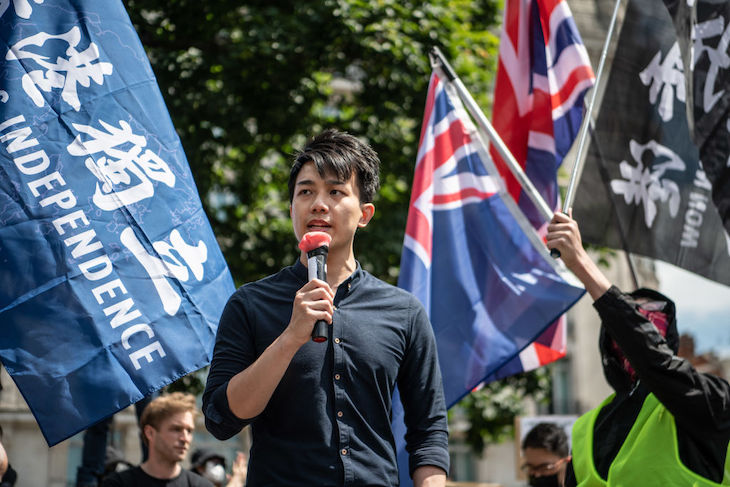
However, there is one individual whose case is causing considerable concern among the diaspora community and those who support them. He is one of Hong Kong’s most prominent pro-democracy campaigners, has endured a campaign of harassment and threats from the Chinese Communist Party (CCP) here in Britain, and he has a price on his head. His name is Finn Lau and he is my friend.

Finn came to Britain in 2019 on a working visa as a chartered surveyor, but switched to the BNO visa two years later. In 2024, he was granted indefinite leave to remain. In June 2025, in accordance with the rules, he applied for British citizenship.
Yet more than nine months later, his application remains undecided. The Home Office says it is still conducting “good character” checks.
Three years ago, the Hong Kong government issued an arrest warrant for Finn and placed a £100,000 bounty on his head. He has also received various other threats which have been widely reported in the media. In the current trial of alleged spies from the Hong Kong Economic and Trade Office, Finn has been cited as a major target of espionage. During the 2019 protests, he was arrested and detained for 48 hours – and only released because the Hong Kong police did not realise that he had played a key role in mobilising demonstrators.
In 2020, Finn was violently attacked in London. While the evidence of this attack being a politically motivated attack on behalf of China’s CCP regime is inconclusive, undoubtedly it has contributed to his understandable trauma and insecurity.
In the recent trial of Hong Kong media entrepreneur and pro-democracy campaigner Jimmy Lai – who was sentenced to 20 years in prison last month – Finn was named hundreds of times.
Unnecessarily delaying Finn Lau’s citizenship application not only causes him uncertainty. It sends mixed messages to the Hong Kong diaspora whom we have rightly welcomed into our country. At a time when they are seeking stability and trying to settle down to new lives in Britain, this uncertainty causes them unnecessary alarm and confusion. In the same week that the Home Office told Finn they were still conducting “good character” checks, 10 Downing Street invited him to a Lunar New Year reception. This inconsistency and limbo is unacceptable.
Most likely, this delay is an administrative hiccup. In the British government, cock-ups are more usual than conspiracies. Nevertheless, the threats to Finn Lau – and the dire consequences if he were to be rendered stateless or worse, deported to Hong Kong to face certain long-term imprisonment – ought to make his case a slam dunk.
It may be worth the Home Office establishing clear guidelines for addressing applications for citizenship from Hong Kongers who have faced political persecution. Finn is known to many Parliamentarians, including the last Governor of Hong Kong Lord Patten – and several have already written to the Home Office about his case. But other applicants facing similar repression may not have the same political influence.
This is not a partisan issue. In an era of often toxic political debates, support for Hong Kongers is one of the few issues that unites our politicians across all parties and that must remain the case. So surely it is in the Home Office’s interests to spare any further bureaucracy or embarrassment by approving his citizenship – and in so doing, sending a clear and unambiguous message to the thousands of Hong Kongers who have come to the United Kingdom over the past six years: you are very welcome here.






Comments