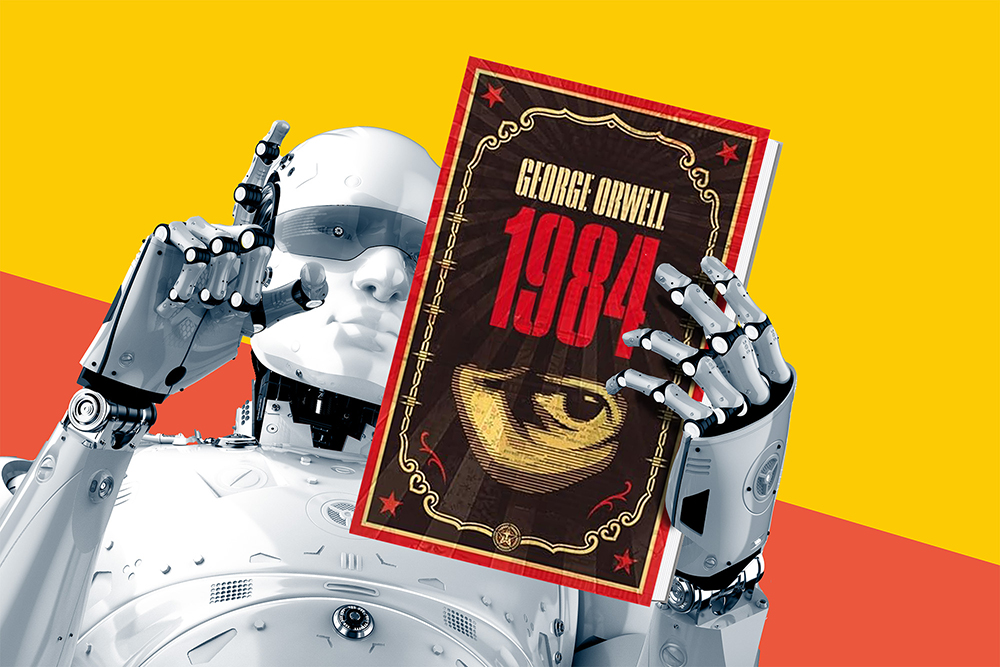
A school in Greater Manchester has stripped 193 books from its library because they are ‘inappropriate’, liable to upset pupils and thus a safeguarding risk. Among the dangerously destabilising material: Michelle Obama’s memoir and George Orwell’s Nineteen Eighty-Four. Who was entrusted with identifying these literary IEDs? An over-zealous head? A prurient librarian? A demented child psychologist? Nope. A humble AI bot. While writing my latest novel, The Hawk Is Dead, much of which is set in Buckingham Palace, I asked ChatGPT to produce a simple floor plan. Not a tough assignment – much less taxing than diagnosing nearly 200 books as existential threats to adolescent wellbeing. It got the Palace’s orientation wrong. For more than 200 years, the East Wing has faced the Mall. According to ChatGPT, it now faces north. And yet this is the oracle now consulted on what children may or may not read. Still, there is a certain grim logic to it. If you want to keep young minds safe from dangerous ideas, why not put a system in charge that struggles to grasp reality in the first place?
And while we’re on the topic of AI (and the now-obligatory anxiety about job losses), I came across a prediction that is both funny and chilling: ‘The factory of the future will have just two employees: a man and a dog. The man will be there to feed the dog. The dog will be there to stop the man touching the machines.’ Love or loathe technology, we’re stuck with it. A hardy 2 per cent of the UK still soldiers on without a mobile phone. An admirable lot, but for most of us? Seriously? Not having a phone or a computer doesn’t simplify life so much as turn it into an obstacle course. Writing this on a laptop is so much more pleasurable than on a manual typewriter – hammering away, backspacing like a woodpecker, painting over mistakes with Tipp-Ex and waiting for it to dry. Progress may be relentless, but it’s less messy. As Stewart Brand observed: ‘Once a new technology rolls over you, if you’re not part of the steamroller, you’re part of the road.’ And, increasingly, the dog is driving.

Writers are often accused of making facts up. I try not to: I’m a stickler for research. In The Hawk Is Dead, I derail the Royal Train with Queen Camilla on board. For my research, I realised I needed to learn how to drive one, and contacted Network Rail. To their credit, they did not immediately call the police. Instead, they provided a senior instructor, a session on their simulator and – more thrillingly – a seat up front on the 10.09 from Brighton to Victoria, followed by the 11.30 back. I am delighted to report that, under my silent supervision, both trains arrived on time. Train drivers tend to get a rough press over their pay. Having seen what the job entails, I’m inclined to think they earn every penny. It is far more demanding than I imagined, with responsibility for up to 1,000 lives at a time. There’s no shortage of technology: not one but two systems will stop the train if the driver’s concentration lapses for even a few seconds. This makes it all the more surprising that the list of stations is not delivered via some gleaming digital interface, but scribbled on a torn sheet of lined paper and clipped to the sun visor. British railways, it seems, run on both advanced electronics and something last seen in a village fête raffle. I asked my instructor whether he had ever missed a station. He confessed that he once forgot to stop at Gatwick. Many passengers missed their flights. ‘You only do that once in your career,’ he said.
The Hawk Is Dead began, improbably, with a question from Queen Camilla about when I might set a Roy Grace novel in London. Given that historically things have not ended well for those who ignore royal commands, I felt it wise to comply. That said, I suspect I am more her fan than she is mine. Few figures today do more to champion reading than HMQ, particularly through her charity, The Queen’s Reading Room. In an age when public attention tilts relentlessly toward sports stars, film stars and popstars, it is rare to see someone of such profile making the case for authors and their books.
Peter James is a National Year of Reading 2026 ambassador. For further information about how you can get involved, including volunteering opportunities, visit goallin.org.uk



Comments