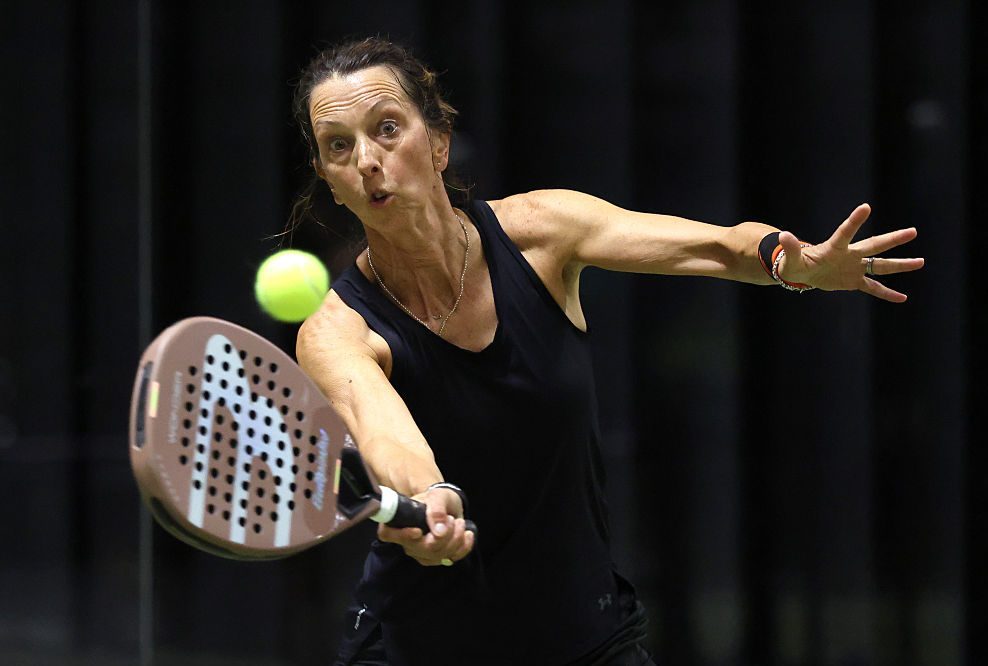
Until I played padel for the first time, I was firmly of the view that it is just an easier version of tennis, and thus exists to be torn down. My position, carefully refined over several years of not playing it, ran as follows: padel is the slightly strange cousin of tennis and squash, created for those who like the idea of a racquet sport and buying all the kit that comes with it, but lack the coordination to play a proper one. The reason the courts have Perspex walls is that players cannot consistently be relied upon to reach the ball without them, and it is exclusively played by pretentious members of Gen Z in north London. When I was recently invited to give it a go, I agreed, fully intending to use the experience as fodder for a prosecution article in The Spectator.
It is one of those sports from which people can take what they want
How wrong I was. I loved it. Padel is inescapable. The Lawn Tennis Association (LTA) – now the governing body for padel in Great Britain – announced in May that a million people in Britain have taken it up. In 2019, the figure was 15,000. Participation more than doubled in 2025 alone. There are now 1,825 courts in the country, up from 72 when the LTA announced plans to merge with British Padel in 2019. It is now so popular that people are inventing robots to play it. Tony, a humanoid robot, recently made his padel debut at a club in King’s Cross. Alas, I had rather hoped that robots would relieve us of unpleasant domestic tasks such as scooping out the kitchen sink plughole and putting the bins out when it’s raining.

Interestingly, tennis doesn’t seem to be suffering from this padel explosion. The LTA recorded 5.8 million adult players last summer – the highest participation figure ever recorded for the sport. I’m from a family of tennis fanatics. When it came to playing padel for the first time, this helped enormously, although it is in no way a prerequisite. What tennis experience buys you is a decent volley and a baseline level of hand-eye coordination.
But this doesn’t go far, because the way one moves around the court in padel is very different from tennis. The court is smaller, but you change direction constantly and from a much lower body position. The ball sits below the knee far more often than it does in tennis, so the majority of the session is spent in a half-crouch. For someone not used to this demand, it very quickly obliterates the quadriceps. By the end, portions of my lower body I had not previously been aware of were on fire. My lungs felt like they had been punctured with a kitchen knife.
My reading of the bounce of the ball off the walls also proved far more difficult than I expected. It returns off the Perspex at angles that, for the first half an hour, I was wholly incapable of anticipating. I had dismissed the walls as a courtesy for the uncoordinated, but they are probably the hardest part of the game.
It’s no wonder padel is so widely enjoyed. It is both great fun and one of those sports from which people can take what they want. Keeping a rally going is largely the point of playing a racquet sport socially. It is much easier to do in padel than in tennis, since the latter is far harder than it looks. Two beginners can spend the better part of a club morning retrieving balls from the next court. Despite its muscular and cardiovascular demands, padel is far gentler on the joints. Given that it is played on a synthetic turf that is lightly dusted with sand, it is far more forgiving than the tarmac of municipal tennis courts, which have reduced my mother’s knees – after decades of charging around on them – to little more than dust.
There is also the crucial difference between the two in terms of serving technique. The serve is the hardest shot to learn in tennis. So often, it is a one-way ticket to shoulder injury or tennis elbow. In padel, players serve underarm, again lowering the barrier to entry and mitigating the injury risk.
Regular physical exercise is great for an individual’s health – mental and physical. Thirty per cent of adults in England are now obese, so anything that gets more of us off our fat arses is worth having. Racquet sports have long been shown to be almost supernatural in their ability to predict longevity. The Copenhagen City Heart Study followed 8,577 people for up to 25 years and found that those who regularly played tennis lived, on average, 9.7 years longer than the sedentary group. This was ahead of badminton (6.2 years) and jogging (3.2 years). Leisure activities that involve more social interaction also had the most powerful impact on longevity. No data of this kind has observed the benefits of padel specifically. Still, given that it is a racquet sport and is almost exclusively played in doubles format, the omens are positive.
But there is the cost. Padel is currently quite expensive. Hiring a court can cost up to £100 an hour in central London. That is a price set by fashion and relative scarcity rather than by the sport itself. These things will pass. I’m very much looking forward to playing again, and to see padel spread further. There are 1,825 courts in Britain. This is only just the beginning.






Comments