
Patrick Smith has narrated this article for you to listen to.
You picture the rainforest, naturally. A clearing at first light, a shaman with thousand-yard eyes, the canopy screeching overhead. What you do not picture is a fourth-floor flat on an east London estate, a woman wafting sage around your head and the slow realization that you have just handed over £150 to be – quite literally – poisoned. This is kambo. And at the lowest ebb of my late thirties, becalmed in a miasma of self-loathing and suffering from PTSD following a moped accident in Thailand, I had decided it was precisely what I needed.
Made from the dried skin secretions of a giant monkey frog, it is also, as of last month, suspected of having killed its first Briton. Kristian Trend, a 40-year-old wellness coach, died after a ceremony in Leicester; a man was arrested on suspicion of administering poison and later bailed. A cross–party chorus – a former health secretary, the chair of the Commons health committee – has since urged Sir Keir Starmer to ban it. The substance is already outlawed in Brazil, Chile and Australia, the last of which files it under the bracingly candid heading “schedule ten poison.” In Britain it remains entirely legal, wholly unregulated and roughly one Instagram search away. All of which I report in the knowledge that, not so long ago, I was lying on a couch in Wapping, awaiting my turn.
There is no bond quite like having watched another man retch his insides into a pail
The substance is harvested by lashing the frog – Phyllomedusa bicolor – to four sticks by its limbs, stressing it into defending itself, then releasing it back into the wild. Among its many compounds it releases is dermorphin, an opioid reported to be some 40 times more potent than morphine. Unlike ketamine (too obvious), ayahuasca (too cringe) and ibogaine (too risky), kambo felt like an elegant and zeitgeisty solution to my problems. It offers no light show, no visions, no cosmic download. This is not Rainbow Rhythms but the cold melismatic runs of retching; of vomit slapping the bottom of a bucket.
If you’re suddenly picturing a frog splayed there in front of me, being harassed for the sake of my mental wellbeing, think again. The shaman had the poison in a Tupperware container. In retrospect, it is distressing to imagine that somewhere in the Amazon there’s a factory farm of prostrate frogs being poked by sticks to feed the insatiable appetite of credulous westerners for the next ayahuasca. But at the time I didn’t know much about kambo beyond its reputation as a panacea for an improbable range of illnesses. What began as a cleansing ritual practiced by indigenous Amazonian tribes, helping men with virility and women with fertility, is now marketed across Europe as a salve for depression, anxiety, chronic fatigue, impotence and even Parkinson’s.

So that’s why I went. How I came to be there, throwing up with such gusto, the mise-en-scène straight out of Peep Show, is down to a PR friend of mine in the music business, who had heard about this woman via the industry grapevine. He joined me that day.
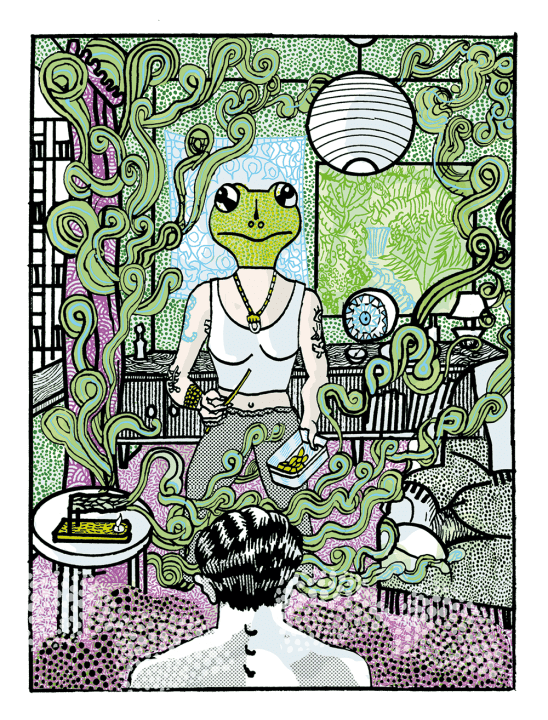
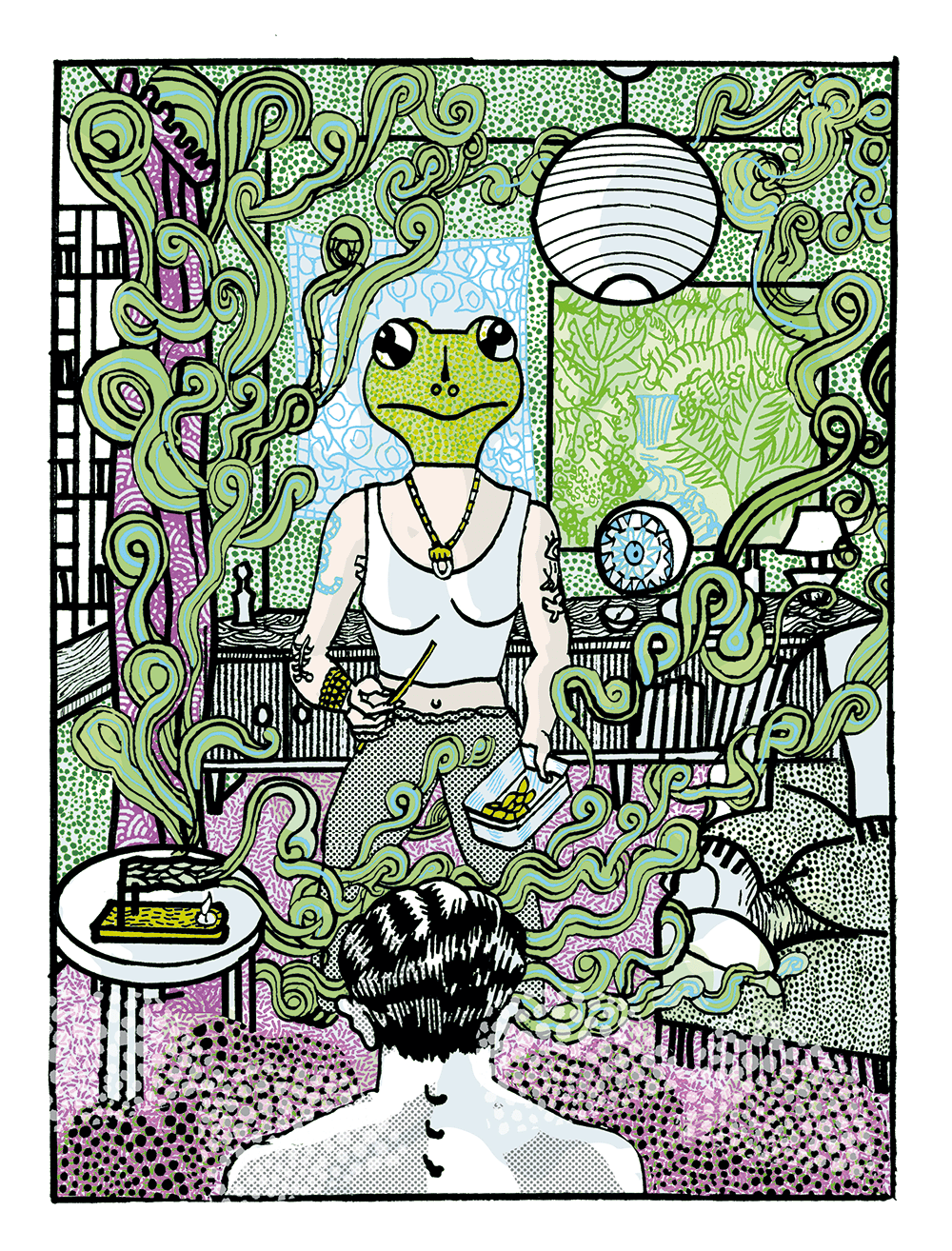
The pre-match instructions had a grim poetry: wear loose tracksuit bottoms and bring a change of clothes in case you soil yourself while being purged. As if to assuage any scintilla of doubt about her qualifications, our shaman was also moonlighting as the frontwoman of a psychedelic rock band, in which she performed in a frog mask.
Having chanted the word “kambo” while tapping at a bongo, she burned three neat blisters into my right arm (men, traditionally, are done on the arms and chest), peeled the skin and pressed the poison into the raw dots. For 20 minutes I discovered what the leaflets coyly call a “strong reaction.” My skull seemed to tighten in a vice. Heat climbed up my neck. Then came the vomiting, violent and tidal and apparently unstoppable, which is precisely where kambo turns from unpleasant to dangerous: the deaths that cloud its narrative – a man at a New South Wales retreat, a woman in Mullumbimby – have tended to involve an oesophagus torn apart by exactly this level of retching.
Across from me, on an opposing sofa, my friend was matching me heave for heave. There is no bond quite like having watched another man retch his insides into a pail while he watches you do the same. Nothing can sever it. It is presumably why I now find it constitutionally impossible to decline my friend’s requests that I interview his clients. A clever move, that, on his part.
Then the shaman lifted the poison and the cloud broke. A cool breeze seemed to pass through me. I felt calm, elated and weightless – a man who had stared down the reaper and been given a reprieve. This idyllic state lasted until she blew tobacco snuff up my nostrils, a pain beside which all previous pain politely excused itself, and then, just as I was recovering, dripped something citrussy into my eyes.
Forty minutes or so later, released back into the wild – or at least back on to the Overground – I felt wonderful. At the risk of sounding like a Vice dispatch, I had put myself through the wringer and come out the other side with my anxiety lifted – though whether that was the cleanse working its ancient magic or merely the giddy relief of a nervous system that had braced for death and been spared, I could not honestly tell you. It held for a few weeks; I went back twice more. The depression, that loyal old dog, eventually padded home regardless – it always does. But for a while things were lighter.
The wellness industry has a knack of taking a sacred practice, tended for centuries by people who understood it, and selling it on at extortionately high cost. For me, kambo wasn’t without its benefits. But I’m sure there are better ways to address depression than getting shanked with frog cortisol in a council flat in Wapping. You’ve got to kiss a lot of frogs, they say, to find your happily ever after. I may have taken this too literally.




Comments