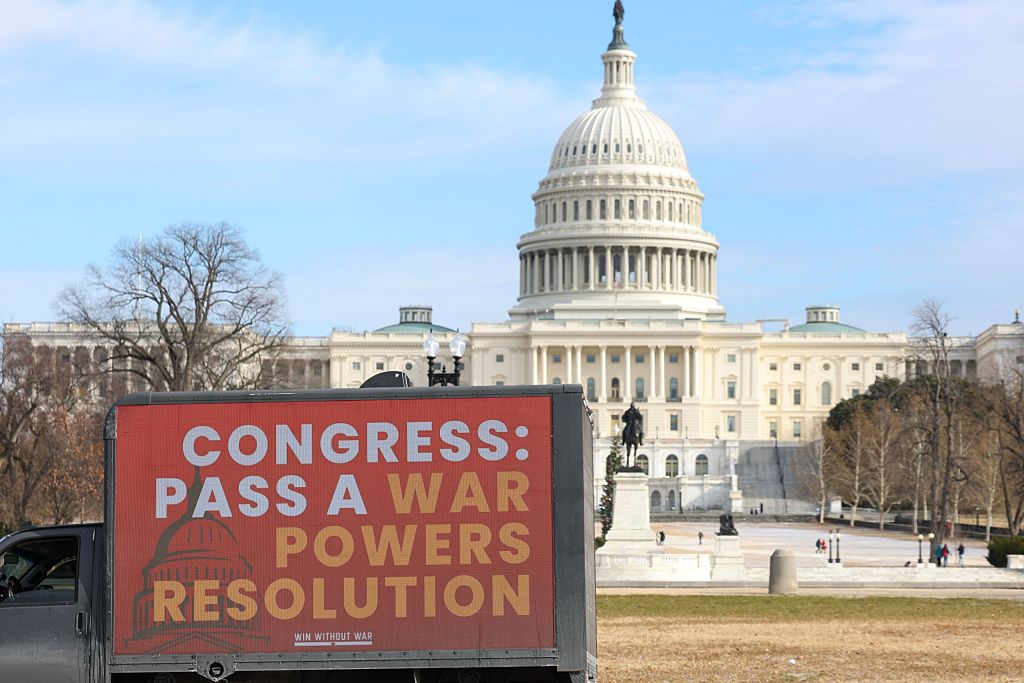
Is there a plausible legal basis for going to war with Iran? Senate Democrats say no, and late yesterday forced a vote on a war powers resolution to bring the hostilities to a halt. It failed along largely partisan lines, 53-47, but Democrats say they intend to bring it up again, citing widening public disapproval of the war.
“We have created a catastrophe in the Middle East,” said Sen. Chris Murphy, a Connecticut Democrat, who sponsored the resolution. “This is what you get when you put talk show hosts and real estate developers in charge of national security.”
The Trump administration has made it plain that providing a legal justification for the war isn’t terribly high on its list of concerns. Its response can be best summed up by Defense Secretary Pete Hegseth, who accused Europeans of “pearl clutching” for citing international law for refusing to join with US military action.
But, in fact, the president can cite precedent.
Since its enactment in 1973, presidents have repeatedly ignored the War Powers Resolution requiring congressional support for military action abroad. Or as President George W. Bush did in 2003, claimed the law was unconstitutional, even as he sought congressional approval for the Iraq invasion.
The same goes for international law. Bush went to the United Nations Security Council for authorization to launch the Iraq war, famously sacrificing his loyal Secretary of State Colin Powell by having him make the later discredited argument that Saddam Hussein had been accumulating weapons of mass destruction.
When the Security Council declined to go along, Bush announced that diplomatic means of resolving conflict had failed and launched hostilities.
At a White House appearance March 3 with German Chancellor Friedrich Merz, Trump, gave the impression of the decision-making process in advance of the attacks as not so much deliberative as an act of gut level instinct.
“We were having negotiations with these lunatics, and it was my opinion that they were going to attack first,” the president said. “I think they were going to attack first, and I didn’t want that to happen. So if anything, I might’ve forced Israel’s hand. But Israel was ready and we were ready.”
The clear inference was the niceties of international and domestic law were hardly a priority.
Despite intense criticism from portions of his base outraged that Trump, who campaigned on keeping the United States out of war, had launched new hostilities, support for the attack has found solid support among Republican lawmakers. The Senate and the House have voted several times since the start of operation Epic Fury on war powers resolutions and in each instance Republican majorities defeated the measures.
Disagreement over the President’s authority to launch military operations absent direct congressional approval is baked into the Constitution. Article 2 of the Constitution declares that the president is commander in chief of the armed forces, but Article I says only Congress has the authority to declare war.
Disputes over what this means as a practical matter, and which branch of government has ultimate responsibility for authorizing a military attack, date back to the 19th century when President James Polk went to war against Mexican forces in Texas and later went on to invade Mexico City. At the outset, Polk attacked Mexican troops in disputed territory then went to Congress a month later asking for a declaration of war, claiming that American troops had been killed inside US territory. Congress eventually assented, but Polk acted first without authorization.
In April of 1861 President Lincoln entered the Civil War again without congressional approval when confederate troops attacked the union garrison at Fort Sumter in Charleston, S.C. Soon after he suspended the writ of habeas corpus in Maryland. Congress eventually gave its approval to both actions, but Lincoln didn’t ask in advance.
In the 20th Century, President Truman had the support of the United Nations Security Council when he sent US troops to repel the invasion of South Korea by North Korea.
But there never was a formal declaration of war by Congress, nor was there a declaration of war in the Vietnam conflict. Explicit congressional authorization was similarly lacking for a host of smaller engagements including President Obama’s bombing campaign in Libya and the United States entry into the Balkans conflict in Kosovo under President Clinton.
Nor have the courts been supportive of congressional efforts to assert authority in military conflicts. Federal judges have repeatedly ruled that the question of when and how a president launches military actions and the degree to which Congress must be consulted fundamentally are political questions beyond the reach of the judicial system.
Hence a kind of stalemate has emerged.
Both domestic and international law hinge on the “imminence” of hostilities as a Jus ad Bellum, or justification, for launching an attack. Whether in the current conflict there was such an imminent threat has been questioned both by international critics of the war and Democrats on the hill.
But when the bullets start flying, legal niceties take on diminished importance. The focus is on the military campaign. If the conflict drags on, and public support wanes, the question of whether the military action is legally justified will inevitably take on greater urgency.




Comments