
America’s war on Iran has revealed much about its allies. Israel is as steadfast as ever, as secretary of war Pete Hegseth pointed out on Monday. Australia and Canada have also made clear their unequivocal support for the military action.
Russia, for all its malevolence, does not have the means to stoke civil unrest in western Europe. The Islamic Republic of Iran does
In Europe, however, the response has been lackluster. Hegseth regretted the faintheartedness of “traditional partners who wring their hands and clutch their pearls, humming and hawing about the use of force.”
Step forward Keir Starmer, who has “disappointed” President Trump by his reluctance to throw Britain’s weight behind America. But Britain isn’t alone in the Old Continent, particularly in western Europe. Hours after the attacks began on Iran, Spain’s Socialist Prime Minister, Pedro Sanchez, declared on X that “we reject the unilateral military action of the United States and Israel.” On Sunday Israel’s foreign minister, Gideon Sa’ar, accused the Spanish government of “standing with Iran.” Spain’s foreign affairs minister, José Manuel Albares, called the claim “absurd and ridiculous.”
Europe’s instinctive reaction to America’s attack on Iran was one of apprehension. Emmanuel Macron fretted about “escalation” and said, “diplomatic efforts must resume their rightful place.” His concern was echoed by the president of the EU Commission, Ursula von der Leyen. She said she was “greatly concerned” by the attack and urged all sides to “exercise maximum restraint.”
The foreign ministers of the EU’s 27 nations held an emergency summit on Sunday evening, the result of which was a joint statement demanding “full respect… of the United Nations Charter, and international humanitarian law. They also spoke of their alarm that the conflict ‘could threaten the Middle East, Europe and beyond.”
The timidity of Europeans towards regime change in Iran is in stark contrast to their aggressive attitude towards regime change in Russia. Last year Von der Leyen called Vladimir Putin “a predator” who can “only be contained by strong means.” In November, Macron declared that Europe “must show that we are not weak in the face of the power that threatens us.”
Why the difference? Russia, for all its malevolence, does not have the means to stoke civil unrest in western Europe. The Islamic Republic of Iran does.
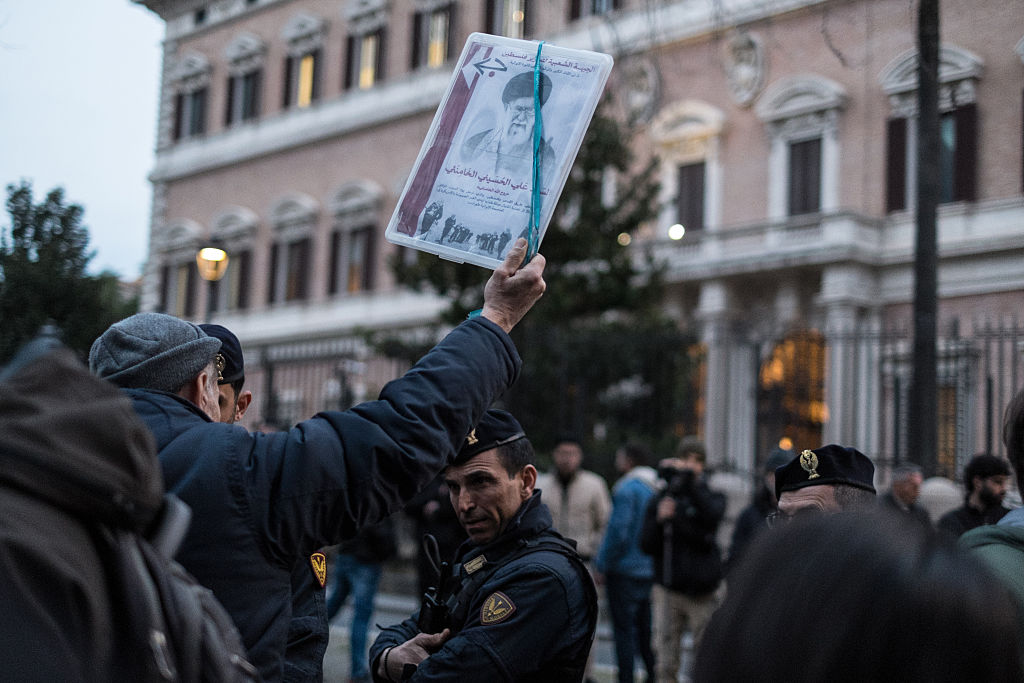
It is estimated that there are 45 million Muslims in Europe, approximately 6 per cent of the total population. Of course, many will support the US and Israeli attack on Iran, mindful of how Tehran massacred tens of thousands of protestors in January. Nevertheless, it is instructive that while there have been countless mass demonstrations in western European cities for Palestinians since 2023, street protests in support of Iranians have been negligible.
European governments are reluctant to wholeheartedly endorse the American-led strikes against Iran because they fear the conflict could spill onto their streets. This alarm is not misplaced; some left-wing parties in Europe see America’s attack on Iran as an opportunity to strengthen their “Islamo-gauchisme” credentials. Zack Polanski, the leader of the increasingly popular Green party, said at the weekend that America’s attack was “illegal and unprovoked.”
The Scottish wing of the party described Donald Trump as a gangster who was demonstrating “total contempt for human rights, international law and negotiations.”
In France, Jean-Luc Melenchon’s La France Insoumise was similarly scathing. One of the senior figures in his party, Rima Hassan, posted on X: “Iran has the right to defend itself, and Israel has the right to shut up.”
Such is the hatred of Israel among many within the European left they are prepared to side with Iran’s murderous Mullahs, particularly if they think it will be electorally advantageous.
This doesn’t surprise Gilles Kepel, France’s top political scientist, who has written numerous books about Islamism. In an interview on Sunday he predicted that the war with Iran would be imported into Europe as the conflict in Gaza had. “Decolonization and wokeism are the offspring of the Iranian Revolution [of 1979],” he explained. “A mix of leftism, third worldism and Islamism.”
It is not just street protests that worries European governments; it is also the prospect of terrorist attacks. A week ago the New York Times claimed that western security officials were “monitoring increasingly worrisome sign” that Iran could order proxies to carry out terrorist attacks in Europe.
A report last year in France, based on intelligence sources, outlined the extent of the threat posed by an Iranian regime. Among their “proxies” in France were people recruited “from criminal networks or even drug trafficking.”
Finding proxies has been made easier for the Iranian regime by the inability of Europe to control its borders.
The BBC reported last week that the number of migrants who crossed illegally from France to England in small boats in 2025 was 41,262, an increase of 13 percent on the previous year. Of this number 11 percent were Iranians. Most sought asylum but how does Britain know some weren’t sleeper cells sent by Tehran? It doesn’t.
This explains the panic in Europe to the American/Israeli assault on Iran. It knows that the regime is evil and that most Iranians long to be liberated; but it also knows that the conflict is likely to cross its borders.
In truth, it crossed into Europe in 1989, when Ayatollah Khomeini issued a fatwa against Salman Rushdie. Thousands of Muslims took to the streets in Britain and France to call for the death of the blaspheming author.
Europe reacted like a rabbit in the headlights to this new religious extremism. Nothing has changed.



Comments