
When the incumbent prime minister – presumably Andy Burnham – lays a wreath at the Cenotaph on Remembrance Sunday this year to honour ‘the glorious dead’, he will potentially be joined by a record number of the glorious undead. If everyone who is eligible attends, there will be nine former prime ministers at the ceremony.
Yes, nine: John Major, Tony Blair, Gordon Brown, David Cameron, Theresa May, Boris Johnson, Liz Truss, Rishi Sunak and Keir Starmer. This is a statistically significant proportion of the 59 prime ministers there will have been since Sir Robert Walpole established the position on his appointment as First Lord of the Treasury in April 1721. Their average age is just under 65, still too young for the state pension.
What does a former prime minister do? A century ago, the pattern was relatively straightforward: if you lived long enough, you departed office, received an earldom, made occasional speeches and died. Today it is striking that only two of the nine – Cameron and May – have accepted places in the House of Lords. But it is understandable that driven, ambitious men and women still want to be active in public.
Starmer’s record on defence has been one of the worst examples of this government’s gap between words and deeds
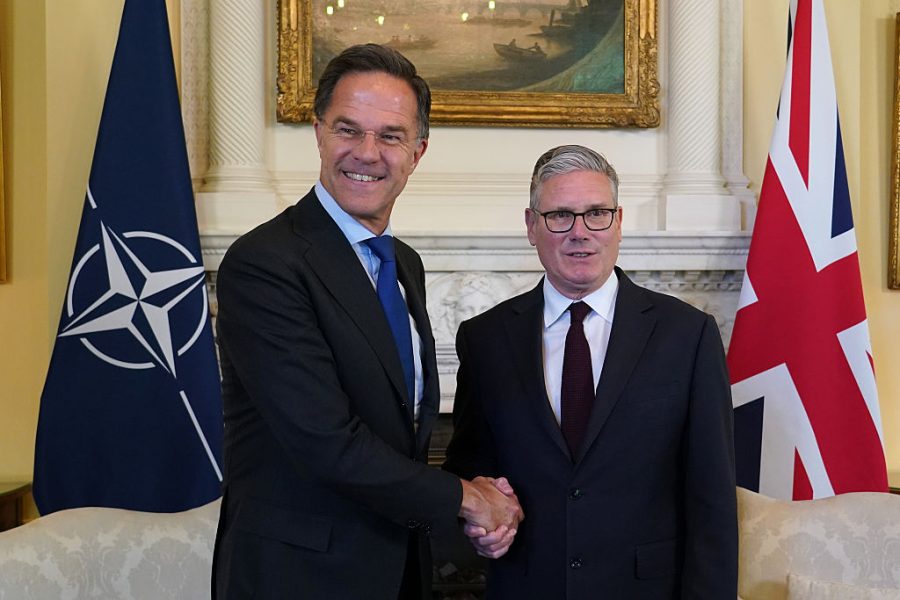
Starmer has not yet gone to the Elysian Fields, though if no one challenges Burnham for the Labour leadership, the transition is probably three weeks away. But according to The Observer, Starmer is already thinking about life after Downing Street and might like to become secretary general of Nato. The post is awarded for a four-year term, and Mark Rutte, former prime minister of the Netherlands, took up the reins in October 2024. In theory, then, there will be an opening in October 2028, only two years or so after Starmer has stepped down as premier.
There are some obstacles. The first is that the term of office for the secretary general is renewable, and Rutte is generally seen to have played a difficult hand well. It would be perfectly reasonable for him to expect – and for the alliance to offer – a second term or at least an extension. Rutte is nearly five years younger than Starmer.
There is a nebulous question of dignity too, although it seems to cause very few modern politicians much anxiety. With the exception of Tony Blair’s hilariously miscast time as Middle East envoy for the ‘Quad’ (the UN, the EU, the United States and Russia), no modern prime minister has gone on to a major role at an international organisation.
Many have served domestically in cabinet under their prime ministerial successors – the Duke of Portland, Henry Addington, Viscount Goderich, the Duke of Wellington, John Russell, Arthur Balfour, Stanley Baldwin, Ramsay MacDonald, Neville Chamberlain, Alec Douglas-Home and, most recently, Cameron – often as Foreign Secretary. The UK has also supplied three Nato secretaries general (Hastings Ismay, Lord Carrington and George Robertson). But there is something which sits uneasily about a former UK head of government giving some of that imprimatur to a multilateral organisation.
The elephant in the room which we should recognise and name is Starmer’s sheer brass neck in fancying himself suitable for a global role. The outgoing prime minister’s acolytes often say that his strengths lie in international affairs more than domestic politics, which may be true in the same limited way that Dick Turpin’s horsemanship outshone his ability to evade capture. Starmer’s record on defence has been one of the worst examples of this government’s mendacious or deluded gap between words and deeds.
Labour won the 2024 election deliberately posing as a party which was strong on defence and on Nato because it knew the subject was traditionally a weakness for the left. Its election manifesto referred to an ‘unshakeable commitment to the alliance’ and described Nato as ‘the cornerstone of European and global security’. There were at first bold words about increasing defence spending and commissioning an independent Strategic Defence Review (SDR). The government announced its acceptance of the SDR’s recommendations, the drafting of which was led by former Nato secretary general Lord Robertson of Port Ellen.
When the rhetoric has died down, however, the delivery of concrete improvements has been woeful. The Defence Investment Plan (DIP), the framework for implementing the SDR, was due to be published in the autumn of last year. It is due to limp into the light today. According to John Healey’s resignation letter from the post of defence secretary earlier this year, UK defence spending under the DIP will only rise to 2.68 per cent of GDP by 2030. It is hard to see how it will reach Nato’s unanimously large target of 5 per cent by 2035.
Yet Starmer was instrumental in agreeing that target and then delivering an investment plan which did not accommodate such levels of expenditure. Earlier this month, it was revealed that the UK had slithered to 30th out of Nato’s 31 members for meeting rearmament targets after Labour’s two years in office.
Not only has Starmer presided over a messy and falsehood-plagued debate on defence spending, he has also, with French president Emmanuel Macron, taken the lead in creating not one but two ‘coalitions of the willing’ for Ukraine and the Strait of Hormuz. These have been the geopolitical equivalent of fantasy football: alliances have been forged without clear strategic aims, and Starmer has talked long and loud despite the UK being unable to make significant contributions of assets.
Starmer may well believe that as a serious, measured politician who shuns dogma and carries international heft, he would be an ideal Nato chief. He should think again: his management of Britain’s defence has seen sanctimonious promises without the necessary capabilities, outrageous manipulation of facts and figures, an astonishing level of indecision and irresolution, and self-congratulatory air of blaming someone – anyone – else.
Even if Mark Rutte decided to move on from Brussels in 2028, Starmer would need to be put forward for the role and unanimously accepted. That seems a very long shot. After all, as President George W. Bush tried so heroically to say, fool me once, shame on you; fool me twice, shame on me.





Comments