
It can be hard to believe, but it is only three weeks since John Healey resigned as defence secretary, saying that Keir Starmer had proven himself, ‘unable… to commit the resources that the nation needs to defend the country at this time of rising threats.’
It is insanity to give the armed forces half the funding they need and expect them to deliver all the missions to which they are committed
The financial settlement for the Defence Investment Plan offered an additional £13.5 billion for the armed forces. The Ministry of Defence had said that it would need £28 billion.
Now Dan Jarvis, a respected former Parachute Regiment company commander, is Defence Secretary, the Defence Investment Plan is still crawling towards publication, and Starmer has decided that if the Parliamentary Labour party wants Andy Burnham so much, it can have him. But the psychodrama is not yet over.
When Jarvis was appointed to succeed Healey on Britain’s least attractive military mission since Lieutenant General Percival took command of Singapore in 1941, he reopened negotiations with HM Treasury over the DIP’s financial settlement. But it seemed impossible he would achieve much change.
Reports suggest the revised DIP will contain perhaps another £1 billion, which could take it just across the halfway mark of what the MoD thinks it needs to implement last year’s Strategic Defence Review. But the priorities for spending have also been reshaped.
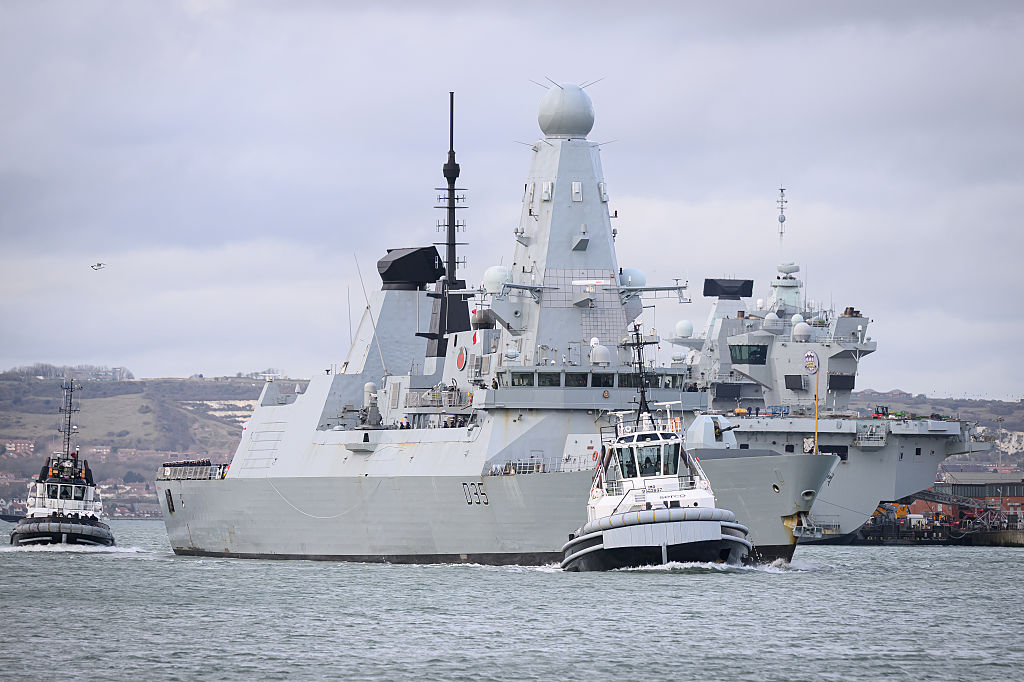
You might think it takes what they call a special kind of stupid to look at the Royal Navy today and conclude that it needs fewer surface vessels. To recap, Britannia currently attempts to rule the waves with two aircraft carriers (but only one carrier air wing); six Type 45 destroyers, of which only three are available; and five ageing Type 23 frigates, the oldest of which has been in service for 30 years.

In revising the DIP, the government is reportedly removing funding for up to eight Type 83 destroyers, which would have replaced the unreliable Type 45s in the second half of the 2030s. It will also no longer fund the design and construction of five Type 32 general purpose frigates which would have taken over some of the duties of the exhausted Type 23s.
This means the Royal Navy’s future surface fleet is currently expecting 13 new frigates (eight anti-submarine warfare Type 26 vessels and five cheaper, more flexible and general-purpose Type 31s). That’s it. The current destroyers and frigates will be taken out of service in the 2030s.
But there is a plan for the future. The DIP will provide funding for at least six ‘common combat vessels’, which will act as hubs to control drones and autonomous surface and sub-surface vessels. This is in line with the ambition of the First Sea Lord, General Sir Gwyn Jenkins, to transform into a ‘hybrid navy’ in which crewed submarines and surface vessels will integrate with autonomous systems and artificial intelligence; this is intended to offset personnel shortages and financial constraints without the Royal Navy losing its capabilities or strategic reach.
So how much will these common combat vessels cost, and how significant a saving over traditional crewed surface ships will they deliver? The MoD doesn’t know. There is no specific cost attached to them, for the understandable reason that they haven’t been designed yet. As matters stand, specific platforms – Type 83 guided missile destroyers and Type 32 general-purpose frigates – are being cancelled in favour of an idea.
Jenkins is probably right: the Royal Navy of 2035 or 2040 will look very different from today’s service. But Starmer has proceeded fundamentally on a false premise. If these new programmes were in place by the mid-2030s, they might be able to deliver a force which had the equivalent capability to now. But the Royal Navy is already on its knees and needs not just modernisation and adaptation but substantial expansion.
The Royal Navy currently has 11 destroyers and frigates. In 2010, it had 31; in 1995, 35; in 1980, 61. The government has cut its commitment to 13 crewed vessels. They could be the finest warships mankind has ever seen, but not even the most optimistic tech evangelists expect a vessel which can be in two places at one. You cannot operate a blue-water navy with global commitments with 13 vessels. If the Royal Navy is to avoid overstretch and dangerous ongoing capability gaps, it needs the common combat vessels and autonomous systems to be designed, built and brought into service at considerable speed. And they must deliver every capability they are promising, without major challenges. That does not sound like any British naval procurement I can recall.
There is no secret about why even the revised DIP is fatally flawed: there is not enough money. It is insanity to give the armed forces half the funding they need and expect them to deliver all the missions to which they are committed. If it could be done, it would be the military equivalent of perpetual motion.
Instead, Starmer has done what he and his ministers have done for the past two years: talk big, underfinance and refuse to acknowledge the gap. Dan Jarvis has already fallen prey to the language of the MoD’s main building. Asked about the vast funding shortfall, he replied:
‘Our Royal Navy is a formidable force, operating to protect our nation and our allies in the Atlantic and beyond.’ Except it’s not, is it? And everyone knows that.






Comments