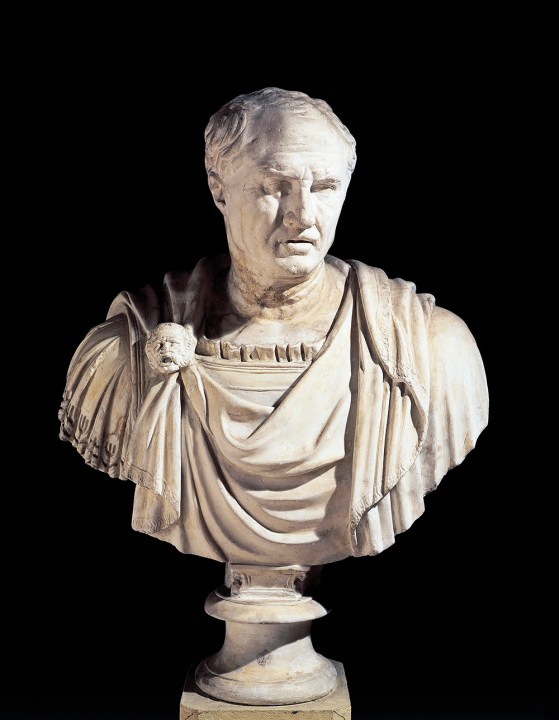
How should we think about Cicero? He was the orator who claimed that he did his best to save the Roman Republic from decadence. To more recent readers, he has come to seem regressive as well as ridiculous: he opposed the redistribution of land and loathed the idea of doling out grain rations. But it’s his self-promotion that makes us roll our eyes. Early in her biography, Catharine Edwards understates the obvious: ‘False modesty was never Cicero’s problem.’
What she does best throughout her surprisingly page-turning account is to reveal Cicero through his own words. (Admittedly, she has many, many words to choose from.) She quotes him reflecting on an early, junior role as a quaestor in Sicily: ‘What Sicilian quaestor has won greater renown or popularity?’ She doesn’t quote what he says next, which is a story he tells about how nobody remembers his stint in Sicily. It’s true that Cicero was an ardent self-promoter, who thought he had not so much rescued Rome as re-established it. But we have to ask, first, by today’s standards, was he really more precious about his legacy and his ego than today’s leaders? And, next, what if he was right?

His boast was to have defended the republic wearing a toga. That is to say, his achievements in oratory and statecraft were equivalent to the military successes of generals. He said this after his term as consul – one of the two heads of government – in 63 BC, when his scathing rhetoric and efficient spy network scotched a conspiracy to overthrow the state. Still, as with his ‘best quaestor ever’ brag, we need context. He was constantly defending himself because he had to. In this case, he was shoring up his reputation against those, including Julius Caesar, who argued that he had presided over the execution of key conspirators without a trial. Up there with blocking land reform etc., to later ages this counts as a Bad Thing.
But can good speeches lead to bad things? Edwards’s book is called Orator, and in her introduction she writes: ‘Cicero did all he could to solve Rome’s problems through negotiation and persuasion rather than violent conflict.’ ‘All he could’ is revealing. It suggests not only that there were limits to what a speech could achieve in those turbulent times, but also that Cicero could go beyond those fine speeches if he had to. The executions of 63 were one example. There were others, and, by mustering all the available sources and arranging them into a pacy narrative, Edwards brilliantly presents the much neglected Cicero, Man of Action.
This is especially true of the events following Caesar’s assassination. If you know the period through Caesar-centric tellings, such as Plutarch or Shakespeare or HBO, you’ll be amazed at how exciting it was from Cicero’s point of view, at least when Edwards handles it. Caesar does bestride the back end of the book, but less like a colossus than we might expect. (Edwards deftly reduces his big moment to a sub-clause: ‘Crossing the river Rubicon, he entered Italy proper around 10 January.’ That’s all we hear about the geographical feature-turned-metaphor.) The times Caesar calls on Cicero are vivid and even funny. After Cicero has to entertain the upstart general and his huge entourage, we hear him confide to his friend Atticus: ‘My guest was not the kind of person to whom one says: “Do come again when you are next in the neighbourhood.”’
Cicero regretted that he hadn’t been party to Caesar’s assassination, even though he was in his early sixties when the knives went in. He wrote to Cassius: ‘I wish you’d invited me to the Ides of March dinner: there’d have been no leftovers.’ Those left-overs included Mark Antony, who mobilised crowds and legions against the murderers. Reading Edwards’s account brings home how close Cicero came to defeating Antony – yes, with his fearless rhetoric, but more by steeling the senate for the fight and even by joining Brutus’s forces in Macedonia. Some think his speeches against Antony – the Philippics – were the acts of a doomed man, perhaps stung by those who wondered why he hadn’t gallantly taken his own life yet. But here the reader can believe for a moment that Cicero had a real chance of isolating Antony and winning a campaign that could have prevented autocracy.
In the event, he lost. Antony and Octavian put him on a list for bounty-hunters (called a proscription). He was trying to escape in a litter when his murderers found him, and he exposed his neck for them. Antony put Cicero’s writing hand and his severed head on the speakers’ platform in the forum; his wife, Fulvia, had prised the head open and run her hairpins through the tongue.
This conveyed something Cicero had already lamented: that the power of rhetoric was already dead, at least in Rome. We’re often told how Cicero believed that good men made good speakers. But here we see enough of his speechifying in context to realise how practical it was. The author sometimes shows us Cicero arguing a case, and then indicates how he’d argue the reverse later in life, or defend people who had once opposed him. She reveals his genius for getting people to act against their own interests. How do you persuade the people’s assembly to vote against populist politicians? Convince them they’ll have to leave beautiful Rome. How do you persuade buyable senators to condemn a corrupt defendant? Tell them their reputation is at stake. How do you persuade supporters of the late Caesar to hate Antony? Convince them he’s betraying Caesar’s ideals.
Cicero had a genius for getting people to act against their own interests
This may sound unctuous, even nauseating; but even as a philosopher, Cicero spent his life making ideals workable. One of those ideals was a harmonious state, based on the checks and balances that the republic had developed. As Edwards says from the start:
At a time when contemporary political structures feel increasingly under pressure, when questions about the place of persuasion and appeals to the popular will in politics are especially pressing, Cicero’s life and times – and his extraordinarily varied writings – have perhaps never seemed more relevant.
It is in keeping with Cicero’s quizzical, sceptical cast of mind, and his ability to see situations from all sides, that Edwards leaves us to answer those questions.





Comments