My late grandmother used to say that seeing Pope John Paul II descend by helicopter into Dublin’s Phoenix Park in 1979 felt like seeing God come down to Earth. I daresay I experienced something similar recently when I looked up from my tuna tartare to see Arrigo Cipriani smiling at me.
For he sits at the head of what is now a global powerhouse of food and drink, with some two dozen venues worldwide, including London, New York and Hong Kong. But we are back where it all began. In Harry’s Bar, Venice, which Giuseppe Cipriani – Arrigo’s father – established in 1931 with a loan from a wealthy American called Harry Pickering. Arrigo joined in managing Harry’s Bar in the late 1950s and, seven decades later and turning 94 this spring, is still to be found regularly patrolling its charming yellow walls. His mission? To ensure that his father’s vision – ‘doing the simple things perfectly’ – endures.
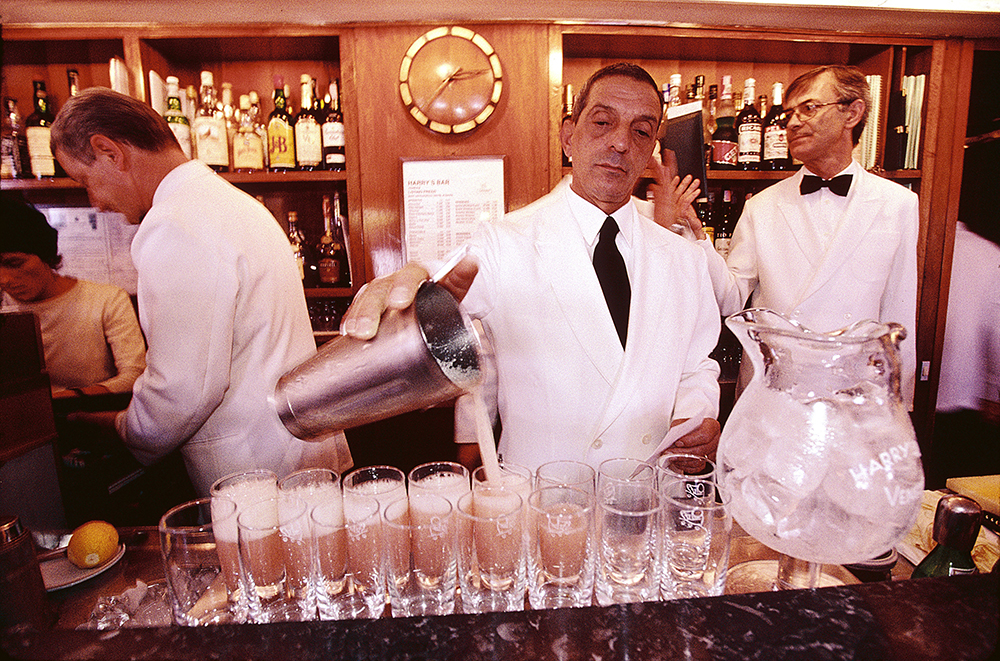
Upon entering, the first thing that strikes one is the size (small), the crowd (busy) and the noise (loud, ma non troppo). The dining tables are low – deliberately so because of the low ceiling – and the walls largely bare. You can sense the continuity, and imagine an Ernest Hemingway, Orson Welles or Truman Capote – to name just a few famous patrons – sitting at the very same bar.
From here you can watch the barman churn out its most famous invention, the Bellini
From here you can watch the barman churn out its most famous invention. The Bellini was invented here in 1948, when Giuseppe decided to use the puree from in-season white peaches and mix it with prosecco. Another invention was inspired by Hemingway, who liked a dry martini by a precise recipe of dry gin to extra-dry vermouth at 15 to one. He named it Montgomery, because he enjoyed the notion that this was Field Marshal Montgomery’s preferred ratio when leading his troops into battle against the enemy. Its sheer dryness makes it ideal for a pre-dinner drink.
For refreshment before or after a long day of strolling around, an off-menu creation that the barmen will still serve might find favour. Rum Roger, created by the legendary former head barman Ruggero Caumo, uses the same white peach base as a Bellini, but benefits from a glug of rum and a splash of fresh orange juice.

At dinner, a half-litre of the house prosecco, produced in the Veneto region, goes perfectly with the fresh fish. In Britain, lamentably, prosecco is often dismissed. Here it reminds you why it should still be widely appreciated. In Venice they produce a delightfully crisp and refreshing fizz which ought to return it to favour as a sparkling wine. A campaign to pursue another day.
Yes, the naysayers will say Harry’s Bar is expensive. And it is. But for even simple things to be done perfectly, it costs money. And of course there are other iconic places to drink in Venice – from the simple red bar in Campo Santa Margherita to the Hotel Danieli. The terrace of the Hotel Monaco, just a stumble out the door from Harry’s, is unbeatable to enjoy a fine white and bigoli in salsa for lunch on a sunny winter’s day. All have something to commend them. But none can compete with the all-round service, history, atmosphere and experience at Harry’s Bar.
Giuseppe Cipriani wrote before his death: ‘Anyone who visits my bar always finds three things: quality, a smile and simplicity.’ That is as true now as it was then, in large part due to Arrigo’s careful stewardship. The Florentines have their Volpi e l’Uva, the Romans have Salotto 42, but Harry’s Bar is Venice’s eternal gem.




Comments