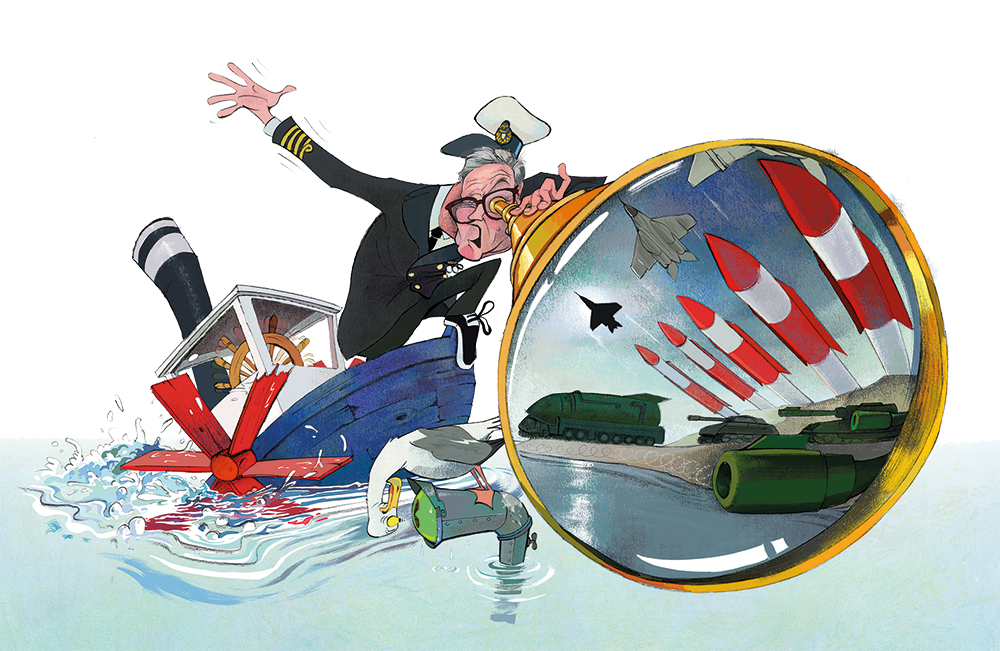


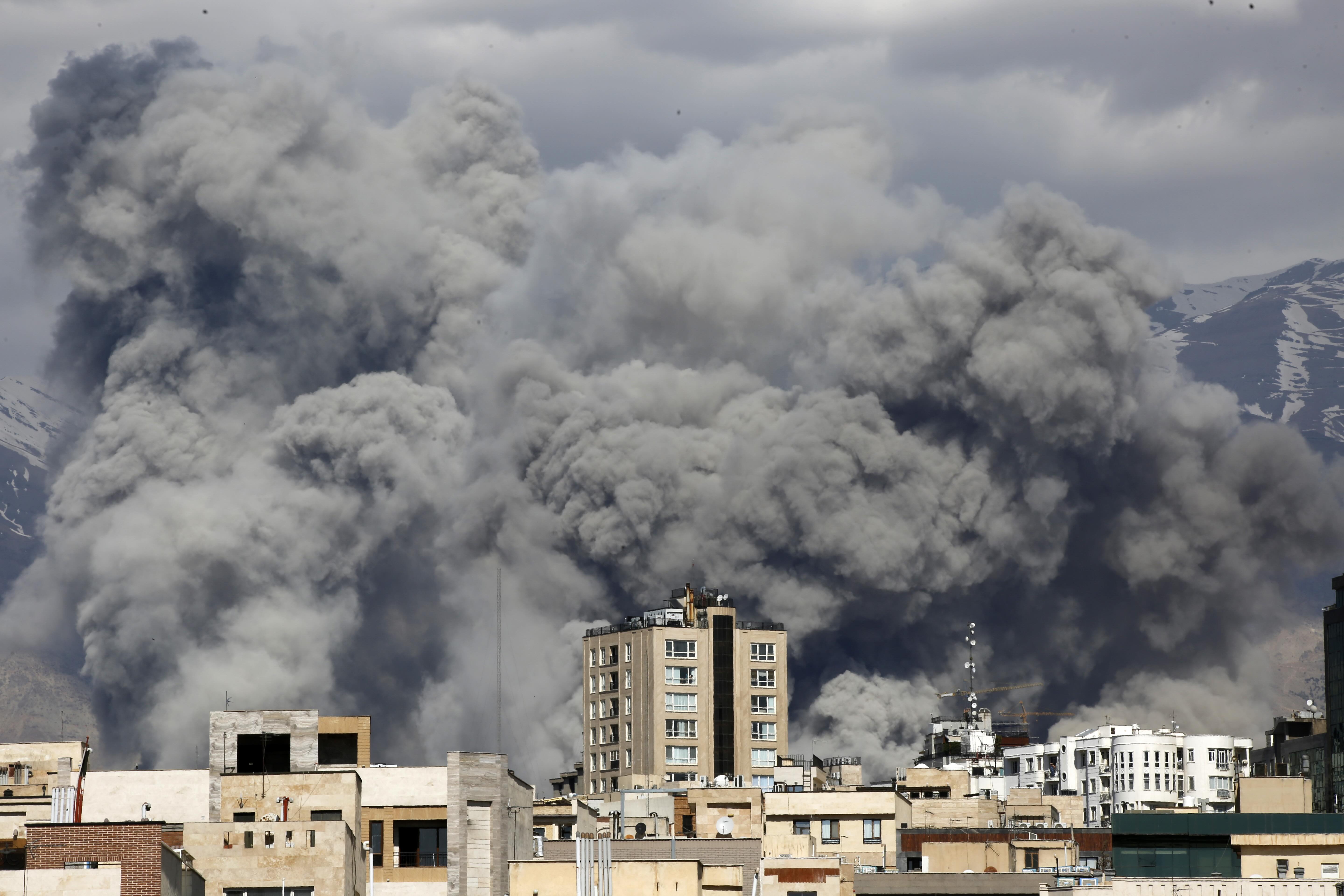
The American-Israeli attacks on Iran were publicly called Epic Fury, but behind the scenes it is Britain’s handling of the war which provoked that reaction – not just from Donald Trump but from the UK’s allies in the Gulf. A Labour peer was in Washington when the first missiles slammed into Tehran on Friday evening and Keir Starmer refused to voice support. A member of the Trump administration told the peer: ‘Britain used to not contribute that much, but you were a good ally. Now you’re contributing nothing and you’re not even a good ally.’
A version of events has quickly become established: a Prime Minister with a near-religious belief in international law hid behind the advice of his Attorney General, Richard Hermer, that the attacks were illegal.
Starmer came under colossal personal pressure from Trump in a series of bullying phone exchanges
The truth is more nuanced and highlights Starmer’s weakness. When the crunch came, in a National Security Council (NSC) meeting on Friday, the Prime Minister was not able to carry his own cabinet. While he did not want Britain to join the military action, he did think there was a case for allowing Trump to use the bases at Diego Garcia and RAF Fairford to launch the attacks. However, he was blocked by an alliance of Ed Miliband, the Energy Secretary, Chancellor Rachel Reeves and Yvette Cooper, the Foreign Secretary.
Hermer’s ruling – that international law does not permit pre-emptive strikes unless there is an ‘imminent’ threat to Britain – was already established when the Americans contacted UK officials on 11 February to ask about the use of the bases – 17 days before the offensive began, 17 days in which Britain could have done much more to prepare. The request was not that Britain join the decapitation strikes but help to protect Gulf allies from likely Iranian retaliation. ‘It was the view of almost everyone that it was not legal for the UK to be involved in the initial attack because there was no imminent threat to the UK from Iran,’ a senior government source says.
Starmer came under colossal personal pressure from Trump in a series of bully-ing phone call exchanges which one source, with Whitehall understatement, calls ‘scratchy’. Another source says: ‘Trump was very angry, demanding, “Why won’t you let me use the bases?” We frequently talk about being shoulder to shoulder with the Americans but, as far as he is concerned, when it mattered to him we were not.’ Matt Collins, the deputy national security adviser, was despatched to talk to Elbridge Colby, the US undersecretary for war, and ‘got both barrels’ as well.
On Friday, ministers attending the NSC were briefed that Iran would ‘fire back at our allies in the region’ and ‘we can then be involved’ to help defend them. ‘That then turned into a massive political argument,’ a senior security source says. ‘The Prime Minister was the person arguing in favour of the UK providing the bases to enhance the US capability’ to attack Iranian missile sites. The source characterises Starmer’s position as: ‘Once Iran starts firing missiles at its neighbours, we need to do everything we can to help prevent that.’ Using Diego Garcia ‘allows the US to significantly enhance the rapidity [with which] they can hit targets’.
Starmer was supported by John Healey, the Defence Secretary, but ‘Reeves and Miliband made it quite difficult for the Prime Minister’. The discussion came down to the legality and whether ‘a positive relationship with the United States of America was a good thing right now for the party. And many people concluded that it was not.’ When asked what role the Labour defeat in the Gorton and Denton by-election played, because the Green party mobilised Muslim voters, a close aide of Starmer says: ‘Zero.’
But security sources are clear that Miliband, in particular, took a ‘petulant, pacifist, legalistic and very political’ approach, questioning why the UK should support the US. ‘He fundamentally doesn’t like Trump, and he doesn’t like this Iran thing,’ one says. As Labour leader in 2013, Miliband thwarted attempts by David Cameron to bomb Syria after the Assad regime used chemical weapons; many in Westminster regard this as a shameful episode. ‘He probably thinks it was a success,’ the source adds.
Cooper adopted the ‘cautious approach of the Foreign Office… de-escalate, negotiate, de-escalate, negotiate’, based on reports she was getting from Oman that talks with Iran over its nuclear programme were making progress. She was only prepared to support basing requests if the conflict moved into ‘phase two’: the Iranians targeting Britain’s Gulf allies. This position was supported by Reeves and Shabana Mahmood, the Home Secretary.

When Healey faced the TV cameras on Sunday morning, Hermer’s advice and the impasse in the NSC prevented him from saying whether or not Britain backed the targeted killing of the Supreme Leader Ayatollah Ali Khamenei, the world’s leading terrorist sponsor. A colleague says: ‘Healey was uncomfortable with what he was being told to say’, because British citizens were in the firing line, ‘but John is not someone who throws his toys’.
On Sunday afternoon there was a second NSC meeting in which Britain’s approach changed. The Americans had tabled an ‘official ask’ on Saturday that the two air bases be used only to attack the missile sites, plus ‘the manufacturing of the missiles and the command and control for the missiles’.
That came after Air Marshal Sir Richard Knighton, the chief of the defence staff, spoke to his American counterparts. ‘He’s been working really hard to explain to the US what is legally possible and to help the US shape their request,’ a senior defence source says. ‘Hermer worked with [Knighton] to determine the art of the possible. And the request became the art of the possible.’ Healey also repeatedly spoke to his opposite number, Pete Hegseth.
This time the NSC agreed that the basing request be granted. Downing Street’s official line is that the situation changed when Iran began firing missiles at hotels and other civilian sites in Dubai and Bahrain. An attack on the Bahraini capital Manama narrowly missed killing British military personnel stationed there. But it is also the case that Starmer and his ministers were shocked by the undiluted fury of their Middle East allies that more had not been done to protect them.
Jordan was ‘fucking furious’, a former minister with friends in Amman says. ‘The Emiratis, Kuwaitis, and even the Canadians are all asking, “What the fuck are you doing? Whose side are you on?”’ The Emiratis pointed out that Britain was failing to help protect the 240,000 British citizens living in Dubai and Abu Dhabi.
After the initial US request, Britain could have sent two Type-45 destroyers, which have air defence capabilities, to the eastern Mediterranean to protect Cyprus and Jordan. Instead, some military assets were withdrawn. ‘The Cypriots are incandescent,’ a security source reveals. Only on Tuesday did it emerge that HMS Dragon will deploy – 20 days after the first US request for support. The only available Astute class submarine was near Australia. ‘It passed through the Gulf area a few weeks ago and it could have been kept there as a contingency,’ a former commander says.
Ministers, officials and military officers all regard Hermer as an impediment to Britain’s national security – both because of his doctrinaire approach to international law and because he reinforces Starmer’s legalistic instincts. ‘Bring back Suella!’ says a member of the National Security Secretariat – a reference to the former attorney general Suella Braverman, who asserted parliamentary sovereignty over international treaties.
‘Every senior minister receives legal advice,’ says the former defence secretary Ben Wallace. ‘It is advice, it is not direction. However, under this government, Lord Hermer has become the power in the land where his advice becomes the rule.’ A former mandarin adds: ‘There’s a lot of frustration in the professional national security gang because they feel that Hermer is essentially running the entire policy.’ Others point out that when Starmer was in opposition, before Hermer was his legal adviser, he backed air strikes on Houthi militias, who had done less to menace Britain than Iran. Security officials now fear Britain is ‘in an incoherent position’ by allowing the US to use our bases to attack Iranian missile sites as an act of self-defence but refusing to launch such attacks ourselves. One calls it ‘unconscionable’ and accuses Starmer of ‘free riding’. A former defence chief brands it ‘reprehensible’.
Britain has actually done more than most to help, deploying F-35 jets and giving missile interceptors to allies. But by dithering on Friday, Starmer has received no credit. He was totally out of step with key allies. Mark Carney and Anthony Albanese, the leaders of centre-left governments in Canada and Australia, openly backed the attacks. ‘We seem to have been blindsided by what they were going to say,’ an official admits.
‘The UK is kept safe by three things: nuclear weapons, Nato and having America as our principal ally’
Friedrich Merz, the German Chancellor, dismissed international law as ‘having relatively little effect’, arguing: ‘This is not the time to lecture our partners and allies.’ Some 60 per cent of the increase in European defence spending comes from Germany, while Britain slips down the list of net contributors to Nato.
On Monday, when Starmer suggested that Trump did not have a ‘thought-through plan’ for Iran, Emmanuel Macron announced an increase in the French nuclear arsenal and the deployment of nuclear-armed aircraft to European allies. ‘To be free, one needs to be feared,’ he said.
A former defence chief says: ‘The UK is kept safe by three things: nuclear weapons, Nato and having America as our principal ally. We’re just about keeping the nuclear show on the road, but we are reneging on our Nato commitments and we’re weakening the relationship with our principal ally.’
It is easy to see why a US diplomat told me this week that Starmer is ‘not exactly Margaret Thatcher redux’. Trump went further, informing reporters that he was ‘disappointed with Keir’ and telling Merz the PM ‘is not Winston Churchill’. The only No. 10 point of contact with Israel is Jonathan Powell, the national security adviser. Starmer and Benjamin Netanyahu do not speak. The fear is that the Americans will now cut out Britain and strike a deal of their own with Mauritius for the use of Diego Garcia. ‘This has put fuel in that tank,’ a former national security official says.
It is hard to escape the conclusion that Starmer’s need to placate his party has been put before the strategic interests of the country. He did at least get credit from his MPs, who remain haunted by the Iraq war. When he addressed MPs on Monday evening, Calvin Bailey, a former RAF officer and the MP for Leyton and Wanstead, got to his feet and said: ‘In March 2003 I flew combat missions into Iraq. I want to thank you, Prime Minister, for doing right by our service personnel.’
In Whitehall, however, there is a fear that the intensity of Labour’s feelings is matched by their irrelevance. A former Downing Street adviser says: ‘The way we’ve behaved towards our allies in the last week means no one cares what we think and we have zero capacity to shape things.’
Tim Shipman discusses Starmer’s response with James Heale & Patrick Gibbons on the latest Coffee House Shots podcast:


Comments