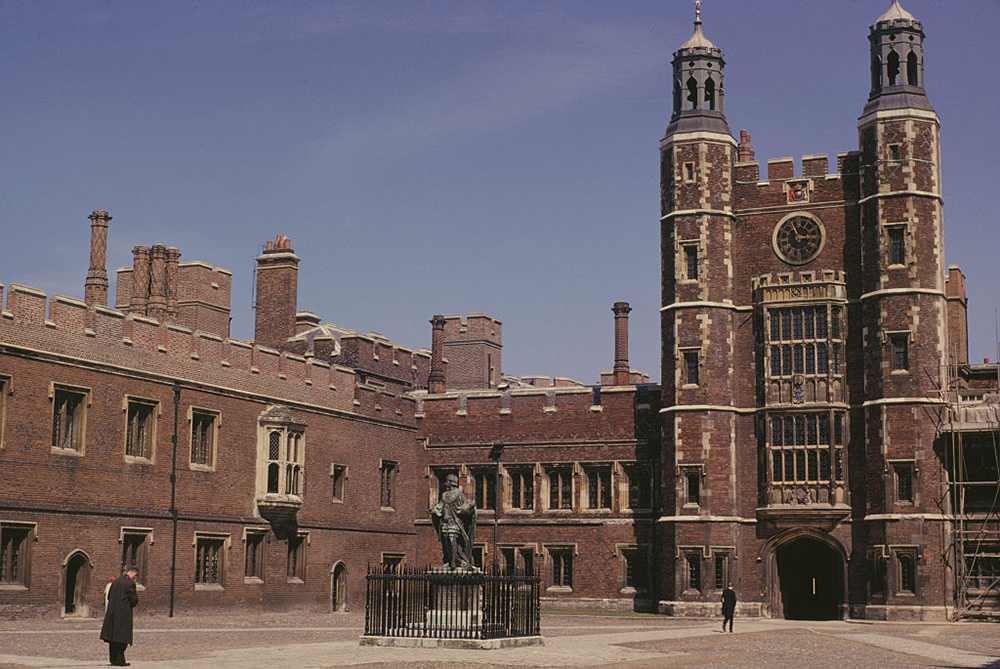
If the Battle of Waterloo was won on Eton’s playing fields – as Wellington allegedly said – might Xi Jinping’s 21st-century ambitions for China end up being pushed there too?
A picture of the list of next year’s King’s Scholars, currently doing the rounds of Old Etonians, shows that of 14 places awarded for September 2026, ten are going to pupils with Chinese names. ‘Yet another nail in the coffin,’ grumbled the OE who sent me the picture the other day. The scholarships were established by Henry VI for ‘poor, scholarly boys’ in his kingdom. These days, with the upper-middle-class English increasingly priced out of paying the £65,000-a-year fees, they are more sought after than ever – and bitterly resented when they go elsewhere.
The make-up of the KS list is just the latest news to have gone down badly with alumni continually being hit up for donations. It has all added to the general angst that’s surrounded the 12-year tenure of outgoing head Simon Henderson. ‘Trendy Hendy’ – as he was nicknamed for his attempts to modernise the school – is being replaced in September 2027 by Alastair Chirnside, currently warden (head) of St Edward’s, Oxford – aka Teddy’s.
‘It’s not much good bleating about being a charity while filling the place up with massively rich foreigners’
I know both men. Chirnside, a brilliant classicist, was a contemporary of mine at Eton and Oxford. Henderson, a pupil at Winchester in the same era, was an amiable opponent on the football pitch who I’ve bumped into occasionally since.
You could barely imagine two more different personalities. Henderson is convivial, sociable and modern to a fault – proudly appointing a director of inclusion education and a female deputy in his early years as ‘head man’, colloquial Eton speak for the official (and strictly two-word) ‘head master’. Chirnside is a more austere, academic figure whose opening gambit when he arrived at Teddy’s was to reinstate landlines and ban pupils from using mobile phones.
What does the change mean for the world’s most famous, and sometimes infamous, school, where Prince George will be arriving in September?
According to some sources, this is the first powerplay by Sir Nicholas Coleridge, the former Condé Nast publishing boss, who replaced Lord Waldegrave as provost of Eton a couple of years ago (provost being the chairman of the school’s governing body). ‘Nick inherited Trendy Hendy, who had been very much William Waldegrave’s man,’ one source tells me. ‘Nick is much more sensitive to old-boy opinion than Waldegrave, who was very supportive of all the woke stuff. Raising money from pissed-off alumni isn’t easy and Nick is nothing if not commercial, whereas Waldegrave was sniffy about the views of other Old Etonians. I think in general there’s a view that Eton has lost a bit of its soul and that we could do with a period of rediscovering what the point of the school is. It’s not much good bleating to the government about being a charity while filling the place up with massively rich foreigners.’

It has been claimed that only about 15 per cent of Eton’s student body are foreign. The true figure, when accounting for boys whose foreign-born parents are living in Britain (often working in financial services), is understood to be rather higher – possibly as much as a third.
Henderson’s departure at the age of 51 was certainly not widely predicted. After some turbulent times in his early years, when he seemed to be endlessly in the media for perceived ‘wokery’, things had recently calmed down. It’s only fair to point to the achievements of his time in the hot seat, not least multiple partnerships with state schools and bursaries to help less wealthy parents meet the ever-escalating fees. Nor is it an easy job – no matter what Eton heads do, they will end up irritating at least some of the people some of the time. And while other schools appear in the media only during the most intense of scandals, at Eton even minor occurrences can end up as double-page splashes in the Daily Mail.
However, it was hard to escape the feeling that, as a Wykehamist himself, Henderson never quite ‘got’ Eton. Where Winchester (alma mater of Rishi Sunak) has always been primarily an academic school, Eton had traditionally catered for a broad mix of academic ability, from the mega-brained King’s Scholars to others who might go on to make their mark in the army, Hollywood, sports or the entrepreneurial world.
One ‘beak’ (as Eton’s teachers are known) tells me: ‘While there has always been an element of moving with the times, generally Eton would sit towards the back of that advance. Under Henderson, it has sometimes seemed as though there was a pointed effort to shock the sensibilities of teachers and OEs by trying to put us at the forefront of progressive education. I think that has been mistaken.’
Such complaints are unlikely under Chirnside, who is at heart a traditionalist, even if more malleable than his outward image might suggest. As a former master at Eton himself, he has deep-rooted friendships in the school’s notoriously tricky masters’ common room. He’s also a fierce achiever: apart from his impressive academic record (a double first in greats and modern languages from Merton College, Oxford), he also starved himself down to ten stone to qualify for a half-blue as a lightweight rower.
Chirnside’s in-tray will doubtless be overflowing when he takes up the post just over a year from now. He will face familiar headmasterly issues – recruitment of top teachers, demands for new facilities – as well as more topical ones, such as the government’s crusade against private schooling. More importantly, though, may he be gently starting the process of answering the more existential question: what is the point of Eton? Is it principally to educate the best of British? Or to be a melting pot for the world’s richest to send their highly tutored children to enjoy the benefits of an institution built up over centuries?
If Chirnside stays the course – his great predecessor Sir Eric Anderson completed 14 years, from 1980 until Alastair’s final term in summer 1994 – he’ll still be there on Eton’s 600th anniversary in 2040. For the school to really remain part of our national discourse, that fundamental question is going to have to be answered.





Comments