
During the autumn of 1888, as London’s East End erupted in panic following the Whitechapel murders, blame was soon cast on a convenient target: the area’s large number of recently arrived Russian Jews. Initially the killings and mutilations were linked to a Jewish suspect called ‘Leather Apron’, real name John Pizer, a bootmaker known to have used and abused prostitutes. But even after he cleared his name the stories persisted.
The new arrivals had heard this all before; back home these sorts of rumours were usually the trigger for the pogroms which had forced them to leave. Expecting the police to round them up and frame one of their number, many within the community went to ground, closing their doors and waiting for the inevitable. It didn’t come, and instead they re-emerged into city life to a new realisation: that wasn’t how things worked in England. The police were not in the business of mob justice; there would be no pogroms, no scapegoating. The process of law and order worked – although, as it happened, they didn’t catch the killer, so not all that well.
Life in Tsarist Russia was different, characterised by a system of policing that ruled by fear rather than by consent, a society of low trust, an intense suspicion of out-groups, a zero-sum approach to prosperity and so a particular hatred of anyone whose wealth was seen to be earned on the back of other people’s labour. There was also deep-seated religious prejudice, manifested in, and fuelled by, a range of beliefs about such things as the ritual murder of children, which spread easily among an illiterate population credulous to outlandish stories.
This misreading of history may be due to our overriding civilisational memory being that of the Third Reich
Although the blood libel had originated in mediaeval England, such thinking had long been suppressed there. There were still people who believed in such things – I’m sure if you polled East Enders in 1888 many probably did think the Ripper was engaged in some wacky Talmudic ritual murder – but politicians ignored them and the police made sure to crush them.
Most of Britain’s 300,000 or so Jews today descend from those Russian refugees who settled in the East End; as they became more established and less impoverished, they migrated in an anti-clockwise direction, the most religious settling in Stamford Hill in north-east London and Golders Green to the north-west, with the more secularised thinly populated in the areas in between. These suburbs were always noted for their tranquillity: cosy, safe and peaceful.
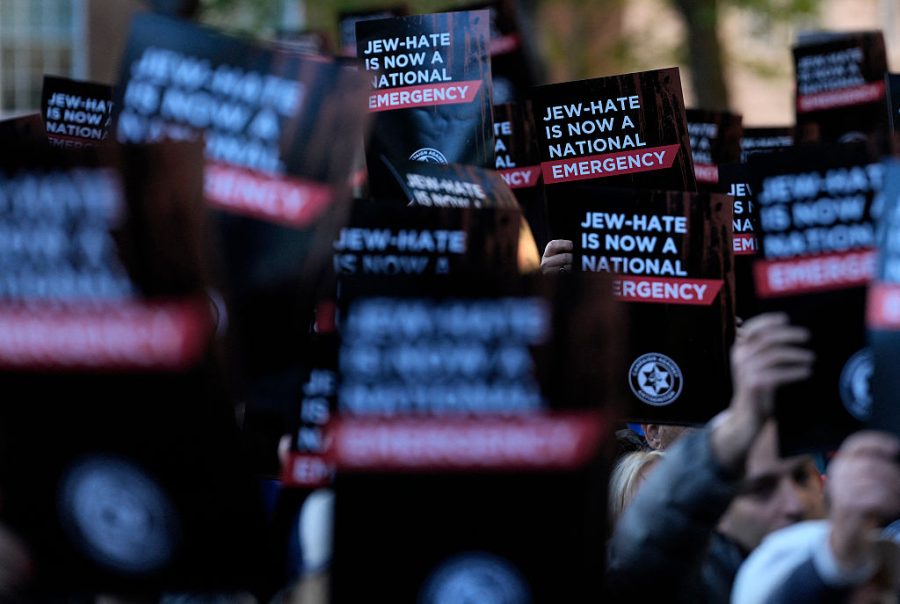
Golders Green today still has the highest concentration of Jews in Britain, accounting for half the local population, but is not so tranquil. On Tuesday, a local memorial wall to the victims of Iranian oppression was firebombed, and on Wednesday two men were stabbed in the street, with a suspect now charged with attempted murder. The latest incident follows a number of anti-Semitic attacks in the wider area which began following the war in Iran.

Such violence is contagious and memetic, as the Victorian authorities knew, and seems only likely to escalate. Anti-Semitism has now been declared a ‘national security emergency’ by a government advisor and Britain’s terror alert has been raised to ‘severe’. The situation is alarming but also perhaps predictable.
One mistaken idea held about multiculturalism was that, as a country became more diverse, so would it become safer for minorities. Up to a point this may be true, but not as a rule. People looked to the history of the United States and assumed that, with such an ethnic mix, no single group could be singled out and persecuted. They got this wrong because they saw the state, backed by the main ethnic group, as the only danger, while an equally plausible threat comes from an absence of order and political stability.
Taking a look at our own continent’s history, the opposite is true; until the First World War at least, Jews were much safer in relatively homogenous states like Britain, the Netherlands and the Scandinavian kingdoms than they were in the diverse regions of central and eastern Europe. In the west of the continent Jews might be a visible minority; they might even be excluded from certain institutions and suffer all the usual minor prejudices that outsiders suffer. But they were not subject to state violence or extortion, nor the mob; they could depend on a fair legal system and stable politics in which ethnic tension was not a driving force. They were not pressured into siding with one political movement because their opponents wanted to oppress or kill them.
This misreading of history may be due to our overriding civilisational memory being that of the Third Reich, which did indeed involve a relatively homogenous European state persecuting its one (highly-integrated) minority. Yet in the wider historical scheme of things, Nazism was extremely unusual: it was not an idea whose time had come, but the creation of an evil political genius exploiting a particular set of circumstances, and one whose genocidal beliefs were formed among the the ethnic hatreds of Austro-Hungary.
In contrast to life in the West, in the Austrian and especially Russian empires the existence of competing ethnicities made Jews a target, or at best collateral damage in the conflict between others. In Ukraine: Forging of a Nation, Yaroslav Hrytsak described how:
Most large cities on the Ukrainian lands resembled New York more than Prague or Tallinn; different ethnic and religious groups walked the same streets but spoke different languages and sometimes even lived in separate neighbourhoods. The social structure of such cities resembled that of medieval towns, where each ethnic group occupied a specific niche: Ukrainians were domestic servants and lived on the outskirts; Russians were officers, engineers and workers; the British, Belgians and French were entrepreneurs or the most skilled workers who lived in the most expensive neighbourhoods; Poles were landowners who spent winters in the city and so on.
This type of ethnic niche-based system, which had been the norm in empires throughout history, proved to be politically toxic in the age of mass movements. Without the economic freedom, political stability and absence of corruption and nepotism found in the United States, not to mention the pressure to integrate, life tended towards an ethnic competition in which the success of others was a cause of resentment.
The politics of class, found in every democracy, here took on a far more toxic nature, for as Bolshevik politician Moisei Rafes put it:
In Ukraine, where the landowner was a Russian or Pole and the banker and merchant were most often Jews and neither understand the common speech, for a Ukrainian, the expression “down with the lords” could mean “down with the Poles, Russians and Jews”.
This also encouraged a zero-sum worldview based on economic illiteracy: we are poor because they are rich. Such a mindset is especially dangerous for market-dominant minorities, such as the Armenians, East African Asians and overseas Chinese, but it is the direction of political travel in the 21st-century West. The Great Awokening, by emphasising the idea that one group’s success must be another’s sorrow – and where politics is marked by the sort of group competition forecast by Francis Fukuyama – psychologically opened the door for anti-Semitism on both the Left and Right. It was the perfect kindling for the orgy of hate which erupted after 7 October and which began here even before the victims of that massacre were buried.
In some ways the conditions may be worse in the United States, where for various reasons anti-Semitism is making a return among young right-wing Americans, raised in the heady atmosphere of racial resentment. Although some fringe figures on the British Right follow a similar logic, the same conditions don’t exist here, where Jews are demographically marginal, more politically conservative, and where the threat of political Islam is far greater and a unifying force for the Right.
Today the state is characterised by well-meaning ineptitude and the natives are hapless onlookers
Yet Britain does have some huge disadvantages, not the least its zero-growth economy, which entails that every financial gain clawed by one group out of the Treasury must indeed come at the expense of another. In the state of nature that is economic stagnation, life does indeed become a zero-sum game. As literacy further declines, we also see a return of bizarre neo-mediaeval beliefs, whether it’s about Jewish involvement in 9/11, human organ harvesting by Israelis or even the use of animals to attack their enemies. Almost every atrocity against Jews in Britain is viewed by significant sections of the population as false flags, beliefs spread on TikTok and Instagram – that chosen medium for the post-literate.
Perhaps most crucially, Britain is now home to a population heavily composed of people who have grown up in the sorts of societies resembling Tsarist Russia – and with all the outlandish beliefs and sullen resentments that go with it, countries in which anti-Semitism is widespread and ingrained. This would be manageable with a state prepared to treat each community fairly and firmly, but the British have lost the will to do so. Obviously dangerous radicals, even foreign nationals, are allowed to preach the most hair-raising invective without fear, while the state fails to punish those engaged in communal violence. This is a degree of complacency which our Victorian forebears would have thought to be outrageously irresponsible.
While many express their sorrow about the current situation, they are unable to articulate what the threat is and so deal with it. The invocation about ‘never again’ refers to violence from the state and from nativists, while today the state is characterised by well-meaning ineptitude and the natives are hapless onlookers. Rather than reliving Nazi Germany, it’s plausible that the future for Jews in Britain is going to be much more like South Africa or Brazil, with communities taking on the feel of a fortified middle class. In other words, they will start to acclimatise to life in a third-world country. Jewish existence won’t disappear; it will just become harder and more miserable, tolerable enough that those who brought this situation about can ignore it because of the fear that liberalism’s excesses create problems which only illiberalism can solve.
This article first appeared on Ed West’s Wrong Side of History Substack.




Comments