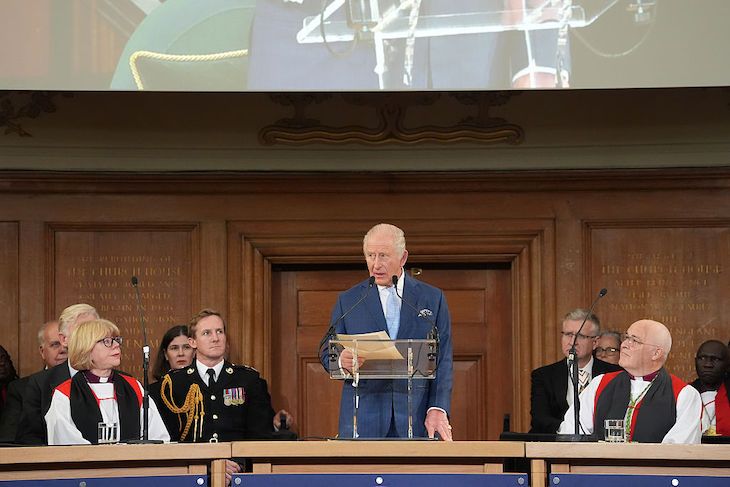
When the King opened the new five-year term of the Church of England’s General Synod this week, he repeated the line about the established Church that both he and his late mother have held for a few decades. As he put it: ‘The Church protects not just the Christian faith of all of us gathered in this room, but the very space for faith itself – of every belief – within our whole society and national discourse’.
The King is affirming this tradition. But he could do so a bit more clearly
The late Queen made the point a few times, most clearly to an interfaith audience at Lambeth Palace in 2012. She said that the role of the established Church was often misunderstood: its duty was not to exclusively defend Anglicanism, or to exclude other religions, but to protect the free practice of all faiths in the UK.
So this is the new orthodoxy about the meaning of establishment. It obviously has the backing of the Church itself to a large extent, though an archbishop would not put it quite in these terms, being more aware that his or her prime duty is to the Church not the nation.
Is it right? Is it true to the traditions of this country? Yes and no, I suggest.
Of course it is at odds with the original meaning of establishment. Even a schoolchild and anyone who has ever watched a history documentary on BBC4 knows that Henry VIII wasn’t much of a liberal. The Tudors basically launched a new version of medieval theocracy – an even tighter version in a way, for nation and Church were now fused.
But this began to change in the late seventeenth century: the nation accepted the principle of religious liberty, up to a point, and rejected the old ideal of a strictly confessional state. From then on, the formal structures of establishment became gradually hollowed out, as liberal politics became more firmly established.
In effect, the Church of England agreed to be the established Church of a liberal state. It’s a bit of a paradox, and we have never really got our heads round it. But it is, in my opinion, a wonderful thing, and the reason that I am proud to be Anglican.
The King is affirming this tradition, the fact that the meaning of establishment has changed in modern times. But he could do so a bit more clearly, I humbly suggest.
He says that the established Church protects religious liberty. This is a bit misleading. It is the state that protects religious liberty. Yes, the Church is part of the state, but the emphasis should be on the state doing the protecting. We have laws that protect freedom of religion, and these laws are upheld by an effectively secular parliament. It is wrong to imply that secular-minded agnostics are incapable of defending religious liberty.
What he should say is something like this: ‘This established Church is pretty unique. It has, gradually over recent centuries, joined forces with the principle of the liberal state. Indeed, it played a central role in the emergence of such a state. It therefore declares that there is a deep affinity between Christianity and liberal politics. I am proud to be the figurehead of that declaration.’



Comments