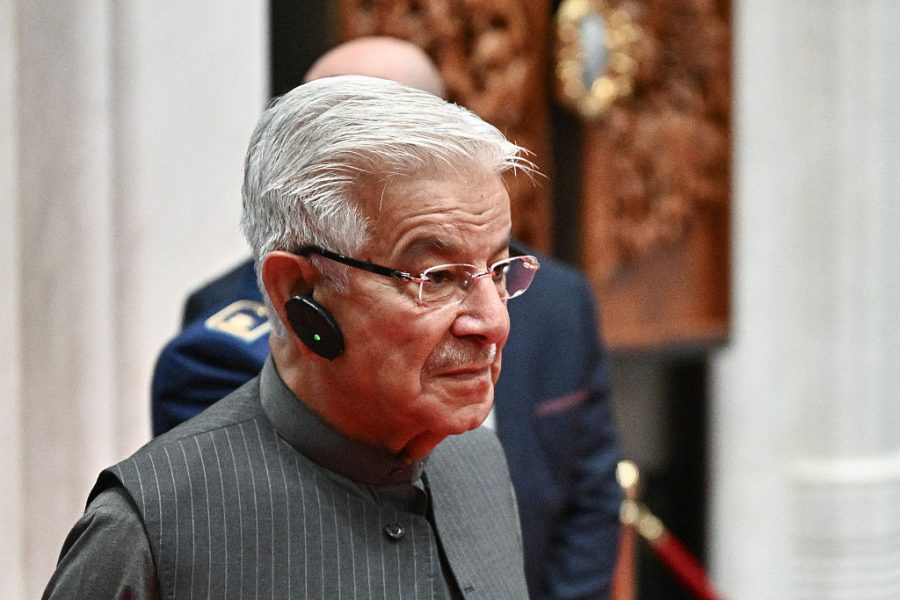
Pakistan’s defense minister, Khawaja Asif, rather excitedly proclaimed a new defense agreement – the Mecca Joint Defense Agreement – between Saudi Arabia, Pakistan and Turkey as the beginnings of a “Muslim NATO” last week. He proceeded to call on Muslim countries to set aside their differences and join them. The key clause – that an attack on any one of the three countries would be considered an attack on them all – is virtually the same as NATO’s much-vaunted Article 5, widely regarded as the underpinning of that alliance. But, unlike NATO – whose historic purpose and focus was articulated by the alliance’s first secretary general, General Ismay, as “keeping the Americans in, the Russians out and the Germans down” – it is very unclear what the strategic intent of this new defense accord is.
Certainly, closer defense and security co-operation between Saudi Arabia, Pakistan and Turkey may bring mutual, complementary benefits. Pakistan is the only Muslim country to own nuclear weapons and has over a million men under arms; Saudi Arabia brings its economic strength, the prestige of Guardianship of the Holy Places, and traditional regional leadership; and Turkey has the second-largest standing army in NATO, wide interests over Central and South Asia and a thriving defense industry. At least on paper, this is a formidable combination.
A new security architecture is emerging in South Asia
The agreement also builds on previous, unshowy, but not insignificant, agreements. The Saudis and Pakistanis signed a not dissimilar pact to the Mecca Agreement in September last year, with almost identical collective security provisions. This, in turn, was built on many years of Pakistani technical and training support to the Saudi Armed Forces. Both countries were keen to stress however, that this did not include the sharing of nuclear weapons technology – despite some sniffing around the possibility of acquiring such weapons by Saudi Arabia, largely in response to the threat from Iran.
This also points to one of the inherent geopolitical contradictions with this accord: unlike the oft-quoted, and well-worn, driver of perhaps unlikely alliances, “the enemy of my enemy is my friend,” with all three countries there are instances whereby “the enemy of my friend is my friend.” In short, unlike NATO, there is no clear threat nor a unified, single, recognized world view between them.

Turkey remains a member of NATO proper and, while the country’s President Erdoğan loathes Israel’s prime minister Benjamin Netanyahu, the two countries co-operated after 9/11 to tackle Islamist threats. Meanwhile, Saudi Arabia’s main focus is containing Iran and, as regards its relations with Israel, while not friendly, they could, until the Gaza conflict, probably be described as “Abraham Accords-adjacent.”
Pakistan’s geopolitical obsession remains India, with a side order of dealing with disorder in its Pakhtunwali (NW Frontier) province and its now unruly former ally, the Taliban-controlled Afghanistan. This is despite Asif’s strong anti-Israeli, and often vile anti-Semitic, rhetoric. The Pakistani defense minister has, among other things, called for “the expulsion of European Jews.” It is also very difficult to imagine Turkey, with its strong trading links to India, intervening in any Indo-Pakistani dispute. Meanwhile, all three countries, who are predominantly Sunni, have been at pains to reassure Iran that this is not the beginning of an anti-Shia coalition. So what is it about?
Beyond an aspirational appeal to Muslim brotherhood, which can still resonate in the Islamic world in a way that an appeal to “Christendom” or even “the West” can sound tinny, the impetus for this defense agreement owes most to the continuing reshaping of America’s alliances and force structures. Its current imbroglio in the Strait of Hormuz will only accelerate this.
America’s National Security Strategy, published last year, carries a clear emphasis on “America First” and the accompanying “Donroe Doctrine”, which declares US pre-eminence in the Western Hemisphere. It also outlines America’s plan to withdraw its forces from various geographical arenas, with allies taking responsibility for their own security. The US may still act as a security “guarantor of last resort” but only – and this is the Trump transactional model – if those allies genuinely burden-share, and not, as the Europeans have largely done since 1991, freeload.
Even Israel, which has always regarded America as its dependable friend, may find that Netanyahu’s insufferable “tail wagging dog” behavior has its limits. America will never abandon the country but would quietly welcome a “contained” Israel, one that is not at continuous war with its neighbors – and thus needing US help. This would allow America to focus on its Middle Eastern business interests, which might even include supping with that resource-rich “devil,” Iran.
The Mecca Agreement suits the US very well indeed. It is inconceivable that the Saudis, in particular, would have signed the deal without consulting Donald Trump first and all three countries are regarded, particularly by the President, as strong allies of America.
The reaction to the Mecca Agreement has been somewhat cautious so far. Commentators point to the lack of an integrated command structure, planning, and the decades of training, habitual affiliation, and doctrinal coherence that the new allies have compared to NATO. But that is to somewhat miss the point: firstly, they may come in time, but more importantly, the Agreement is primarily, at this stage, a political statement. Meanwhile, both Israeli and Indian commentators have found common cause, suggesting closer co-operation between their two countries to counter this potential “Muslim bloc”. In the Mediterranean, anti-Turkish concerns have precipitated the ever-deepening Israeli-Greek and Israeli-Cypriot defense partnerships. This now includes a $4 billion “Achilles Shield” layered air defense program, signed in July this year.
A “Muslim NATO” may not be an exact, or even helpful, analogy for it, but the Mecca Agreement does mark a watershed. While it is not an “East of Suez” moment for the US, it signals that a new security architecture is emerging in South Asia, which will take time to develop. Britain, until now America’s faithful auxiliary in the Middle East and elsewhere, may struggle to find its place as this new order takes shape.




Comments