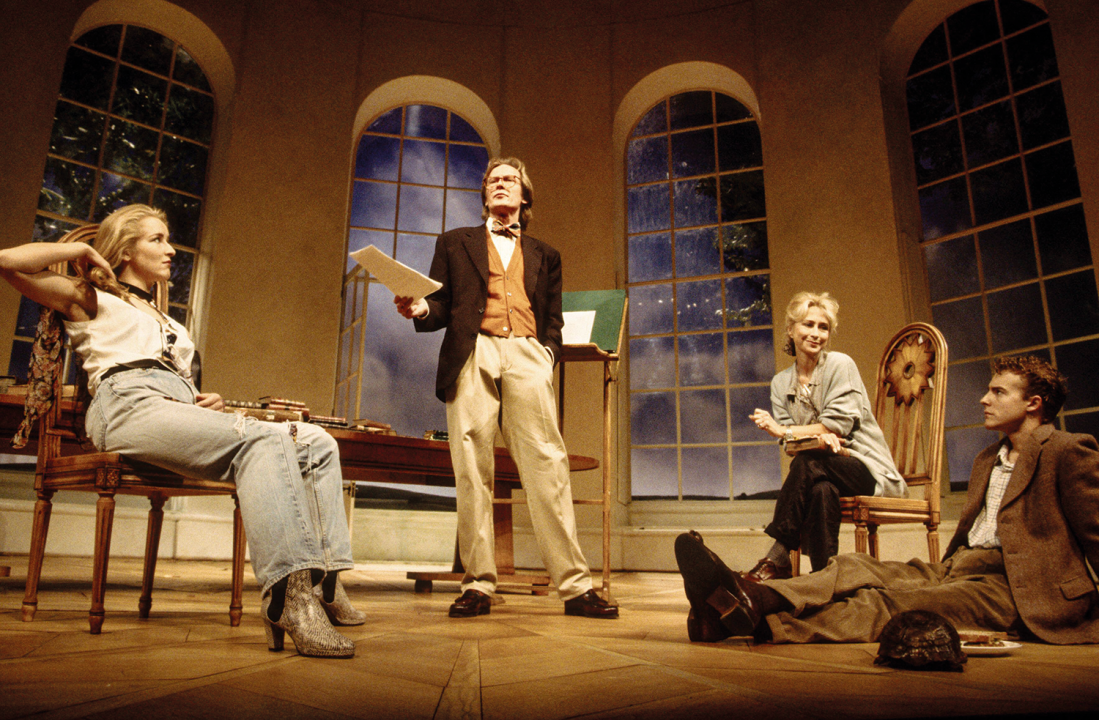
A few days after Tom Stoppard’s death last month, Michael Baum, a distinguished surgeon, wrote a letter to the Times. He explained how Stoppard’s discussion of chaos theory in Arcadia had inspired him to discover a new and far more effective chemotherapy to treat breast cancer. ‘Stoppard never learnt how many lives he saved by writing Arcadia,’ wrote Baum.
I’ve long been fascinated by the relationship between science and drama. I knew Tom Stoppard and when I was professor of history and philosophy of science at UCL, we had several illuminating conversations about art, science and theatre, which he recalled in a 1994 article entitled ‘Playing with Science’ for the journal Engineering and Science. ‘Science and art are nowadays beyond being like each other. Sometimes they seem to be each other,’ he wrote. I don’t think he would object to my replacing ‘art’ with ‘drama’.
‘Stoppard never learnt how many lives he saved by writing Arcadia’
For anyone wanting to get to grips with science and get a sense of what is happening inside a scientist’s head, plays and films are essential. They can enable us to read between the lines of, for example, a scientist’s correspondence. What were they getting at in their complicated hypotheses or articles? ‘The great challenge facing the storyteller and the historian alike is to get inside people’s heads… to make some informed estimate of their motives and intentions,’ wrote Michael Frayn discussing Copenhagen, his play about the physicists Werner Heisenberg and Niels Bohr. ‘And this is precisely where recorded and recordable history cannot reach. Even when all the external evidence has been mastered, the only way into the protagonists’ heads is through the imagination.’
I’ve tried to do this myself in Synchronicity, my play about the relationship between the analyst Carl Jung and the brilliant but troubled physicist Wolfgang Pauli that ran at the White Bear Theatre last year. Today, there are plenty of dramas that take science as their theme. But how many actually contain scientific ideas? Most, in my experience, merely celebrate the scientist’s life. They don’t push scientific thought further, let alone catalyse a scientist’s thoughts. Oppenheimer (2023), for example, contained very few ideas, being more about one man’s persistence in the face of political adversity than anything scientific. It’s a people story masquerading as a science story.

Contrast this with Copenhagen (1998). In it Bohr and Heisenberg, together with Bohr’s wife Margrethe, meet some time after their deaths. They are in a nether world, where Bohr and Margrethe forever puzzle over why Heisenberg visited them in Copenhagen in 1941 during the Nazi occupation. Existing outside of space and time, the three circle each other like electrons around a nucleus, tossing ideas about, talking sometimes to each other, sometimes to themselves.
In the course of the play they discuss Heisenberg’s uncertainty principle, nuclear physics, the making of the bomb. All the while, Bohr is wondering what Heisenberg is really up to. Does he want to find out whether the allies are building a bomb or is he trying persuade Bohr to cooperate with the Germans? Frayn doesn’t shy away from presenting the science as correctly as possible, while integrating it into a complex plot charged with human emotion.
Frayn has said that he used only the actual words spoken by the individuals themselves, but in reality no one had taken any notes of the meeting. He relied on published reminiscences and the historical reconstructions of others to construct his plot.
The success of Copenhagen amazed Frayn. But it wasn’t the first time that theatre and science had been brought together with such panache. Brecht’s masterpiece The Life of Galileo was, like Oppenheimer, about a scientist’s travails but it went far beyond the personal, presenting grand ideas with intellectual courage.
Another play that brilliantly wove together a human story with science – and vividly brought it all to life – was A Disappearing Number. It’s the story of the Indian mathematician and self-taught genius Srinivasa Ramanujan and the racism he suffers in early 20th-century Cambridge. The play bombards the senses with Indian music, dance and wildly colourful scenes, providing a visual kaleidoscope which seems to reach towards infinity, as did Ramanujan’s mind.
Patterns lie at the heart of the work: the number patterns that Ramanujan’s mathematics reveal, which in turn touch on the fabric of nature. These patterns also touch on our lives. This is brought out in a parallel story set in modern times about an English maths teacher who goes to India. Her untimely death mirrors Ramanujan’s, and forces her Indian-American husband to follow her to India to be with her ghost.
TV has also occasionally succeeded in marrying the two disciplines. In the BBC film Einstein and Eddington (2008), with David Tennant as the British scientist Arthur Stanley Eddington and Andy Serkis as Einstein, the science is sound, the ideas central to the film. But though creative licence is taken with the two protagonists’ lives, Tennant and Serkis closely resemble the characters they portray, avoiding caricature as is too often the case with Einstein. They also know how to speak the science.
For science to work as drama we need poetic licence, going beyond the documents at hand
This can be a problem. Too often playwrights and directors have virtually no experience of how scientists talk or behave towards each other. Scientists are sometimes consulted on these matters but the problem persists. Perhaps we need actor-scientists to avoid what happened in Oppenheimer, where the characters sounded like musicians comparing each other’s compositions.
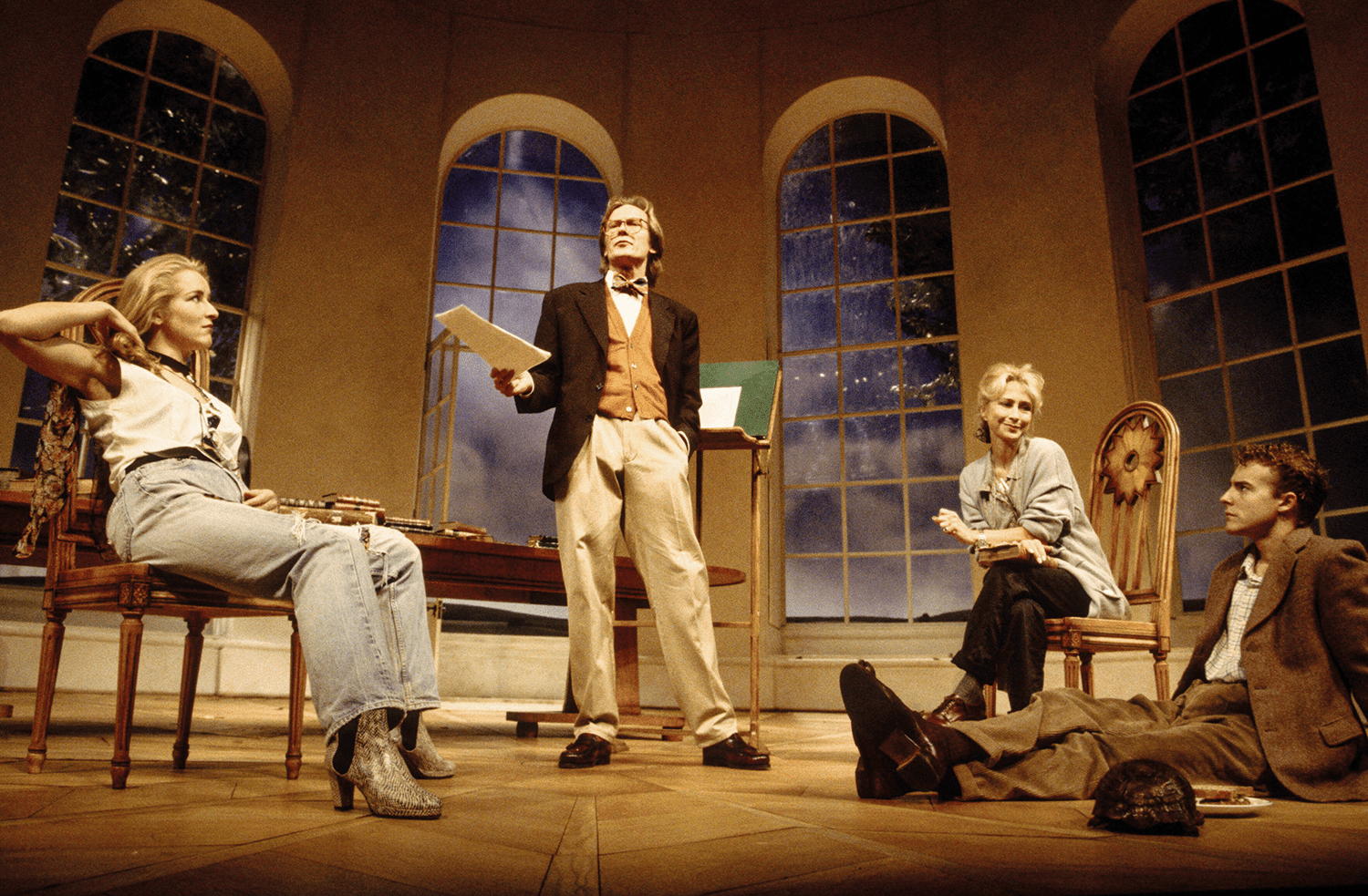
Stoppard’s Arcadia (1993) is a tour de force and is frequently revived. But how is the science? The play is about chaos theory, thermodynamics and determinism. Rather than attempting to explain these, Stoppard instead sets out to dazzle, with a plot that brings together scientists and poets and veers towards the esoteric. We also get a scientific detective story, with two timelines hundreds of years apart, all delivered in Stoppard’s trademark effervescent dialogue. Arcadia is a celebration of erudition as much as of theatre and science.
When I wrote Synchronicity, I was determined to get inside the heads of Jung and Pauli. My play explores their sometimes stormy relationship. In their discussions they struck sparks off each other. Synchronicity is about psychology, physics, alchemy and the extraordinary things that can happen when great minds meet. I re-imagined much of the dialogue using Jung and Pauli’s extensive correspondence as well as Jung’s Psychology and Alchemy that incorporates Jung’s notes from his analysis sessions with Pauli. To be sure that the actors actually spoke like scientists, I coached them myself. I was gratified when Jungian analysts came up to me after performances and told me I had caught the essence of these sessions.
For science to work as drama we need poetic licence, going beyond the documents at hand. At some point the director will take over and may insert material and interpretations that have dramatic value but play fast and loose with the truth. The question is, does this matter and if so, how much? There’s a balance that needs to be found between the human stories being presented and the fact that the science will be why the scenario matters in the first place.
What is certain, however, is that when science and drama come together they can forge something quite exceptional. Look at Arcadia: a play not merely about science but one that actually changed the course of science itself.
Arcadia is at the Old Vic until 21 March.


Comments