There are actors who dominate the cinema screen, and actors who deepen it. There are stars who are ‘bankable’ and have names above the titles, and there are artists who, almost invisibly, give a film its weight, its texture, its lasting emotional impact.
Catherine O’Hara, who has died at the age of 71, belongs emphatically to the second group. She was one of the rare performers whose presence elevated everything around her. She understood precisely how to serve the story, the tone and the ensemble. Over a career that spanned many decades, genres and registers, O’Hara enhanced every film she appeared in.
What made her exceptional was not merely that she was funny, though she was one of the great comic performers of her generation. Nor was it just that she could pivot seamlessly from absurdity to vulnerability, though that adaptability was central to her craft. It was that she understood the meaning of a film – how characters existed in relation to one another, how to sustain a consistent tone, how psychological truth could survive even in heightened or surreal worlds.
O’Hara brought structure, emotional credibility and tonal coherence to films that might otherwise have drifted into caricature or chaos, and at the same time displayed an unusually discerning eye for scripts – appearing again and again in films that were modestly received or misunderstood on release, but which have endured because of their intelligence, specificity and human insight.
A lead character can afford to be broad, schematic or iconic; a supporting character has to be precise. An actor with few lines must suggest a whole life in limited time, often while reinforcing the emotional reality of the protagonist’s journey. Catherine O’Hara mastered that art so thoroughly that she disguised how difficult it is.
One of her defining skills was her ability to establish a film’s internal logic almost immediately. In Beetlejuice (1988), director Tim Burton’s visual imagination is so dominant that it’s easy to overlook how precarious the film’s tone is. The story oscillates between horror, farce, domestic comedy and satire of art-world pretension. Without a stabilising presence, it might easily have fractured.
O’Hara’s Delia Deetz provided stability. From her first appearance, she taught us how seriously to take this universe. Delia was absurd, but she was never overplayed for easy laughs. O’Hara committed fully to Delia’s self-image as an artist and intellectual, delivering lines with total sincerity, impeccable diction and a hilarious lack of self-awareness. By refusing to wink at the audience and playing the whole thing as embarrassingly real, O’Hara allowed Burton’s heightened world to feel internally consistent.
Earlier, she brought similar gifts to Martin Scorsese’s black comedy After Hours (1985), where O’Hara’s role was far smaller but equally important. As Gail, she embodied the film’s central anxiety: the unpredictability of human interaction in an urban nightmare. Her performance was unnerving precisely because it was not exaggerated. In a movie populated by grotesques, O’Hara played a woman who felt plausible – warm, seductive but slightly off-kilter. She established the rule that made the whole movie feel both plausible and original. Trusting someone who seems normal is the most foolish mistake a person can make.
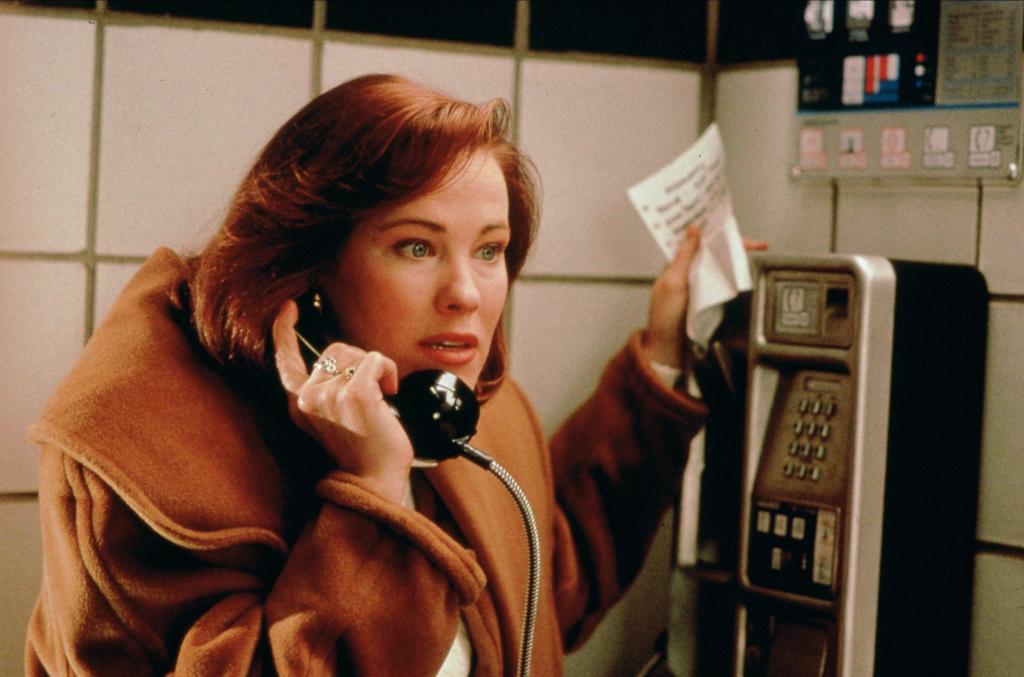
O’Hara’s value was just as evident in films such as Home Alone (1990), where the lead performances were broad, naive and slapstick. The film’s set pieces were cartoonish by design, and Macaulay Culkin’s gurning performance was built on charm and enthusiasm, rather than emotional depth. Without a grounding force, the film would have collapsed into pure farce.
That grounding weight was the boy’s mother. O’Hara played her as a woman barely holding herself together – frazzled, guilty (not without reason) and increasingly desperate – but never as a parody of maternal hysteria. Watch the scenes where she bargains, pleads and improvises her way across Europe. O’Hara injects each moment with lived-in panic rather than comic exaggeration. The audience believes her fear, and because we understand her, the film’s emotional stakes feel real. She provides the emotional infrastructure that makes the comedy matter.
She was drawn to films where humour arose from behaviour rather than punchlines
The same pattern appeared in the much less commercially successful A Mighty Wind (2003). While this comedy was about egotistical folk singers who took themselves far too seriously, O’Hara anchored the satire in something close to melancholy. Her performance was deliberately restrained: she listened more than she spoke, and when she did utter, there was a soft ache beneath the humour. Her quiet resignation gave the film its emotional undertow. Again, she made us care.
What emerges from O’Hara’s filmography are projects that respected actors and audiences equally. She was drawn to ensembles, character-driven stories and films where humour arose from behaviour rather than punchlines. Many of these films were never designed to be blockbusters, and most were misunderstood by the critics, who are not generally renowned for understanding comedy.
Over time, as audiences and critics continue to reassess what makes performances last, O’Hara’s work increasingly looks like a masterclass in how to matter without insisting on being noticed. She reminds us that art does not need to be showy or commercially successful to be lasting. The most valuable contributors are often those who ask not how much attention they can claim, but how much meaning they can create.
That was her gift to our culture. It is a profound one.


Comments