
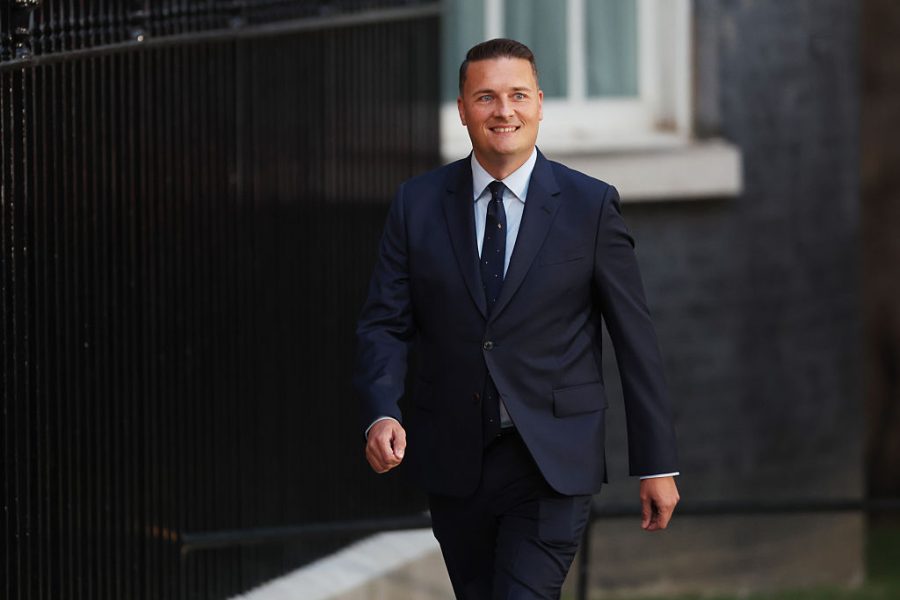
Reshuffles vary in significance. When John Healey was spotted in Downing Street yesterday, there was an obvious question: was Andy Burnham reinstating him as defence secretary? Was this a coded message that Healey had been right on the need to increase defence spending beyond that in the Defence Investment Plan (DIP) and Keir Starmer wrong?
It was more surprising than that. Healey became Chancellor of the Exchequer, a move unanticipated by a commentariat watching a two-horse race between Ed Miliband and Shabana Mahmood. When the bottle stopped spinning later last night, 43-year-old Wes Streeting was the new Defence Secretary. He became Health Secretary in 2024, having shadowed the portfolio for nearly three years, but resigned in May, saying he had no confidence in Starmer’s leadership.
It is worrying that Streeting lacks any kind of grounding in defence
There is nothing in Streeting’s background to suggest any interest in defence or national security. He was elected to the Commons in 2015, and Jeremy Corbyn’s election as Leader of the Labour party that year left Streeting, a Blairite centrist, with little chance of preferment. Instead, he spent nearly five years on the House of Commons Treasury Committee, comfortably the keenest and most able of Labour’s presence.
When Starmer was elected Labour leader in 2020, Streeting had time to make up. After six months shadowing the Exchequer Secretary to the Treasury, one Kemi Badenoch, and six months opposite veteran school standards minister Nick Gibb, he was promoted to the shadow cabinet. Initially given a cross-departmental brief on child poverty, he succeeded Jon Ashworth as shadow health secretary and dug himself into the subject.
Most popular
Steven Edginton
Invented claims of lynchings and racist violence are irresponsible — and dangerous
Streeting shadowed five health secretaries, knowing that the role in government would be the ultimate in high risk, high reward. Healthcare is always near the top of voters’ priorities, and if he could show that he’d effected meaningful improvement, he would be a hero. At the same time, he knew that predecessors had not been chewed up and spat out by the NHS simply because they were inept or stupid.
Streeting is only the second former health secretary – after Lord Reid of Cardowan – to progress to the Ministry of Defence (MoD) and therefore to be undaunted by its scale. As arguments rage over spending 2.7 or 3 per cent of GDP on defence, the Department of Health spends 10 per cent. The defence budget has climbed to nearly £70 billion, while that of the NHS in England is over £200 billion. There are 245,000 uniformed and civilian personnel at the MoD, but 1.37 million full-time equivalents in healthcare.
As health secretary, Streeting was prepared for major reorganisation. By early last year, he began the winding-up of NHS England, the arm’s-length body which ran the health service day-to-day, and reached a new agreement with the independent sector to expand capacity. But at the MoD, the institutional reform – creating a military strategic headquarters which gives the Chief of the Defence Staff direct command over the individual service chiefs; establishing the National Arms Directorate – has already been done. The challenge is making everything work in practice.
There are huge tasks awaiting at the MoD. The DIP, however underfunded, must be implemented to prioritise the worst shortfalls – in ammunition and missiles – and the most urgent capability gaps, like missile defence, availability of surface ships and a combat-ready, equipped and trained, sustainable core ground force which can actually be deployed.
In the longer term, the MoD needs more money if it is to meet its Nato spending commitment of 3.5 per cent by 2035. Streeting will have to face down the new Chancellor. Healey understands the level of expenditure necessary, but will have impeccable cases from areas other than defence: education, health, social care, welfare.
It is worrying that Streeting lacks any kind of grounding in defence. During his five years as a backbencher, he spoke about defence barely a dozen times, and the word ‘navy’ never passed his lips. Neither did ‘destroyer’, ‘frigate’, ‘Challenger’, ‘Ajax’ or ‘F-35’. Defence is a relatively niche area of interest among MPs, and Streeting has never been in that niche.
But now he is Defence Secretary. The new Prime Minister shows an indifference to defence and international affairs greater than any premier since Stanley Baldwin. If he does not share the view of Lord Redesdale, father of the Mitford sisters (‘Abroad is unutterably bloody and foreigners are fiends’), Burnham still seems as if he will concentrate his energies on domestic politics.
There is a rare opportunity for Streeting, if he can find a modus vivendi with the new Foreign Secretary, Ed Miliband, to exercise real independence in policy-making. But Streeting needs to learn fast and he needs to avoid being boxed in by officials and senior officers for whom defence policy is second nature. Even more than demonstrating mastery and asserting himself over officials, Streeting must show his commitment. He has to show that he wants this job and wants to do it well. He has a hell of a lot to do.





Comments