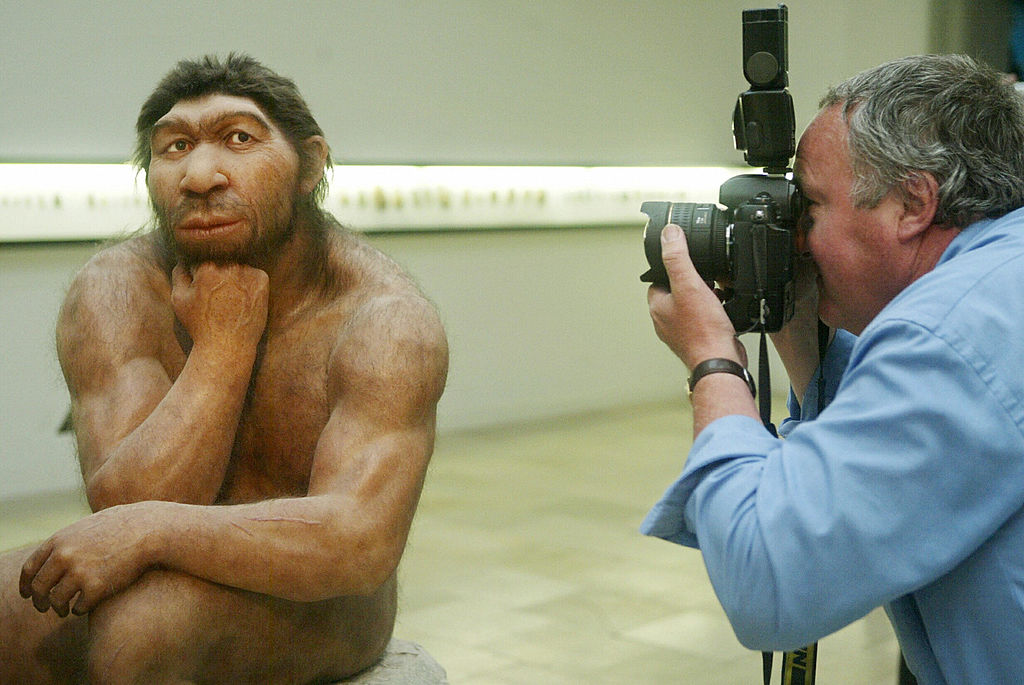
In The Inheritors, Willliam Golding’s second novel, Neanderthals utter only a few short words and think entirely with images. A family is disturbed by the arrival of people who are not like them, and who talk in sentences. The two groups clash and in the end the only Neanderthal to survive is an infant, stolen by the newcomers – that is, us, Homo sapiens.
The idea that language gave our ancestors the edge over Neanderthals, leading to their extinction 40,000 years ago, remains strong. New research though suggests it may be wrong. Modern language skills, it seems, were present hundreds of thousands of years ago, before Neanderthals and sapiens had evolved. Linguistically, Neanderthals might even have been a little more advanced than us. So why was it Neanderthals and not sapiens who disappeared? Why has the biological basis for language apparently not changed for so long? And if language wasn’t the key factor in Neanderthal extinction, what was?
Let’s start with the science. Genetic research published a few years ago identified what scientists called HAQERs (human ancestor quickly evolved regions) – areas in the human genome which evolved particularly fast. HAQERs are not genes themselves, but between the separation of the chimpanzee and human lines six or seven million years ago, and the split 600,000 years ago that resulted in Neanderthals and sapiens, they controlled genes which led to rapid changes in the human digestive system and brain. The latter grew in size as the other shrank. This is explained by what’s known as the expensive tissue hypothesis, which says the high energy demands of a larger brain were compensated for by a smaller, less energy intensive gut, made possible by a higher quality diet (itself facilitated by clever thinking).
Now a new study, reported in Science Advances, has found another HAQER association – this time linked to modern language skills. Unexpectedly, this means that genomic regions connected to language ceased to evolve 600,000 years ago. Which means Homo sapiens and at least two other early Eurasian humans – Neanderthals in the west and Denisovans in the east – inherited the same biological language skills. For hundreds of millennia, there may have been three distinct species on the planet capable of sophisticated speech.
A gene known as FOXP2, initially thought linked to the appearance of language among modern humans, has been identified in our common ancestor with Neanderthals. Many other genes linked to speech are similarly being investigated. Fossils show Neanderthals had similar throat and ear anatomy to us, giving them at least the potential to express and hear speech.
Evidence has long been growing that Neanderthals were more than grunting beasts. Golding had them unable to make tools or hunt, but archaeology shows otherwise. They crafted a variety of stone tools according to their needs and killed large animals with wooden spears. They wore skin and fur clothes, controlled fire, carefully buried their dead and created simple designs by engraving bones with geometric shapes, running their fingers through mud or blowing paint across their hands held against cave walls.
What then caused their extinction? Firstly, this new research is not conclusive when it comes to language. While our brain’s language skills apparently remained static, how they were exercised remains an open question. Our other cognitive functions have steadily been growing for at least the past 20,000 years, and may have separated us from Neanderthals long before then.
Even so, we are unlikely to have been the only factor in the Neanderthals’ demise. Recent research has highlighted the effects of extreme climate change, when ice age conditions forced Neanderthals south into limited refuges, isolating their populations and causing inbreeding.
There is another surprising possibility: that the linguistic skills of Neanderthals may have made them more likely to become extinct. That our brain’s language skills stopped growing so long ago, say the scientists, is down to what they call the obstetric dilemma: a bigger brain might have brought us more advantages, but a larger head caused more deaths at birth, of both baby and mother. Neanderthals had a slightly larger brain than modern humans, suggesting that the growth of linguistic skills may have made their births even more difficult. Jacob Michaelson, a professor in psychiatry and communication disorders at the University of Iowa and co-author of the new study, points out that modern medicine like the C-section might relieve such selective pressure: while we fret about excessive screen time, evolution could be quietly expanding our language skills.
The archaeological evidence for Neanderthals is often hard to interpret or date precisely. This allows for varied readings, and appropriate caution can hide an ingrained sense that Neanderthals were lesser than us – or, by contrast, researchers who like to break with convention can portray them as highly cultured and intelligent, when the data are, frankly, equivocal. Knowing that we beat Neanderthals in the extinction game encourages us to underplay their achievements. They engraved marks but it wasn’t really art. They might have had speech, but their talk was limited.
Golding’s creatures faced each other in fear and ignorance. But perhaps our joint possession of speech, however mutually incomprehensible, engendered a fellow feeling. That would help explain what we know from DNA studies: a significant number of humans and Neanderthals had children together. We may well have been much closer to Neanderthals than we once thought.






Comments