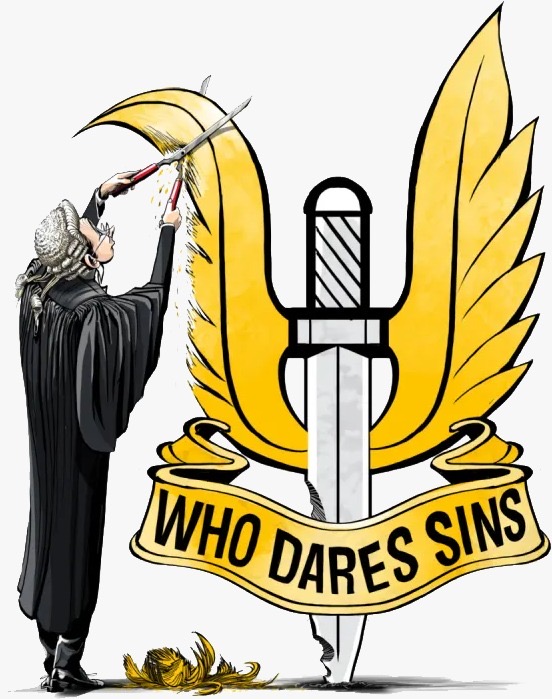
The Special Air Service, Special Boat Service and other elements of UK Special Forces are held in the highest regard by the Pentagon and by US special operators. British and American special forces have forged a bond of trust over decades with joint high-risk operations and combined training.
A recent visit to Washington made clear that the American leadership on both sides of the political divide, and within the military and intelligence services, believe the current British government has broken that alliance. America views the SAS and SBS as equal to its own tier one special forces operators in Delta Force and SEAL Team Six. The eight saber squadrons of the SAS and SBS contribute a significant amount of the special forces’ manpower relied upon by both countries.
The unique partnership with the US comes with big benefits for the UK. From 2001, during the so-called Global War on Terror campaigns, close cooperation with the technologically more advanced US Joint Special Operations Command catapulted an under-funded UK Special Forces into the 21st century.
This combined US-UK special military capability represents the finely honed tip of a counter-terrorist spear, capable of neutralizing any lethal threat to ourselves and our allies at a moment’s notice. A “Praetorian Guard” that keeps us all safer, our democracy secure and our many violent enemies hesitant to take us on. They work under a rigid command structure, to carefully set legal standards and always on the very best intelligence.
However, the political and military leaders we met with made it clear that America is now considering withdrawing the invitation to participate in and benefit from this combined military machine. A move that would have deeply damaging long-term consequences to the UK’s national security.
They believe that the UK government is undermining its own ability to contribute meaningfully to any form of military alliance by misapplying British human rights legislation. The legislation is being used to support witch hunts into decades-old UK counter terrorist combat actions, primarily involving the SAS in Northern Ireland, Syria and Afghanistan.
And they believe the British government is undermining its long-term ability to defend itself by failing to prioritize investment in defense to ensure that the UK’s special forces can keep up with the ever-evolving, high-end US capability.
Within British special forces, this toxic mix of lawfare, resource uncertainty and an obvious lack of national resolve is also forcing an exodus of the most experienced personnel and a corresponding negative effect on attendance at the grueling selection course.
With one SAS squadron now at under half strength, and rumors of dozens of experienced warrant officers preparing to leave, British special forces are already unable to provide the trained manpower to that tier one US-UK alliance that it once could.
Even more serious than that, some US special operators – themselves held accountable to the highest legal standards – are now asking whether what remains of UKSF can be trusted to fight, given the debilitating hand of misapplied UK Human Rights law. Far better to go it alone, they say, than take the risk of hesitations on target or being pulled into UK-generated, post-operational lawfare witch hunts.
The witch hunts into decades old cases have been triggered by the introduction by the Labour government of the Northern Ireland Troubles Bill. The Troubles refers to the attempted insurrection by the IRA that started in the 1960s and the British army’s efforts to deal with it. Labour have attempted to present the Bill as a measure of reconciliation. In practice, it has proved controversial and dangerous.
The Bill invites decades-old cases to be reopened through retrospective lawfare, selectively re-examining the actions of British soldiers and police officers who were sent to uphold the law, while extending comfort and immunity to those who sought to destroy it.
During the Troubles, terrorist organizations were assiduous in frustrating any attempt to bring them to justice. Their actions were reminiscent of organized crime. They intimidated and murdered witnesses. They destroyed forensic laboratories. They refined their methods: wearing rubber gloves, overalls, rubber boots, and avoiding leaving fingerprints. As a result, the normal machinery of criminal justice was largely ineffective.
The only viable method of prevention was interception – catching terrorists in the act, as they attempted to murder police officers, Ulster Defence Regiment personnel or British soldiers. Inevitably, such encounters frequently ended in firefights and casualties.
At Loughgall in 1987, eight heavily armed IRA terrorists destroyed a police station using a 400-pound bomb mounted on a digger, while firing automatic weapons to kill officers inside. At Coagh, 1991, terrorists attempted to assassinate a UDR officer. And at Clonoe, 1992, an IRA team mounted a direct attack on a police station using a twin-barreled Soviet DShK .50 calibre heavy machine gun.
In each case, there was a firefight. In each case, IRA terrorists were killed. And in each case, the soldiers involved were doing precisely what they had been sent to do: prevent terrorists killing innocent people.
But now lawfare is being waged to prosecute the brave veterans who fought these terrorists. Consider what might have happened had the SAS hesitated at Loughgall in 1987 and the terrorists had escaped. The unit included Patrick Kelly, the officer in command of the East Tyrone Brigade, which was already responsible for 250 killings. Kelly was personally linked to at least five murders, including two UDR soldiers. Jim Lynagh, nicknamed the “executioner”, was responsible for the deaths of many others, as was Padraig McKearney – both of whom were also part of the unit.
Kelly’s family peddles the narrative that they “went to blow up, not to kill”, an extraordinary claim given that they used a 400-pound bomb to destroy the police station, with the police officers inside. A scout involved in the attack confirmed: “The point of the [IRA] operation was to get in before they [the RUC officers] left, to take them out.”
Nevertheless, a government minister, Hilary Benn, has promised Patrick Kelly’s sister that he will launch a fresh inquest into the events at Loughgall. The inquest itself will be considered a propaganda victory by the IRA.
Any trial into these events conducted half a century later is farcical. Such trials cannot recreate live fire, constant danger, or split-second decisions where hesitation meant death.
Veterans are being questioned, re-questioned, and publicly attacked for following lawful orders under lethal threat. One veteran has already died from a heart attack. His family say the stress of the twenty-year legal ordeal killed him.
More recently, the Northern Ireland Veterans Commissioner – actually appointed by the current government – spoke out. He said the Bill treats veterans as “worse than terrorists” and is “eating at the very fabric of the Armed Forces”.
The reality is that the SAS shows extraordinary restraint. A number of their soldiers died in action in Northern Ireland, not to mention in many other counter-terrorist operations. And when they do have to kill terrorists, the net outcome is saving hundreds if not thousands of innocent civilian lives.
When we visited Washington, it became clear that the current US administration does not trust the UK government. Our allies cannot comprehend why Britain seems intent on maintaining such a self-inflicted vulnerability to lawfare. This breakdown in trust will have severe consequences.
Indeed, it has reached such a point where we would not be surprised to hear that the US has conducted a counter-terrorism operation on British territory without telling the UK about it. With confidence eroded to the degree it has been, scenarios that once seemed unthinkable become conceivable.
And as the United States continues to pour vast investment into space, cyber, and other advanced technologies, its special operations forces may increasingly move away from working with British special forces and towards partners they see as more politically reliable and operationally unconstrained.
If the UK government continues down this path, it will be guilty of a horrific act of self–harm, undermining not just its own defensive capability but that of its allies.
We must not let the British government do what our enemies have never been able to do and force these brave men and women to turn their backs on our nation’s enemies. To sit blunted in their barracks, asking the bleak question: should I call my lawyer before I go out on ops?


Comments