


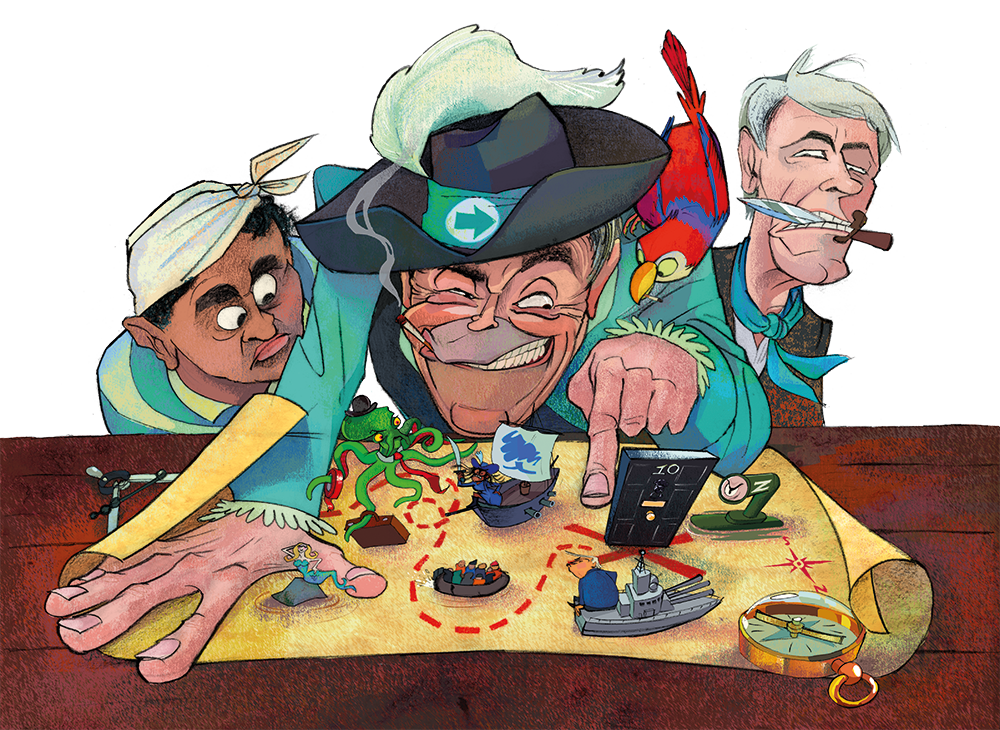
As he made his way to lunch on Monday, Danny Kruger, the former Tory MP who defected to Reform last year, could be seen clutching a well-thumbed copy of John Campbell’s biography of Lord Haldane, one of the forgotten heroes of British politics.
Most British politicians in search of heroes look to Churchill or Attlee for inspiration. But as a reforming secretary of state for war and lord chancellor in the Liberal government before the first world war, Haldane ‘basically modernised the British state’, says Kruger. ‘He created the War Office and the Imperial Defence Committee, the Admiralty, the modern navy, the LSE and the RAF.’ Add to that the intelligence agencies, Imperial College London and the Territorial Army.
‘If you try to block us, we will use the power of democracy to blow you away if we have to’
With his academic bearing, his shock of silver hair and his heavy three-piece suit, Kruger resembles an Edwardian figure, and he may be the most significant politician the public has barely heard of, rather as Haldane was in his day. In 2026 he has one of the most pivotal jobs in British politics – preparing Reform for government.
Nigel Farage is ‘fixated’ on May’s local elections, another ally says, at which point he hopes to convert his party’s lead in the opinion polls into huge gains in the Welsh and Scottish parliaments and the English councils. After that, attention will be on whether Reform can evolve from an insurgency into a potential majority government.
The task is daunting. Zia Yusuf, the head of policy, says: ‘What we’re having to do is quite unprecedented. We have to select hundreds and hundreds of parliamentary candidates, probably hundreds of peers. We’re going to need a manifesto for how we turn the country around. We’ve got a once in a century chance to do this. It’s many orders of magnitude beyond what’s been done before.’ Looking to America for a comparison, Kruger adds: ‘It’s got to be Trump 2, not Trump 1. We’ve got to have a plan and we’ve got to have the people to implement it.’
Reform is conscious that much of what they want to do – leaving the European Convention on Human Rights, mass detention and deportation of illegal migrants – will be opposed by the Establishment. ‘Half the work is: what are the things that we’re going to need to do?’ says Yusuf. ‘The other half is: how do you get the patient to take the medicine? Most of the non-democratic institutions in this country are going to be at the very least ambivalent, in many cases hostile.’
Working out how to achieve the biggest shake-up in government since Haldane is Kruger’s job. ‘We are prepared to be very ruthless,’ he says, but his preferred approach is ‘polite but firm’. He wants to restore the primacy of parliament over the Blairite legalistic state, where international law, a politicised judiciary and unelected quangocrats hold sway. ‘We’re about restoration, not revolution – returning to parliamentary accountability, ministerial responsibility, cabinet government. These are quite old-fashioned principles. We are essentially undoing the Blairite inheritance.’
Kruger plans to make a speech later in the year setting out a clear message to the deep state. ‘I want to say to the system: “You shouldn’t try and oppose us. We’re not Lenin-ists, we’re conservatives, we’re restorationists. And yes, you might not like our position on international law, but get over it. We’re not going to destroy the country. So you shouldn’t want to block us, but if you do we will use the power of democracy to blow you away if we have to.”’
This is why Reform wants to devise a clear plan in 2026. They want the public to know what it is. They want as much detail as possible to be written down in a manifesto so that they can obtain the clearest mandate possible for change. ‘You certainly need to be able to say: “These are the bills.” You don’t necessarily have to have the text of the bills but with some of them you might want to do that.’
So what will they contain? Much has been made of plans for a ‘great repeal bill’ to withdraw from international treaties, override the human rights act and the equalities act. But less dramatic changes will be just as important. Reform will also rewrite both the civil service and ministerial codes and amend the 2010 Constitutional Reform and Governance Act 2010 (known as CRAG in Whitehall) to make it easier to appoint outside experts as civil servants.
The appointment of judges and bishops could also be taken back into government, with the prime minister advising the Crown, rather than leaving the responsibility with the Judicial Appointments Commission and the Church of England, both of which are seen as self-perpetuating elites accountable to no one but themselves.
Kruger is examining how many changes could be pushed through using Orders in Council, a device in the Privy Council, as well as statutory instruments and ministerial guidance to avoid the need for primary legislation. Henry de Zoete, a special adviser in the Cameron and Sunak governments, recently wrote an article on how to make government work. ‘Do not legislate unless you really have to,’ he advised. ‘It takes forever. And once every MP and Lord has their say you won’t get what you wanted in the first place.’
If this all looks like a power grab for the executive, Kruger is also considering reversing Robin Cook’s reforms of the Commons which give the executive more control of the timetable for debate. While Reform would use force majeure to pass their initial changes, they believe returning legitimacy from the courts to the elected parliament means giving powers back to MPs. ‘There’s a bunch of bills that we want to ram through as fast as possible,’ Kruger explains. ‘But in general, the normal operating model should be that parliament gets proper time to debate stuff. You can’t have a dictatorship.’
‘There are so many people out there, desperate to see the country saved, who will step forward’
Reform fully expects a clash with the Lords. Yusuf says: ‘Packing the Lords is absolutely on the table as an option.’ Again, the point of having an early plan in place would be to offer a bargain to sitting peers. ‘We can say to serving peers: “This is what’s coming. Will you sign up to it?”’ Kruger says. ‘Unless there is very explicit commitment in advance of the election from sitting peers, Tories and others that they will not stand in the way of our legislation, then we will need to create even more.’ Yusuf says being clear about what they should expect and winning ‘a strong public mandate’ will give Reform ‘the high moral ground’ against a recalcitrant peerage. The convention is that the upper house moves towards mirroring the Commons, and if Reform has a majority, that might mean creating 500 new peers.
It is going to be very difficult to find 600 credible parliamentary candidates, 500 peers and all the special advisers, policy and communications experts that would be needed to run a government, plus the legal experts to write key bills ahead of an election. Kruger has set up an online portal where those who want to help can contact Reform. ‘We’re having a whole bunch of conversations with serving people in the system, the military and Whitehall, not out of any personal support for Reform, but out of the sense that we might well win and it would be good if we did a good job.’
But the party is only in the foothills of identifying the people it would need. Farage and most of the people around him have no experience of government. ‘There are so many people out there, desperate to see the country saved, who will step forward,’ Kruger says. ‘I think there’s no shortage of good people. We just need to identify them, recruit them, train them, appoint them. We need a kind of college or kind of academy.’ Reform has beefed up its media operation and is shortly to announce the appointment of a senior figure to recruit the backroom political advisers it will need.
This is all easier said than done, however. Dominic Cummings, the former senior aide to Boris Johnson who has discussed with Farage how he might deal with ‘the blob’, says his private polling shows that even Reform’s supporters doubt the party will succeed. ‘In focus groups now the conversation goes like this: “I hate the Tories. They screwed us. I hate Labour, they screwed us… I guess we should vote for Farage. What will happen then? Well, he hasn’t got a team. He hasn’t got a plan. It’ll probably be a failure.” Maybe one in seven people say: “I think he’ll sort it out.”’
Farage has an effective tight-knit team, but many wonder if he or they are capable of handing real power to those with expertise. ‘Nigel doesn’t trust other politicians,’ one source observes. Having a clear plan will mean every single candidate will be forced to sign up to it in advance – Johnson did this with Brexit in 2019 – which should minimise rebellions. But if Reform did get in, managing MPs would be a nightmare in the longer term, since Farage says he would slim down cabinet and hand half the jobs to outside experts appointed to the Lords. That would be like telling all but a dozen of, say, 350 MPs that they could forget about a job at the top table.
While the full plan is unlikely to be clear before the autumn, Yusuf says Reform will have policy to announce before May’s elections, for two reasons. On issues such as immigration and crime, high command believes they have already moved public debate in their direction. Secondly, Reform’s leadership thinks that, in some areas, they need to do more to explain what the problems are that they want to fix, if voters are to buy their proposed solutions.
‘There’s an old adage in politics, don’t announce policy too early – somebody else will steal it,’ Yusuf says. ‘We don’t take that view. Politics is like a tiller on a ship. On immigration we have moved the conversation and we’re going to continue to do that in any area we can. We’re looking at welfare payments which are totally out of control. Welfare to foreign nationals is a big focus, and likewise law and order. You’ll also hear from us on cost of living. Those are the biggest areas over the next six to 12 months.’
Kruger says people are the most important resource, and by signalling they have a plan, Reform hopes to summon those they need. But Cummings says: ‘If Farage really wanted to do something about it, he would set out this public story about how he’s going to go around the country and recruit people.’ The message? ‘If you are brilliant at running a hospital, if you were brilliant working in the armed forces, if you’ve built a wonderful business… we need you to come in and replace the duds who’ve driven us into the sand.’ He adds: ‘That to me is one of the critical questions in 2026. If Farage tells that story… that will be transformational.’
Watch The Edition with Tim Shipman on Spectator TV:





Comments