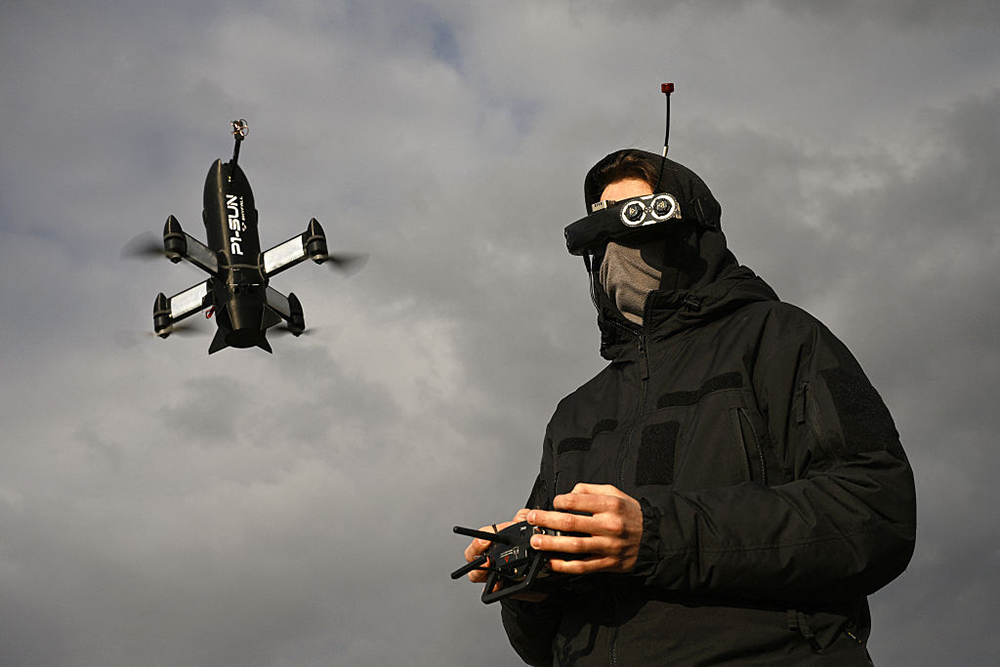


A stray thought of my own while watching Iranian drones tracing fiery paths over the Gulf, a stray quote from Ukraine and the background rumble of uncertainty about Britain’s Defence Investment Plan, have set my mind racing. My conclusion is at the same time obvious yet unnerving.
As a European power, we have been watching the Ukraine war from almost the front row, but it has seemed a world away. Nightly on television we’ve seen Russian and Ukrainian attack drones streaking through the sky, half-reminiscent of a grisly firework display. From our armchairs we’ve read about how this conflict is turning into a competition between drone capabilities.
Putin’s huge reserve of human meat for the infantry grinder massively outweighs Kyiv’s reserves of manpower; but Ukraine’s rapid development of drone technology has more than matched Russia’s – even tipping the scales in Zelensky’s favour. Or so, from our armchairs, we learn.
The new warfare will be much more like terrorist insurrection – except the terrorists will be hostile states
We’ve been spectators too in another war: that between Israel and the United States on one side and Iran on the other – with Gulf states caught literally in the crossfire. This has been a war entirely without infantry: not a single boot on the ground, just a few missiles and lots of drones – even sea-going drone-boats now.
And we watch, unthreatened. Of course wars that we’re not ourselves involved in have always served as spectator sports for those drawn to this kind of thing; but the arrival of drone warfare appears to offer yet another pane of bulletproof glass between spectator and spectacle. Not only are our own soldiers not in this fight, but the warring nations’ armies too (in the Middle East if not Ukraine) stay confined to base. Even the adversaries can watch the conflict as audience rather than participants. In a ghastly way, the arrival of drones as a principal weapon of aggression threatens to turn the whole thing into something like a video game for all concerned.
This is already having consequences for defence planning. We’re told Britain’s procurement needs must now be rebalanced away from new naval destroyers and in favour of drones and vessels to carry them. We’re told that though our own standing army is now so pitifully small it could fit in Wembley stadium, this may simply reflect the modern reality that sheer numbers of soldiers may not be what decides the outcome.
Earlier in the Ukrainian war, we read about the trenches and wondered if the Somme would prove the model for the conflict. It has begun to look as if the Battle of Britain is the better model – but without pilots.

Especially for an island nation like ours, watching a war in which we are participating, but with no immediate expectation of its arrival in our midst, is hardly new. So a first response is to ask what’s not to like about war as a video game: far fewer soldiers, sailors or airmen die in video wars that, God willing, will never repeat the first world war horror of mass slaughter.
But a moment’s reflection brings a shudder. I experienced that shudder when reading a report by my Times colleague Maxim Tucker in Ukraine. Max had been talking with a crack team of Ukrainian drone-launchers. He quotes one of them, codenamed ‘Panama’: ‘The technology we have today means that war is no longer simply something where you can enter someone else’s territory and keep it at arm’s length. It will return to your own home. And when you smell war burning on your doorstep, you perceive it in a completely different way than when you are just looking at a picture on your television.’
‘Your own home’. That’s the shudder. Drone and missile technology mean that you and I and everyone we know may be recruited, without our say-so, as participants in wars Britain may fight. We will no longer be able to watch from afar as our armies perform. The new warfare will be much more like the terrorist insurrection we faced from the IRA – except the terrorists will be hostile states detonating their explosions remotely.
Israeli and Lebanese residents on their respective sides of their border already know this. Londoners and the people of Coventry experienced something like it, as did those in Dresden, when the bombs rained down. So you’d be right to remark that there’s nothing new in targeted or untargeted destruction whose principal victims are civilians.
Where you’d be wrong, though, is if you supposed that past civilian-targeted bombing campaigns were anything but a preparation for invasion. In the second world war it was, from the start, always the case that in the end we would physically invade and occupy them, or they would invade and occupy us.
Invasion is no longer the prospect, and Russia’s low-level hostilities with pipeline-cutting and cyber-aggression give us a foretaste of what we’re in for – just as Russians are experiencing the ‘smell of war burning on their own doorsteps’ at the hands of Ukraine and its drone technology.

Nobody is planning to invade or occupy our country, and, in my lifetime at least, nobody looks likely to. That is the good news. The bad news is that conflicts which may involve us will be at a lower level – somewhere between threat and nuisance – but persistent and long-running. Operating at arm’s length and using remotely activated technology of which the drone is only the most striking example, our enemies will possess the capability (which we too will possess) to be a bloody nuisance: hornets we can swat but whose nests we cannot remove.
Hostilities we observe remotely from our armchairs are by the same token fires we may smell on our own doorsteps, observed remotely from the armchairs of enemies. It works both ways. ‘Remote’ is a double-edged sword.





Comments