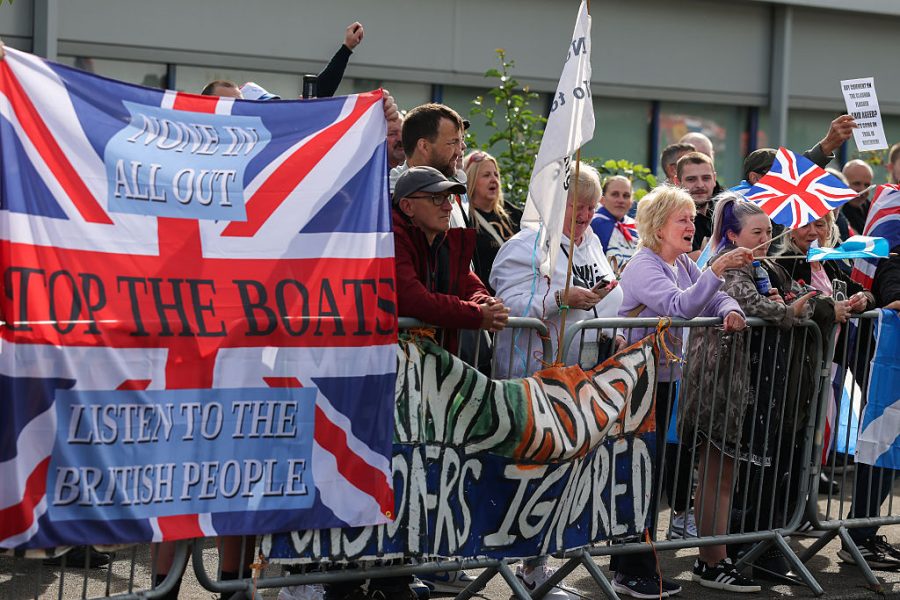
Are ‘buffer zones’ becoming the latest weapon in the political establishment’s clampdown on dissent? Scottish First Minister John Swinney says he will consider a buffer zone to ban protests outside migrant hotels. It comes after angry scenes at the Radisson Blu in Perth on Saturday, which saw competing pro- and anti-migration demonstrations. Anti-migration activists reportedly rushed up to the hotel and banged on the windows, though no arrests were made. Local MP Pete Wishart has described the actions of the anti-migration protesters as ‘disgraceful’ and called for ‘buffer zones’ around migrant accommodation.
Buffer zones already exist in Scotland around abortion clinics and the surrounding 200 metres, making a criminal offence of ‘influencing the decision’ to undergo or perform an abortion; ‘preventing or impeding’ the same; or ‘causing harassment, alarm or distress’ to those involved. The law also criminalises conduct outside the ‘buffer zone’ when it is ‘capable of being seen or heard by another person who is within the safe access zone’.
These restrictions passed without any grand public debate. Scotland is a thoroughly post-Christian nation and opposition to abortion, even when it takes the form of little old ladies audibly praying the Rosary across the street, offends against our new religion of progressive autonomy: everyone is free to live their lives as they please, provided they live it in a leftwards direction. Yet abortion clinic buffer zones planted a seed whose shoots were always going to spread to other ground and affect many more people than the tiny number who attend anti-abortion vigils. Migrant hotels are the first offshoot. They won’t be the last.
First abortion clinics, now migrant hotels. What next?
Swinney has called the actions of the anti-migration counter-protesters ‘absolutely disgusting’, seeing them as an attack on the speech and protest rights of pro-migration activists. The First Minister plans to speak to the chief constable of Police Scotland to ‘make sure that all my constituents who want to protect those who have sought asylum in this country from this vile amount of abuse can be protected in exercising their democratic rights’. He believes Wishart’s points about buffer zones ‘need to be considered’ but added that they ‘will need to be legislated for’.
There would be an overwhelming majority for migrant hotel buffer zones. The ideological spectrum at Holyrood runs from the fringe left all the way to the centre-left, and there is little sympathy for the sorts of characters who protest outside migrant accommodation. Of course, it was a different story last year when one ‘migrants welcome’ politician after another strained to find a technicality on which to oppose plans to house 300 men in Cameron Barracks near Inverness. Even Swinney had to walk a high wire between condemning the ‘racist views’ of some protesters and acknowledging the public’s legitimate concerns. The First Minister stands with migrants, just not too close when there’s an election around the corner.
Introducing buffer zones would have nothing to do with ensuring safe access to migrant hotels and everything to do with making it impossible – indeed, illegal – to make them the focal point of protests over immigration and public safety. The fact that no arrests were made suggests that police witnessed no conduct they deemed criminal, such as property damage or public order offences. The call for legislation implicitly concedes the same point: if nothing unlawful happened at this migrant hotel protest, then migrant hotel protests themselves must be made unlawful.
While it would be possible to draft a statute that is facially neutral on migration politics – e.g. banning pro- and anti-migration protests that impede safe access – the intent would still be to restrict speech and demonstrations that elite opinion disapproves of. Whether we share that disapproval or have sympathy for the protesters, we should resist the urge to expand the backdoor censorship of buffer zones. The slippery slope is not a logical fallacy; it is a description of how progressivism operates. First abortion clinics, now migrant hotels. What next?
There will be a next. The political classes across the UK are unnerved by indications of public disquiet with the status quo and defensive of the progressive settlement that has been in place since the late 1990s. Key elements of that consensus – multiculturalism, mass immigration, the European Convention on Human Rights – are being questioned and the potential for a Reform government at Westminster puts their future in peril. Elite actors, including politicians, civil servants and commentators, continue to resent Brexit, observe fascism in the actions of Donald Trump, and suspect the sinister hand of Russia behind every unhelpful news story or social media disclosure. Paranoia is a breeding ground for authoritarianism.
Progressives will continue to narrow the space for expressive and protest activity by finding new exceptions in the name of safety, public order, and other phoney pretexts. The real motivation will be the suppression of right-wing and other disfavoured views in both the physical and online realms. The government’s threat to ban X is, in effect, a digital buffer zone around controversial conversations that can be had on Elon Musk’s less-censored version of Twitter. Users manipulating Grok to superimpose bikini-clad bodies on images of prominent women is a pretext, made obvious by the government having prohibition plans ready and waiting to go for a trend that only began a week or so ago.
Cast your mind back to this time last year, when Musk began posting and reposting about the grooming gangs scandal and the British state’s connivance in and cover-up of widespread sexual abuse of white British girls by Pakistani-heritage men. The potential for X to foment public anger and perhaps unrest on the streets by drawing attention to state and other institutional malfeasance is too acute for the government’s liking. Put X inside an exclusion zone and you protect the political establishment from public obloquy and democratic dissatisfaction.
It might well be that buffer zones are the future. Multiculturalism is unmanageable without fundamental changes to time-honoured customs, norms and expectations in Britain. Only by making life in Briton less free, more regulated, and geared towards avoiding sectarian conflict can multiculturalism be propped up in the long term. Not only progressives but centrists and conservatives could come to embrace buffer zones in their own strategies for managing a false but insistent doctrine.
If Muslim mobs continue to gather outside schools and cinemas to protest perceived slights to their religion, sooner or later we will have to consider buffer zones around educational institutions and arts and entertainment venues. If no distress to migrants is to be permitted by anti-immigration demonstrators outside their hotels, why must staff at the Israeli embassy and Israeli citizens visiting to collect documentation endure the distress of anti-Israel protests? The more we insist on importing the world, the more of the world’s problems we will have on our doorstep. Those problems will need to be policed and restricting the right to protest is arguably the most straightforward way to go about it.
In politics as in physics, every action has an equal and opposite reaction. So when progressives expand buffer zones beyond abortion clinics and use them to suppress dissent from mass immigration and multiculturalism, they shouldn’t be surprised when the centre and the right come to the same conclusion: that cracking down on protest is the only way to keep the peace. We are on our way to becoming buffer-zone Britain, an island of internal fortresses erected to protect the state from its citizens and citizens from the consequences of the state ideology.

Comments