
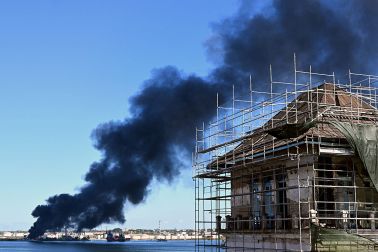
The history of the global trading system is a story of narrow and vulnerable waterways: the Suez and Panama Canals, the St. Lawrence Seaway, the Straits of Dover and the Skagerrak, which defends the entrance to the Baltic. But none has the power to seize up the global economy as much as the Strait of Hormuz.
Barely 30 miles wide at the narrowest point and bounded on one side by the state of Iran, this passage is used for a quarter of the world’s oil supplies and a fifth of its liquified natural gas (LNG). As we have now discovered, the consequences of disruption are severe: on the day that Qatar suspended its LNG production – partly because of the closure of the Strait and partly because of Iranian attacks on its infrastructure – the price of LNG spiked by 50 percent in a matter of hours.
The US can ramp up oil and gas production to fill the gap, but not in sufficient quantities
In a speech to the International Energy Agency last month, US Energy Secretary Chris Wright delivered a remarkable statistic: fossil fuels account for 83 percent of global primary energy supply – the same as they did when he began his career. But the global energy market has changed little in another important respect: the world remains almost as dependent on the Middle East for those fossil fuels as it did at the time of the Yom Kippur. In 1973, the region accounted for 36.8 percent of global crude oil production. In 2024, it was still 31 percent. That overall figure conceals a vast difference in the energy policies of the US and Europe. Successive US administrations have made a priority of national energy security. By contrast, Europe – inasmuch as it has pursued energy security at all – has tried to achieve it through renewables. The result is that, even before the current crisis, US consumers paid only around a third as much for their gas as their counterparts in Britain and Germany. It is a similar story with electricity.

The war on Iran has exacerbated the failure of European energy policies. Sun and wind account for only a sixth of overall energy consumption. Fossil fuels supply most of the rest. Yet Europe has acted as if the end of fossil fuel is imminent. Oil and gas fields in the UK sector of the North Sea are being prematurely shuttered. The Netherlands has closed gas fields that were still productive. The EU has all but banished the exploitation of shale gas and made the choice to rely on imports instead.
Until four years ago, much of Europe’s gas supply came from Russia – a folly that Donald Trump pointed out when he attended the 2018 NATO summit in his first term, only to be ignored. Then came the war in Ukraine.
In energy as in defense, Europe has pursued a policy of unilateral disarmament – and looks to America to fill the gap. It took the President threatening to withdraw from NATO to jolt European countries into funding their own defense. Will the war on Iran now do the same for energy, pushing Europe to abandon its policy of winding down its fossil fuel industry?
That, sadly, seems doubtful. While Trump is often accused of being in the hands of the oil industry, European leaders fail to recognize that their energy policies are every bit as much driven by vested interests. Green-energy lobbyists are not going to give up as a result of the current Middle East crisis. On the contrary, they are already attempting to use current events to push harder for renewable energy as a form of security – conveniently ignoring the fact that fossil fuels will remain part of every country’s energy mix for decades to come.
There is little chance of a swift resolution to the Iranian crisis. Ayatollah Khamenei may be gone, but the mullahs remain in power. Access to the Strait of Hormuz could well be limited for months. Iraq, Syria and Libya – all major oil producers – remain tinderboxes. The US can ramp up oil and gas production to try to help fill the gap, but not in sufficient quantities or rapidly enough to alleviate the immediate crisis. In a highly interconnected world, America cannot be immune to great shocks to the global economy. But Americans can be thankful that their energy supplies are less vulnerable than Europe’s.
Both worlds
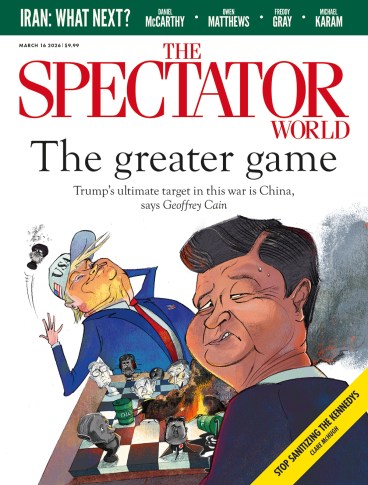
You’ll notice this issue of The Spectator is different. In the past, we have blended articles from our New York, Washington and London offices, which had its advantages, though at times that meant our cherished American print readers missed out on some of The Spectator’s brilliant writing from the other side of the pond. So, from now on, we’re offering you two magazines in one. In the front half, you’ll find the American edition, comprising our US editorial, diary, features and columnists, as well as an extensive American Life section, which will cover literary, artistic, social and gastronomic pursuits.
The second half is now a Best of British edition, consisting of a selection from our London-based magazine, including its own arts, books and life pages, carefully picked for a US audience with a broad imagination. The Spectator World now lives up to its name, bringing you originality, insight and wit from both sides of the Atlantic. We hope you enjoy it all, and would be grateful to know what you think.
Please send any feedback to the editor: editor@thespectator.com.



Comments