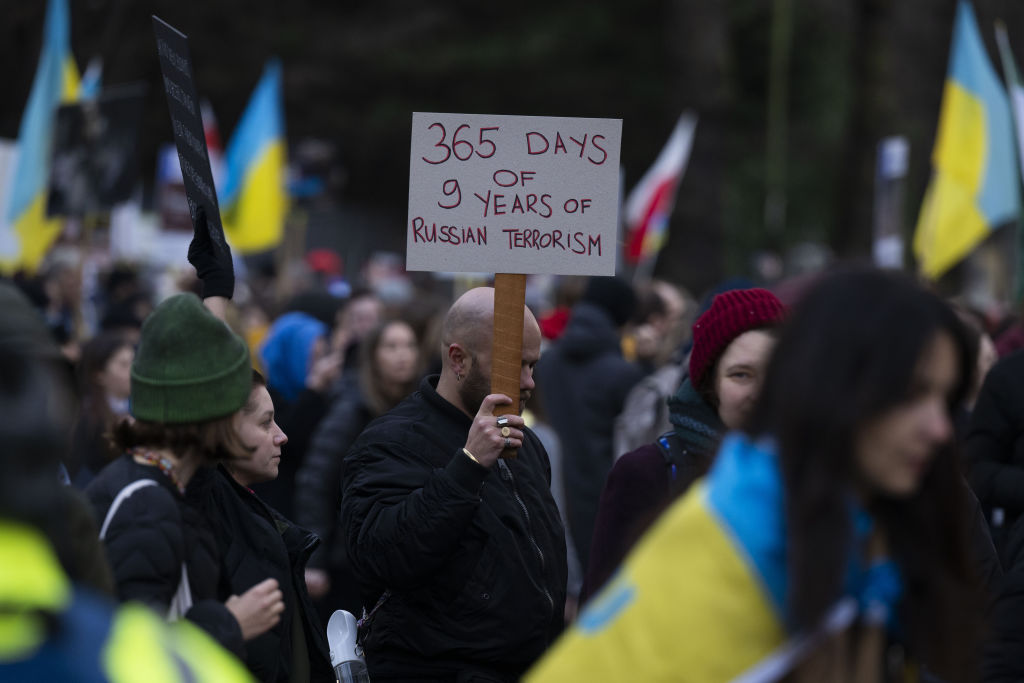
One year on
The Biden administration marked today’s one-year anniversary of the start of the war in Ukraine with a one-two punch of additional support for Kyiv and a fresh slate of sanctions aimed at Russia. Elsewhere, Europe’s most powerful NATO members are mulling a more formal defense pact with Ukraine, and Beijing issued a call for peace talks even as it considers delivering artillery and drones to Russia.
Taken together, these developments are a reminder of the global consequences of Vladimir Putin’s decision to launch an invasion of Ukraine. A decision that surprised the world and changed the world, in clear and irrefutable ways. Less obvious is what happens next. One thing few expect is a speedy resolution to the conflict. “Only optimists expect that the next anniversary will occur in peacetime,” writes Robert Service for The Spectator. (For some further clarity, I recommend reading the thoughts of a panel of experts assembled by my colleague John Pietro.)
The probability of a drawn-out conflict was a major theme of Biden’s speech in Warsaw this week. If the president wanted to communicate one thing in that address, it seems to have been a willingness to stay the course.
The unity and resolve of Western allies has been one of the pleasant surprises of the conflict so far. Another, for Biden, is the stance of the American people on the conflict, which has been overwhelmingly pro-Ukrainian and pro-American support for Ukraine.
According to a Fox News poll published yesterday, half of Americans think the US should support Ukraine for “as long as it takes to win,” whereas 46 percent think there should be a limit to the timeframe for that support. The same poll found that voters’ approval of the president’s handling of the conflict has reached its highest rate since the start of the war; his net approval rating on the issue is still -1, but that figure was as bad as -16 last summer.
The rhetorical line Biden has taken throughout the war has been to emphasize the clear moral stakes of the conflict. The strategic reality, though, is more complicated. This administration acts like one aware that a balance must be struck and that the risk of a direct confrontation with a nuclear power brings with it grave consequences. Then there is the even trickier question of placing this conflict into its full geopolitical context, balancing support for Ukraine with other priorities, namely deterring an increasingly belligerent China.
Viewed from Washington, the first year of the conflict in Ukraine has demonstrated many horrors and a few pleasant surprises — that Kyiv did not fall, that the West has largely held firm, that Russia’s military might is not what everyone thought it was. As the war moves into its second year, though, the strategic dilemmas faced by a US president — the unenviable geopolitical in-tray that sits on Biden’s desk — are becoming harder to ignore.
*** Sign up to receive the DC Diary in your inbox here ***
Jill Biden: Joe is (almost certainly) running
Until he formally throws his hat into the ring, an octogenarian first-term president is never going to be able to escape speculation about his presidential shelf-life. Hence the brief flurry of maybe-he-won’t-run-again-after-all chatter in Washington this week. “Joe may not run — and top Dems are quietly preparing” read the headline to a gossipy Politico piece published Wednesday.
Cue the First Lady riding into frame to snuff out any suggestion that a Democrat not named Joe Biden should be seriously considering a 2024 bid. “How many times does he have to say it for you to believe it?” said Jill Biden in an interview with the AP in Nairobi today. “He says he’s not done. He’s not finished what he’s started. And that’s what’s important.”
In perhaps the closest anyone in the White House has come to confirming his re-election bid, the First Lady said that there’s “pretty much” nothing left to do but figure out the logistics of his announcement.
More inflation trouble ahead
This morning’s report from the Commerce Department, an update on the Federal Reserve’s preferred measure of inflation, showed consumer prices rising more swiftly in January than at any point since June. The 0.6 percent rise from December to January is a lot more dramatic than the previous increase of 0.2 percent from November to December. It’s an indicator that, contra the chipper tone adopted by the White House so far this year, US policymakers are yet to escape the inflation headache that has plagued them since the pandemic.
A bad day for dark psychic forces
Mark March 4 in your calendars. Marianne Williamson, the New Age author and 2020 presidential candidate will be launching a bid for the Democratic Party’s 2024 nomination. That makes her the first formal challenger to Joe Biden, should he seek re-election. It also means the main antagonist of America’s dark psychic forces is back on the national political stage.
What you should be reading today
Matt Purple: Dear God, not this national divorce thing again
Amber Athey: Are the adults back in charge at the New York Times?
Teresa Mull: What I saw in East Palestine
Michael Bloomberg, Wall Street Journal: Summer school can reverse the pandemic learning loss
Chris Anstey, Bloomberg: Larry Summers sees signs of sharp drop-off in economic activity
Bradley Saacks, Semafor: Some ‘middle-class’ wealthy donors are annoyed at being ignored by DeSantis
Poll watch
President Biden job approval
Approve: 44.6 percent
Disapprove: 50.6 percent
Net approval: -6.0 (RCP average)
What is the current greatest threat to US public health?
According to Democratic voters
Gun or firearm access: 35 percent
Obesity: 17 percent
Opioids/fentanyl: 17 percent
Cancer: 9 percent
Covid 19: 9 percent
According to Republican voters
Opioids/fentanyl: 37 percent
Obesity: 25 percent
Cancer: 17 percent
Gun or firearm access: 4 percent
Smoking: 4 percent(Axios/Ipsos)